



Boao Moments 2026: 100 days in, the Hainan FTP is just getting started
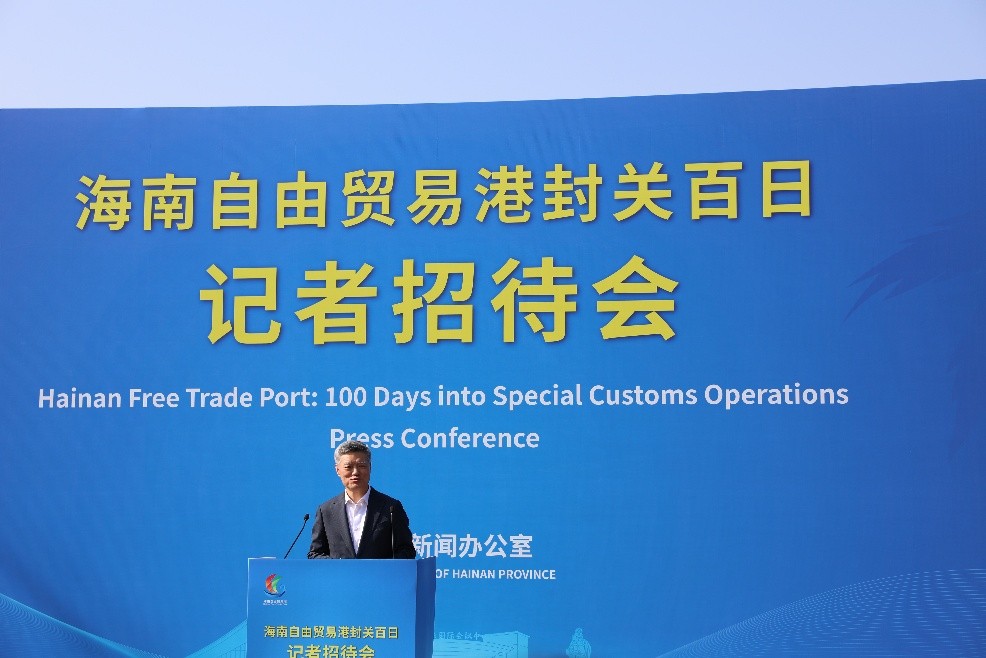
Cai Qiang, secretary-general of the Hainan Provincial Government and the province's official spokesperson, speaks at the Boao Forum for Asia 2026 Annual Conference, in Boao, south China's Hainan Province. (People's Daily Online/Li Ze)
The press conference did not take place in a conference room. That, in itself, felt like a statement.
On the afternoon of March 26, officials, journalists and cameras gathered not under fluorescent lights but on the grass outside during the Boao for Asia 2026 Annual Conference, with a warm Hainan breeze coming off the water. 46 media organizations, 120 reporters. The setting was deliberate: open air, open island, open for business. Three months after Hainan launched full-island special customs operations on Dec. 18, 2025, the province was marking its first 100 days and it wanted the world to notice.
Cai Qiang, secretary-general of the Hainan Provincial Government and the province's official spokesperson, opened the proceedings with a headline figure that set the tone for everything that followed: foreign trade imports and exports had surpassed 80 billion yuan (around $11.58 billion) in the first 100 days, up 32.9 percent year on year.
The numbers behind the milestone
The data Cai presented painted a picture of a port policy moving from paper to pavement. Zero-tariff goods now cover 6,637 product categories, 74 percent of all taxable items, up from 21 percent before island-wide special customs operations and already above RCEP baseline levels. In the first 100 days, 11,773 business entities qualified for zero-tariff status, and 7,503 new foreign trade enterprises registered, a year-on-year increase of 65.7 percent.
The multi-function free trade account, or EF Account, processed 137.6 billion yuan in transactions during the same period, four times the volume recorded in the same period a year earlier. Since the policy was first introduced, 990 EF accounts have been opened, with total transaction volume exceeding 450 billion yuan and fund transfers reaching businesses in 99 countries and regions.
Passenger and freight flows told the same story. Some 861,000 inbound and outbound travelers crossed Hainan's border during the 100 days, up 36.3 percent, including 217,000 visa-free arrivals, a 54.2 percent jump. Hainan can now be entered visa-free by nationals of 86 countries.
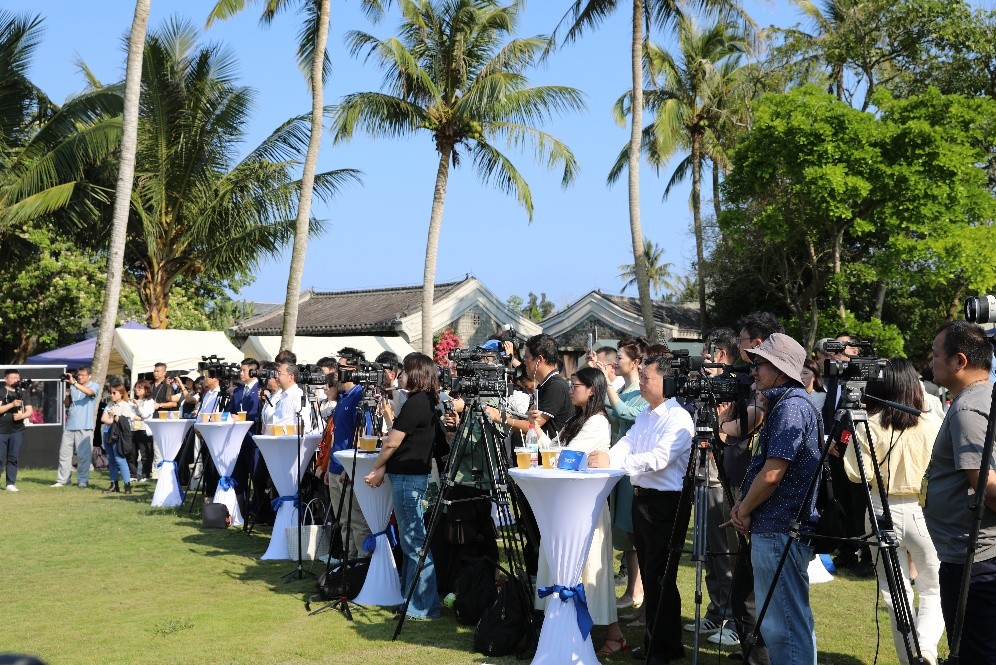
Media and attendees at the "Hainan Free Trade Port: 100 Days into Special Customs Operations Press Conference" held at the Boao Forum for Asia 2026 Annual Conference, in Boao, south China's Hainan Province. (People's Daily Online/Li Ze)
Standing on the grass, feeling the shift
There is something fitting about holding a press conference outdoors. Standing on the lawn with officials at podiums and cameras pointed toward an open Hainan sky, the setting itself seemed to capture the mood: this is a place that feels like it is opening up in real time.
What comes through clearly, both in the data and in the atmosphere around the event, is that the policy framework underpinning the Hainan FTP is no longer just a framework. It is producing results that businesses and travelers can actually feel.
The corporate commitments are concrete. Siemens Energy has established its first gas turbine assembly base in China in Hainan's Danzhou. Singapore's Fullerton Hospital has opened as the first wholly foreign-owned hospital in the country. Switzerland's Swatch Group has registered a regional supply chain and logistics hub. French pharmaceutical group Mayoly is building its China GSP distribution center here. These are operational decisions by companies that assessed the environment and chose Hainan.
For visitors, the changes are just as tangible. The Spring Festival holiday saw 12.32 million tourists on the island, spending 18.37 billion yuan, up 14.6 and 16.2 percent respectively. The duty-free shops are drawing visitors from Indonesia, Malaysia, New Zealand, Italy and beyond. Hainan is becoming, in practice, the international tourism and consumption destination it has long set out to be.
The road ahead
The 15th Five-Year Plan for Hainan, passed by the provincial legislature in January and formally issued in February, sets the longer horizon. The goal is a free trade port fully compatible with high international standards, serving as a strategic node between China's domestic market and the global economy. The plan lays out an ambitious industrial architecture: to consolidate and upgrade the four pillar industries (tourism, modern services, high-tech industries, tropical efficient agriculture);five major industrial directions it aims to strengthen, including advanced seed technologies, marine industries, aerospace and low-altitude aviation, green and low-carbon industries, and digital and data-driven industries; four emerging “future industries” for strategic investment: biomanufacturing, hydrogen energy, brain–computer interface technologies and embodied artificial intelligence.
One hundred days is a modest start against that timeline. But the underlying numbers point consistently in one direction, and the policy environment that businesses have been waiting for is now in place. The island is open. The work is underway.
Photos
Related Stories
- English version of policy inquiry, interpretation platform for Hainan FTP to be launched on June 1
- Hainan FTP promotes opening-up with swift, steady steps
- Hainan FTP to improve Sino-ASEAN economic ties
- China releases white paper on Hainan free trade port
- Welcome to Boao Forum for Asia Annual Conference 2026 — a forum for an uncertain world
- Robot dancing to 'Dahuajiao' steals the show at Boao, S China's Hainan
- Boao Moments 2026 | Advancing regional cooperation between China and ASEAN
- Boao Moments 2026: Investing for the future, cooperation is the path
- Boao Moments 2026: China's APEC hosting year a chance to reinject confidence into fragmented world
- Green, smart technologies shine at Boao Forum for Asia Annual Conference 2026
- Boao Moments 2026 | Michele Geraci shares views on China's 15th Five-Year Plan and the Hainan FTP
- Boao Moments 2026: China's economic outlook centers on high-quality development
- Boao Moments 2026 | Want to do business in China? Read the five-year plan
- In pics: press conference for Boao Forum for Asia annual conference 2026
Copyright © 2026 People's Daily Online. All Rights Reserved.
