



Boao Moments 2026: Investing for the future, cooperation is the path
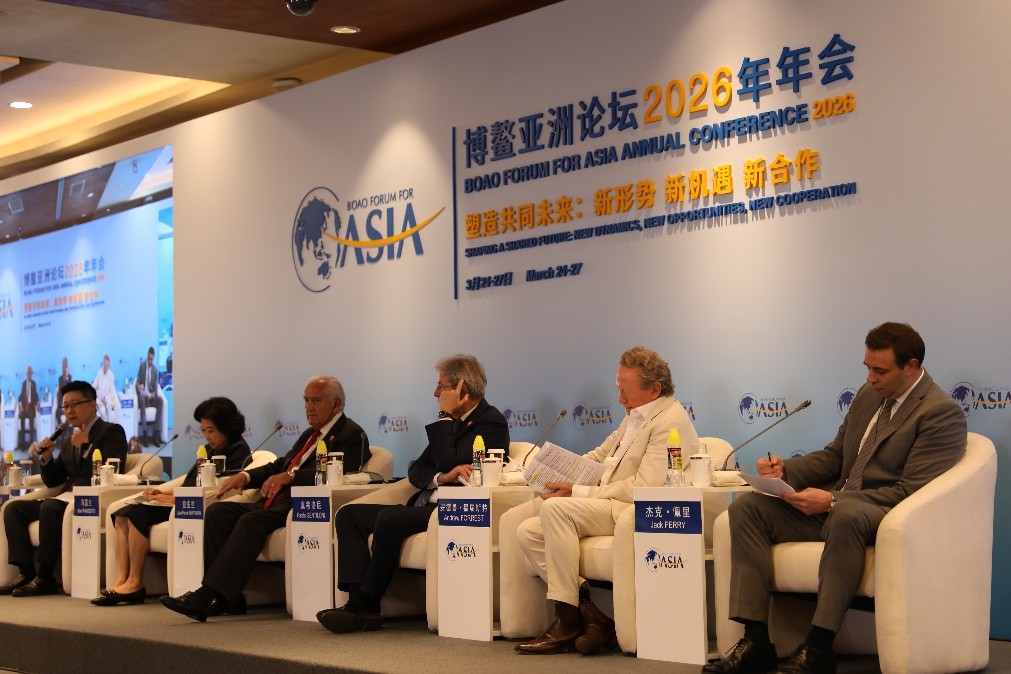
Panelists prepare during the "Investing for the Future: Are We Ready?" sub-forum at the Boao Forum for Asia 2026 Annual Conference in Boao, south China's Hainan Province. (People's Daily Online/Li Ze)
At a time of deepening geopolitical uncertainty and accelerating technological change, global leaders gathering at the Boao Forum for Asia 2026 Annual Conference converged on a common answer to the question of how the world should invest in its future: work together, or fall behind alone.
The high-level dialogue "Investing for the Future: Are We Ready?" brought together former heads of government, senior economic officials and leading business figures. Across wide-ranging exchanges on green energy, trade architecture, European strategy and China's innovation ecosystem, regional cooperation emerged as the session's defining refrain.
A different kind of disruption
Mari Pangestu, vice chair of Indonesia's National Economic Council, framed the moment with directness. The world will not return to what it was, she said, as interdependence, once a source of strength, is now widely treated as a vulnerability, while slow growth, economic security pressures and the retreat of multilateralism compound the challenge. Yet she was equally emphatic that the moment presents genuine opportunity, with the acceleration of the energy transition, the diversification of regional supply chains and shifting global power dynamics all opening space for new forms of cooperation.
Her prescription was practical. Rather than reacting to global fragmentation with protectionism, Asian economies should build domestic resilience and deepen regional integration. Drawing on a concept from APEC, Pangestu called for "concerted unilateralism": countries acting in parallel and in coordination rather than waiting for full multilateral consensus, building coalitions of the willing around shared goals. Her team's analysis showed that proactive regional cooperation could effectively offset the economic impact of U.S. tariffs. The message to governments was clear: the agreements are already in place. What is needed now is implementation.
The leadership question
Jean-Pierre Raffarin, former prime minister of France, offered a more somber diagnosis. The rule of law is weakening, he warned, and force has re-entered the vocabulary of international relations. What the world needs most is a new kind of leader: mobile, unafraid of change, and genuinely knowledgeable about the world beyond their own borders. Quoting Antoine de Saint-Exupéry, he said: "To love is not to look at each other, but to look together in the same direction." That, he argued, is the model Europe and China must adopt.
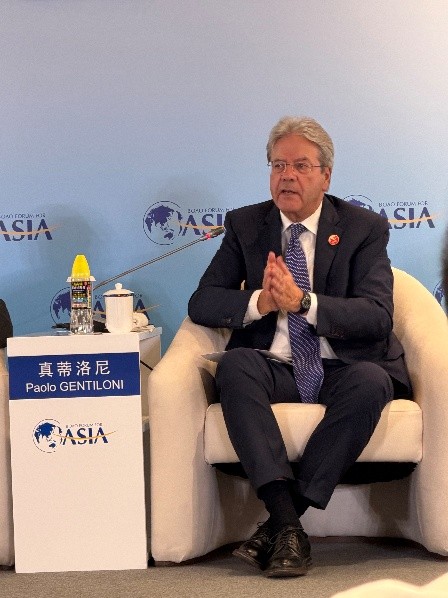
Paolo Gentiloni, former Prime Minister of Italy and former European Commissioner for the Economy, speaks at the Boao Forum for Asia 2026 Annual Conference in Boao, south China's Hainan Province. (People's Daily Online/Cai Hairuo)
Paolo Gentiloni, former Prime Minister of Italy and former European Commissioner for the Economy, shared the concern over institutional erosion. Trade wars and the weaponization of economic relations represent a dangerous new normal, he said, but they have not ended globalization, as trade volumes continue to rise even amid tensions. His counsel: resist the temptation to abandon existing institutions. The WTO, the IMF and the UN are imperfect, but a weakened architecture is preferable to none. For Asia and Europe alike, the priority should be to preserve and strengthen what already exists.
The economics of green energy
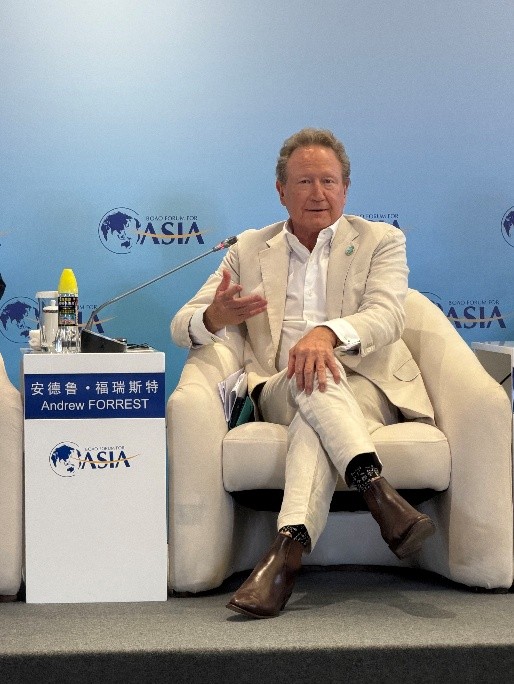
Andrew Forrest, executive chairman and founder of Fortescue, speaks at the Boao Forum for Asia 2026 Annual Conference in Boao, south China's Hainan Province. (People's Daily Online/Cai Hairuo)
Andrew Forrest, executive chairman and founder of Fortescue, made the session's most emphatic argument for clean energy, grounding it in arithmetic rather than ideology. Fortescue is eliminating 1 billion liters of diesel from its operations within years, not decades, with the world's first fully green iron ore operation set to come online next year. Going fully green had been calculated to cost 6.2 billion U.S. dollars, compared to 18 billion dollars for a comparable fossil fuel development. Once capital is paid off, the operating cost of renewable energy approaches zero. Solar panel efficiency, he said, is being pushed from 23 percent toward 40 percent, and Fortescue is now installing 50,000 panels per day in Australia. The principal obstacle to the transition is not technical or economic but political, he said, specifically the conflicts of interest that prevent leaders from embracing necessary change. Countries that achieve energy sovereignty achieve genuine independence; those dependent on imported fuel remain exposed.
China's innovation ecosystem
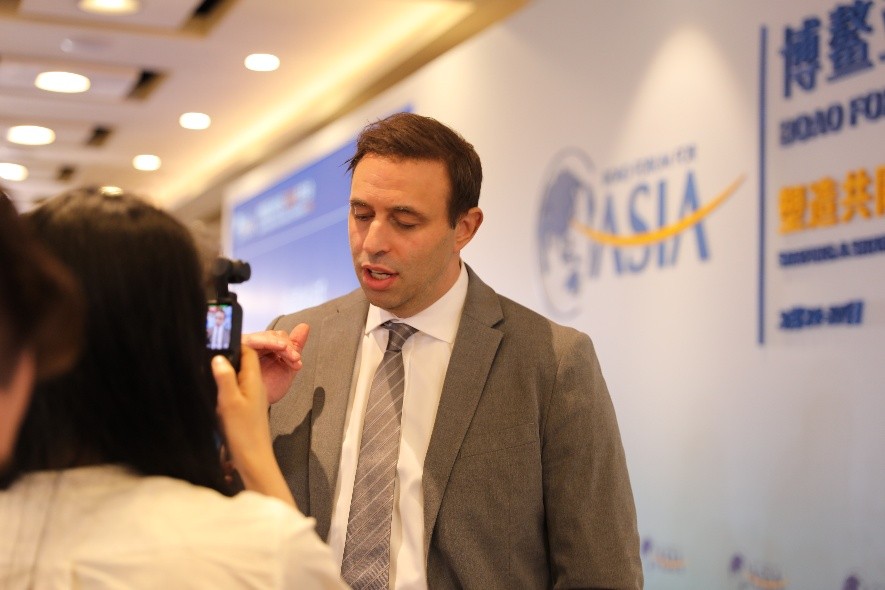
Jack Perry, chairman of the 48 Group Club and executive chairman of AEC Robotics takes questions at the Boao Forum for Asia 2026 Annual Conference in Boao, south China's Hainan Province. (People's Daily Online/Li Ze)
Jack Perry, chairman of the 48 Group Club and executive chairman of AEC Robotics, brought a multigenerational perspective to China's role in global innovation. His grandfather began trading with China in the early 1950s, and three generations of engagement have given him, he said, a particular vantage point on where China stands today. Perry argued that the new world order is being built on four interlocking layers: energy, quantum, artificial intelligence and robotics. China was said to be 18 months behind the West on AI before DeepSeek arrived; he now believes China holds a meaningful lead. On manufacturing scale and the ability to move from innovation to deployment, no other country can match China. On quantum, which Perry called the true power of the future, he assessed the U.S. and China as broadly comparable. The challenge, he argued, is not capability but communication: bridging the gap between what global companies need and what China's manufacturing base can deliver. Those who remain disengaged from China's innovation ecosystem, he said, will be left behind.
Cooperation as the only path
Pangestu closed the loop on regional architecture, reporting from her recent co-chairmanship of the RCEP Joint Committee in Wellington, New Zealand, that political will is present but practical gaps remain. Harmonizing tariff schedules, standardizing rules of origin and enabling the free movement of skilled workers are the immediate priorities. She also proposed building shared regional energy reserves modeled on the ASEAN Plus Three emergency rice reserve, as a concrete expression of collective resilience.
On Europe and China, Raffarin acknowledged plainly that China has a plan while Europe does not, and called for a shared vision of where both sides want to be in 2040. Gentiloni agreed, arguing that a stronger, more strategically autonomous Europe would be a better partner for China and Asia, not a more distant one.
As the session closed, the panelists' differences of emphasis gave way to a shared conclusion: the tools for investing in the future exist. What remains to be seen is whether the cooperation required to use them can be assembled in time.
Photos

Related Stories
- Boao Moments 2026 | Michele Geraci shares views on China's 15th Five-Year Plan and the Hainan FTP
- Boao Moments 2026: China's economic outlook centers on high-quality development
- Boao Moments 2026 | Want to do business in China? Read the five-year plan
- In pics: press conference for Boao Forum for Asia annual conference 2026
- Boao Forum for Asia 2026 Annual Conference gets underway in S China's Hainan
- South China's Boao ready for the annual forum for Asia
- China's top legislator to attend Boao Forum for Asia Annual Conference 2026
- Boao Forum for Asia empowers overall development of Qionghai City in China's Hainan
- Boao Forum for Entrepreneurs spotlights industrial innovation as new impetus for China's high-quality development
- Interview: Boao Forum's Riyadh conference opens new avenues for cooperation, says CEO of Saudi chemical giant
Copyright © 2026 People's Daily Online. All Rights Reserved.
