



Boao Moments 2026: China's APEC hosting year a chance to reinject confidence into fragmented world
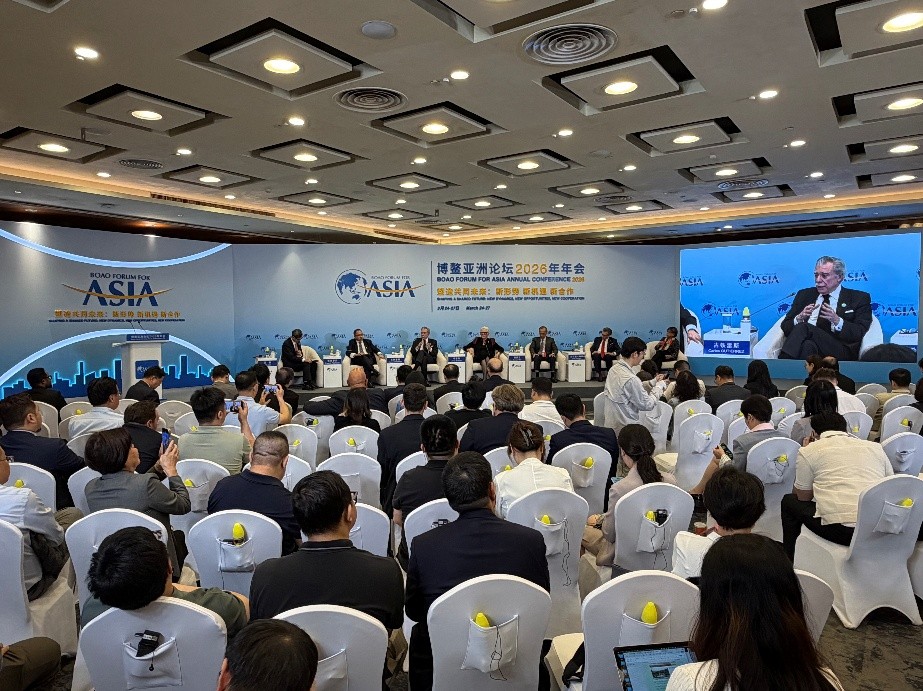
A scene from the "Revitalizing APEC: Towards the Vision of an Asia-Pacific Community" sub-forum at the Boao Forum for Asia 2026 Annual Conference in Boao, south China's Hainan Province. (People's Daily Online/Cai Hairuo)
As the world grapples with rising protectionism, fraying multilateral institutions and deepening geopolitical uncertainty, global leaders and officials gathered at the Boao Forum for Asia 2026 Annual Conference agreed on one thing: China's turn as APEC host this year could not have come at a more consequential moment.
The sub-forum "Revitalizing APEC: Towards the Vision of an Asia-Pacific Community" was moderated by Tan Jian, former APEC senior official and former Chinese ambassador to the Netherlands, and opened with remarks by Chen Xu, chair of the APEC 2026 Senior Officials' Meeting and president of the China Public Diplomacy Association.
A pivotal hosting year
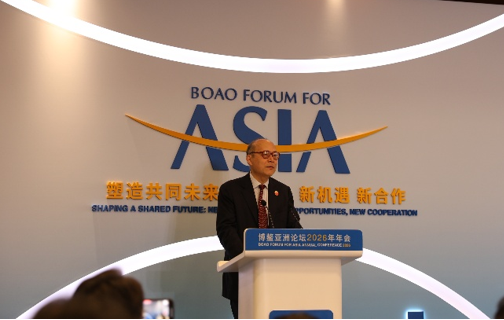
Chen Xu, chair of the APEC 2026 Senior Officials' Meeting and president of the China Public Diplomacy Association, speaks at the Boao Forum for Asia 2026 Annual Conference in Boao, south China's Hainan Province. (People's Daily Online/Li Ze)
Chen set an ambitious tone. China is hosting APEC for the third time, and the 33rd APEC Economic Leaders' Meeting will be held in Shenzhen in November, a city that itself embodies China's story of opening up. The timing carries symbolic weight: 2026 marks the 20th anniversary of the Free Trade Area of the Asia-Pacific vision, the first year of China's 15th Five-Year Plan, and a moment when APEC economies, accounting for more than 60 percent of global GDP and nearly half of world trade, face a stiff test of their commitment to cooperation. China's three priorities for the year are building an open and interconnected Asia-Pacific, driving innovation-led growth, and fostering win-win cooperation across the region.
APEC's unique value under the spotlight
Former New Zealand Prime Minister Jenny Shipley, who hosted APEC in 1999, opened the discussion with a call to remember what makes the forum distinctive. Unlike the United Nations or the European Union, APEC operates on consensus without binding obligation, allowing members to advance shared goals without forcing anyone's hand. What concerns her is that APEC has gradually drifted from that results-driven spirit toward a process-driven one, producing declarations negotiated weeks in advance that generate little concrete action. China's hosting is an opportunity to reverse that drift, she said, and the moment calls for courage: to streamline the agenda, resist adding new topics without removing old ones, and protect genuine space for leaders to engage privately rather than follow scripts.
Former Singaporean Foreign and Trade Minister George Yeo warned that, the Asia-Pacific risks being split down the middle along geopolitical lines. It is now China's turn, he said, to ensure the Pacific remains undivided. When leaders and ministers meet at APEC, he added, the world watches, and that visibility creates its own pressure to behave constructively.
The business case for delivery
Goldy Hyder, president and CEO of the Business Council of Canada, spoke for the investment community. The 170-plus chief executives he represents are searching for one thing above all: regulatory predictability. Capital has no nationality and no ideology, he said. It follows confidence. Asia is well placed to attract it, with young populations, a rapidly expanding middle class and leaders with genuine ambition for their people. But realizing that potential requires APEC to function as a magnet for capital by demonstrating policy coherence and regulatory alignment. His message was blunt: say less and do more. Credibility is built through delivery, not communiques, and the only thing standing in the way is a lack of collective will to act.
Former U.S. Secretary of Commerce Carlos Gutierrez offered a measured assessment of U.S. engagement under the current administration. Washington will not stay away from APEC, he said, but its contributions this year will be selective. Artificial intelligence, where the administration is focused on deregulation and deployment, is the most promising area for meaningful U.S. engagement. His advice to the forum: welcome American participation, lean into the AI opening, keep friction-prone issues to one side and let Asia continue demonstrating its own model of building, investing and growing.
Eduardo Pedrosa, executive director of the APEC Secretariat, and Rebecca Fatima Sta Maria, former executive director of the secretariat, both stressed that much of APEC's most valuable work happens well below the headline level, across a number of ministerial meetings, hundreds of working group sessions and capacity-building programs that rarely make news. Sta Maria highlighted APEC's track record as an incubator: pathfinder initiatives led by small groups of like-minded economies, most notably the original TPP grouping of New Zealand, Singapore, Chile and Brunei, have repeatedly seeded agreements that later grew far larger. That model of starting small and scaling outward remains one of APEC's greatest contributions, she said, and should be consciously applied to emerging challenges including artificial intelligence and the green economy.
Confidence as the common thread
As the session drew to a close, panelists returned repeatedly to a single theme: confidence. Shipley called for an environment in which ministers can speak candidly and find common ground without being boxed into vetoes. Hyder urged the forum to show results rather than make promises. Yeo observed that when leaders stand together and engage positively at APEC, that image alone carries a message to the world.
With Shenzhen hosting the leaders' summit in November, and a packed global calendar of major meetings to follow, the panelists were united in their view that the ingredients for a successful APEC 2026 are in place. What is needed now, as Hyder put it, is simply to get on with it.
Photos

Related Stories
- Boao Moments 2026 | Michele Geraci shares views on China's 15th Five-Year Plan and the Hainan FTP
- Boao Moments 2026: China's economic outlook centers on high-quality development
- Boao Moments 2026 | Want to do business in China? Read the five-year plan
- In pics: press conference for Boao Forum for Asia annual conference 2026
- Boao Forum for Asia 2026 Annual Conference gets underway in S China's Hainan
- South China's Boao ready for the annual forum for Asia
- China's top legislator to attend Boao Forum for Asia Annual Conference 2026
- Boao Forum for Asia empowers overall development of Qionghai City in China's Hainan
- Boao Forum for Entrepreneurs spotlights industrial innovation as new impetus for China's high-quality development
- Interview: Boao Forum's Riyadh conference opens new avenues for cooperation, says CEO of Saudi chemical giant
Copyright © 2026 People's Daily Online. All Rights Reserved.
