


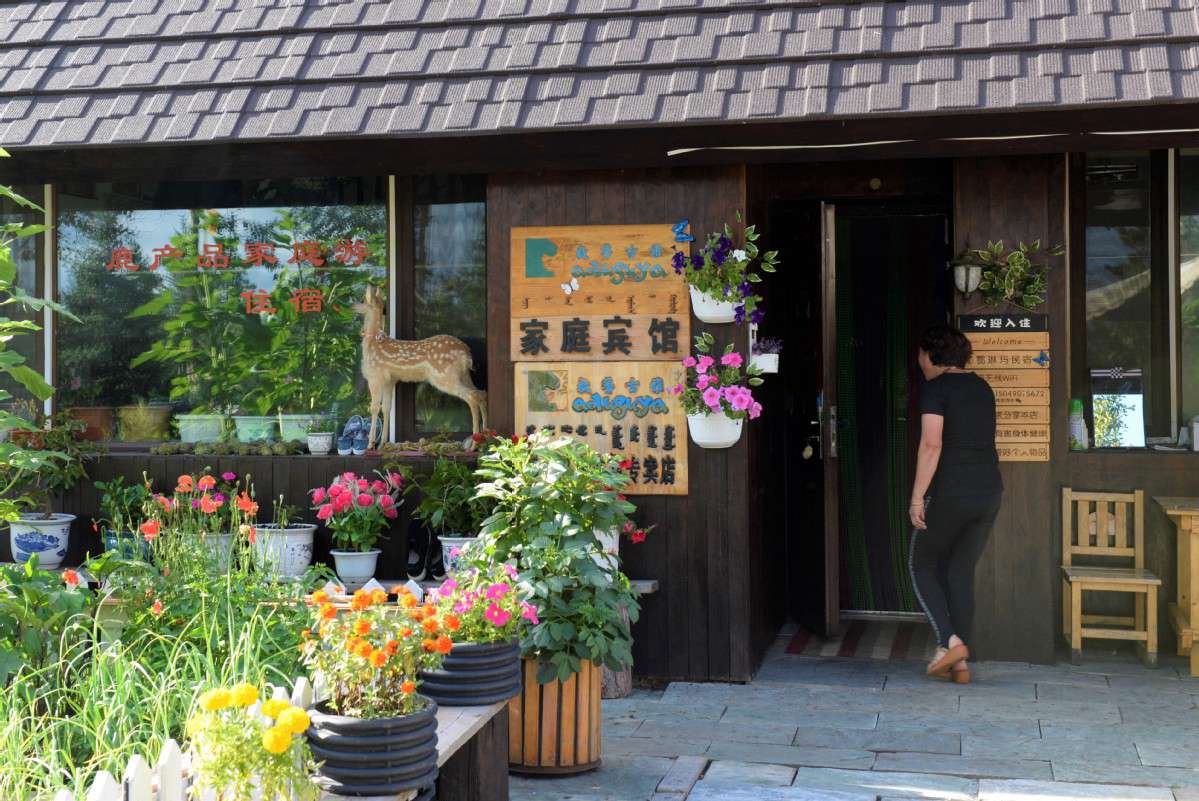
Zhang Guofeng's family hotel at Aoluguya nationality township in Genhe, Inner Mongolia autonomous region, on Aug 6, 2020. [Photo by Zhao Shiyue/chinadaily.com.cn]
Zhang Guofeng, 58, who manages a family hotel with three rooms in Aoluguya, has also lifted herself out of the low-income group and found a way to wealth. After working away from home for over 10 years, Zhang and her husband have returned as tourism prospers in this remote forest area.
"All rooms are fully booked during the peak tourism season from July to August," said Zhang, "and my income reaches around 20,000 yuan for those two months."
Zhang is one of the ecological migrants of 62 Ewenki families who moved from mountains to the national minority community under the government's environmental protection project starting in 2002. With 160 million yuan of investment, local authorities constructed 32 units of two-tier houses in the city suburb, with 88 square meters each.
To maintain the balance between local inhabitants and natural resources, a permanent hunting ban was also enforced the same year.
 |  |

 Award-winning photos show poverty reduction achievements in NE China's Jilin province
 People dance to greet advent of New Year in Ameiqituo Town, Guizhou
 Fire brigade in Shanghai holds group wedding
 Tourists enjoy ice sculptures in Datan Town, north China
 Sunset scenery of Dayan Pagoda in Xi'an
 Tourists have fun at scenic spot in Nanlong Town, NW China
 Harbin attracts tourists by making best use of ice in winter
 In pics: FIS Alpine Ski Women's World Cup Slalom
 Black-necked cranes rest at reservoir in Lhunzhub County, Lhasa
 China's FAST telescope will be available to foreign scientists in April