



Wildlife flourishes in Tangjiahe area of Giant Panda National Park
Deep in the mountains of the Giant Panda National Park's Tangjiahe area, located in Qingchuan county, Guangyuan city, southwest China's Sichuan Province, bamboo forests sway and layered woodlands stretch in deep green.
"We saw a heartwarming scene of an Asiatic black bear with its cub on the slope across from the Caijiaba road," said Chen Shiying, head of publicity and education at the management office of the Tangjiahe area, excitedly showing a video on her phone. In the footage, a mother bear shelters her cub as they climb over rocks by a stream and head into the dense forest.
The Tangjiahe area has a forest coverage rate of 96.15 percent and a well-preserved forest ecosystem. More than 3,800 species of wild animals and plants thrive here. Listed among more than 30 biodiversity hotspots worldwide, the area is committed to scientifically protecting and sustainably utilizing its natural ecological resources, building a beautiful homeland where all life coexists in harmony.
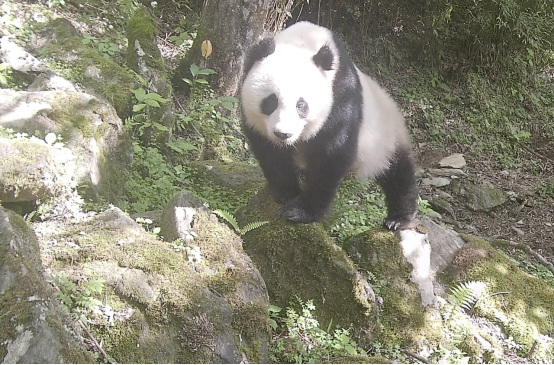
A giant panda is pictured by an infrared camera in the Tangjiahe area of Giant Panda National Park. (Photo provided by the Tangjiahe area of Giant Panda National Park)
In the backpack of Jia Feide, deputy head of the Baixiongping protection station in Tangjiahe, are a telephoto camera, an infrared camera, a satellite phone, binoculars, and other equipment—over 20 kilograms in total.
"The deep mountains and forests are our 'office.' My colleagues and I usually begin patrols at 6 or 7 a.m. Short routes cover 5 to 6 kilometers, while longer ones can reach 20 kilometers a day. After returning, we still have to organize our monitoring logs," Jia said, noting that from March to April and again from October to December, panda activity peaks, requiring rangers to camp in the wild for up to a week.
One of his most memorable experiences was encountering three wild giant pandas. "That morning, we went deep into the mountains to an area where pandas are active. We found one resting on a tree, while two others were fighting beneath it. We quickly set up our equipment and recorded the rare scene," Jia recalled.
Jia has worked in the mountains for 14 years. "Although giant panda conservation is hard work, I feel fortunate to be able to do it full-time," he said.
Zhang Aihua, a villager from Luoyigou village in Qingxi town, Qingchuan county, runs a B&B while also serving as an ecological ranger.
"The duties are quite extensive. During fire prevention periods, I patrol 20 days a month; in non-fire seasons, 15 days," Zhang said.
On a large screen at the information center of the Tangjiahe area, panda migration tracks since 2020 are displayed. Red dots marking panda activity have gradually shifted from scattered points to connected clusters.
Since the establishment of the Giant Panda National Park, the Tangjiahe area has focused on panda conservation and research, while advancing broader biodiversity protection. Monitoring now covers not only pandas but also rare associated species such as golden snub-nosed monkey, Sichuan takin, and Chinese monal, marking a shift from single-species monitoring to ecosystem-wide conservation.
"We have built an integrated ground-sky-space intelligent monitoring network, deploying over 400 infrared cameras to record giant panda and associated species activity around the clock. Drones are used for large-area habitat patrols, terrain mapping, and remote monitoring, overcoming the limitations of ground patrols," said Xiao Mei, head of the research and monitoring department at the Tangjiahe management office.
In addition, DNA testing identifies individual giant pandas and prevents duplicate counts, enabling accurate population statistics. Artificial intelligence rapidly screens images of giant pandas and other rare species, greatly improving data-processing efficiency.
"With advanced equipment and digital technology, patrol efficiency has increased several times over," Jia said. Rangers also use a mobile app that works offline in areas without signal, allowing them to record animal droppings, fur, or vegetation types and upload data once back online, generating complete patrol logs with coordinates, timestamps, and event details.
Relying on monitoring big data, the Tangjiahe area has also launched a livestream of wildlife. "By opening the 'Sichuan Tangjiahe' WeChat video channel, netizens can watch live footage from the wild and gain a more direct understanding of biodiversity conservation," said Chen.
Photos



Related Stories
- Baoxing: Where giant panda conservation fuels sustainable growth
- Giant panda and its cub pictured at Shenshuping base in Sichuan, SW China
- Advanced technology boosts panda conservation in China
- Chinese giant panda in ROK gives birth to fourth cub
- Giant panda pictured at Foping base in NW China's Shaanxi
- In pics: Giant panda origin camp in Ya'an City, China's Sichuan
- Giant pandas enjoy themselves at Wolong National Nature Reserve in China's Sichuan
- Giant pandas pictured in China's Chengdu
- New round of China-U.S. giant panda conservation cooperation contributes to bilateral friendship: spokesperson
- Giant pandas attract tourists at Chongqing Zoo
Copyright © 2026 People's Daily Online. All Rights Reserved.
