



Smart vessels revolutionize port operations across China
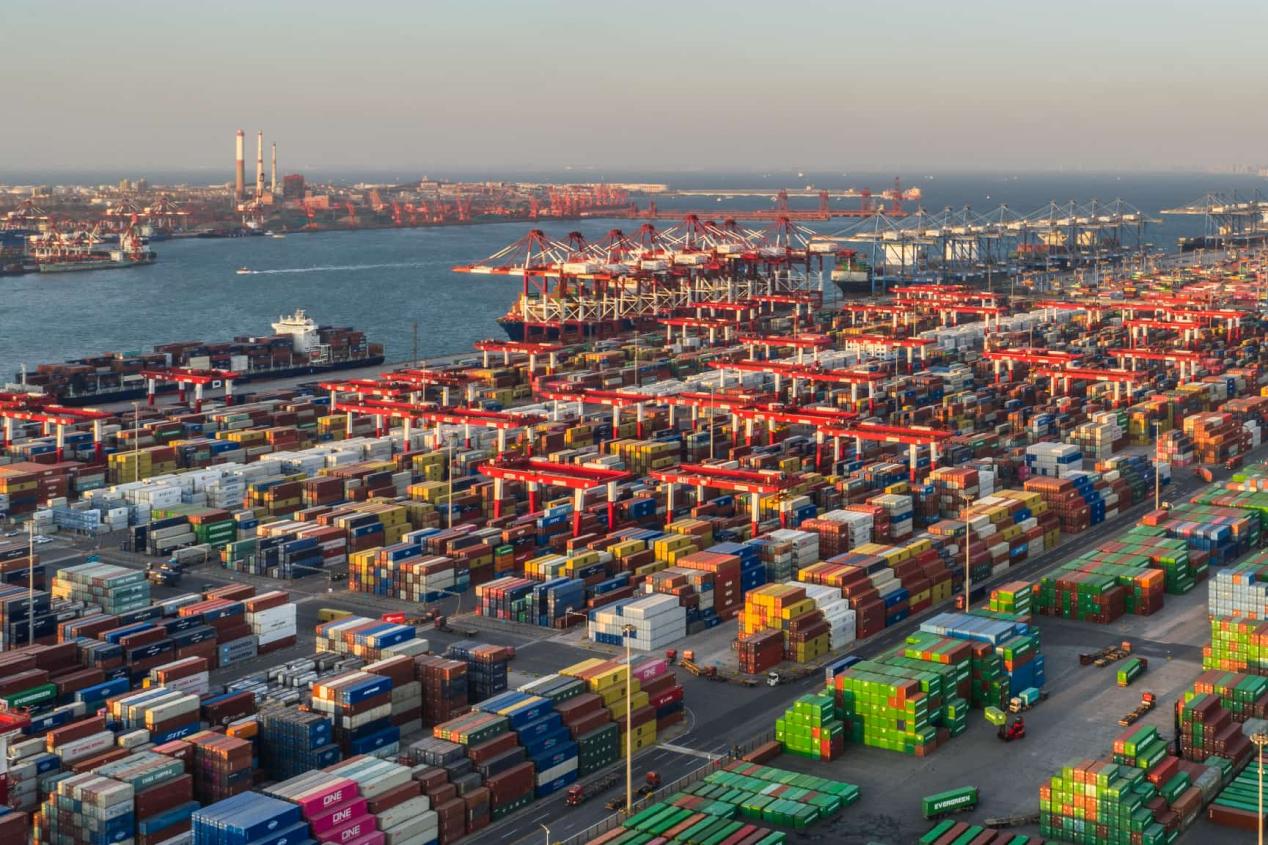
Photo shows a busy scene at an automated terminal of Qingdao Port in Qingdao, east China's Shandong province. (Photo/Wang Hua)
In February 2026, the autonomous container ship "Zhifei" docked with pinpoint precision at the automated terminal of Qingdao Port in Qingdao, east China's Shandong province. Without pilot boats or tug assistance, the ship's autonomous navigation system guided it seamlessly to berth.
Upon arrival, the terminal's vacuum-assisted mooring system secured the vessel with more than 10 suction cups in just 30 seconds. Remote-operated quay cranes then coordinated with automated guided vehicles for efficient cargo handling.
The seamless coordination between the intelligent ship and the smart port offers a glimpse into the development of intelligent shipping.
By 2030, China is expected to elevate its intelligent shipping development to an internationally advanced level, according to a plan recently released outlining the general requirements, key tasks, and support measures for intelligent shipping development during the 15th Five-Year Plan period (2026-2030).
"Intelligent shipping is a waterway transport system centered on autonomous vessels, supported by digital infrastructure, and coordinated operational control," said an official from the Maritime Safety Administration under China's Ministry of Transport (MOT). Years of development have brought a series of breakthroughs in China's intelligent shipping.
A new generation of smart vessels is emerging. Domestically produced intelligent ships with autonomous navigation capabilities, including the "Zhifei" and the "Zhu Hai Yun" smart unmanned scientific research mother ship, have hit the water, with some already in regular commercial operation. Decision-support systems are now applied at scale on bulk cargo carriers, oil tankers, and container ships.
Infrastructure has become smarter. Currently, there are 60 automated ports in China, and the national electronic navigational charts coverage now exceeds 10,000 kilometers of waterways. Meanwhile, the application of blockchain technology in port electronic cargo release and maritime electronic bills of lading is continuously expanding.
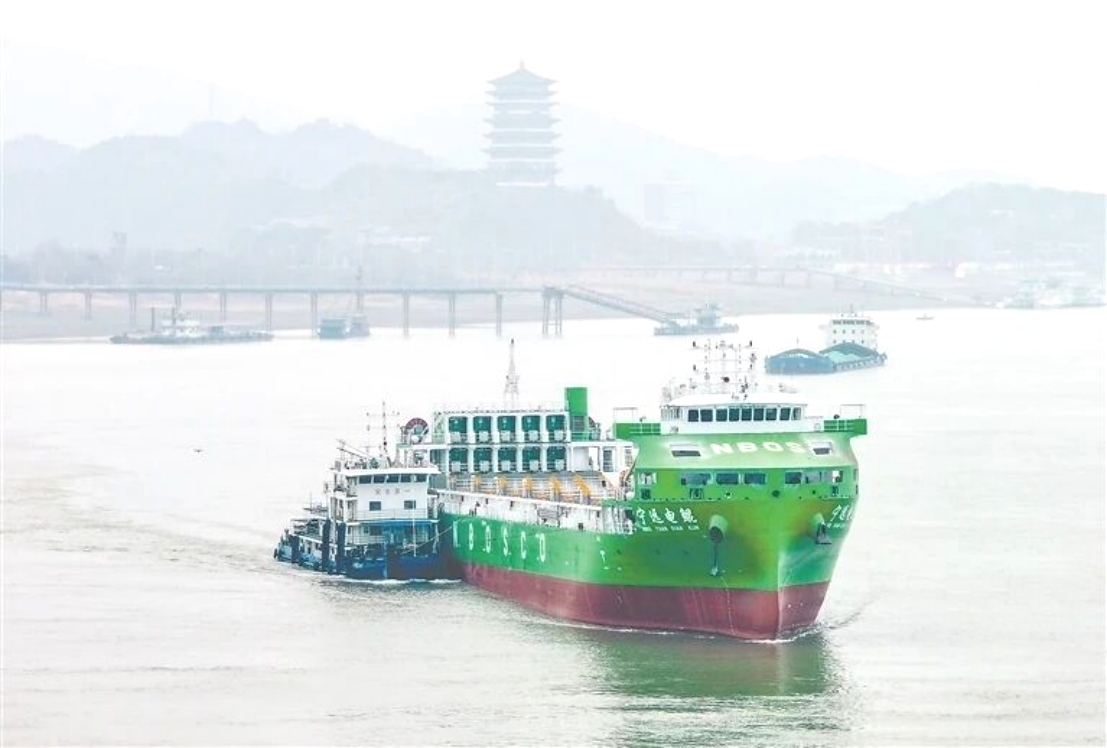
Photo shows the Ningyuan Diankun, the world's largest and China's first 10,000-tonne pure electric intelligent vessel. (Photo provided by Jiangxi Daily)
The framework for smart shipping has been steadily strengthened. China has issued a five-year plan for green and smart ship technology standards, introduced interim rules for the technical requirements and inspection of autonomous ship navigation trials, and taken the lead in drafting key chapters of the International Maritime Organization's (IMO) Maritime Autonomous Surface Ships Code. The country has become a key player in setting global standards for intelligent shipping.
"A new generation of technologies, represented by artificial intelligence (AI) and big data, are shifting shipping from experience-based to data-driven operations. Within a decade, intelligent shipping will reshape global industry competitiveness," said Zhang Baochen, vice chairman of the Chinese Institute of Navigation.
Along the Yangtze River, greenery stretches for miles. Recently, the world's largest and China's first 10,000-tonne pure electric intelligent vessel, the Ningyuan Diankun, began trial voyages in Jiujiang, east China's Jiangxi province.
The vessel is integrated with an intelligent platform and smart engine-room system, and is equipped with core autonomous navigation technologies for open waters. It features a full suite of smart functions, including all-weather visual perception and autonomous navigation. The vessel is powered by 10 containerized battery packs and is expected to reduce carbon dioxide emissions by nearly 1,500 tonnes annually after being put into operation.
"Although China's shipping industry leads the world in scale, it continues to face a range of structural and systemic challenges, including persistently high operating costs and mounting pressure for green transition. Technological innovation is urgently needed to turn these challenges into new growth momentum," said an official from the China Maritime Safety Administration.
The official added that the plan seeks to empower the shipping industry chain through innovative technologies, guiding the sector from scale-driven expansion toward quality-oriented development.
With a focus on smart vessels, the plan calls for intensified research into key areas such as human-machine collaboration and multi-agent coordination. As complete smart ship technologies continue to advance, future vessels are expected to become increasingly intelligent, capable of operating across far more complex and expansive maritime environments.
The plan also calls for breakthroughs in smart port and waterway technologies, as well as integrated systems for autonomous navigation and remote-controlled ship operations. In practical terms, this points to a future where more vessels will be able to dock autonomously at ports.
"The implementation of the plan will promote the deep integration of intelligent technologies across all elements and processes of shipping. This will not only drive innovation, empowerment, and transformation within the shipping industry itself, but also spur upgrading across upstream and downstream industrial chains, cultivating new growth drivers for China's smart economy," said Geng Xiongfei, director of the Intelligent Shipping Technology Research Center at the China Waterborne Transport Research Institute of the MOT.
Scenario-driven development is central to advancing smart shipping. According to the plan, China aims to establish at least three smart shipping pilot zones, launch more than five pilot smart shipping routes, develop over 10 replicable application scenarios, and put more than 100 intelligent vessels into operation over the next two years.
Photos


Related Stories
- Major shipyards power ahead with green, high-tech vessels amid order surge
- China delivers world’s first FPSO vessel with carbon capture, storage system
- China delivers self-developed deep-sea research vessel
- China's first comprehensive deep-sea research vessel with global exploration and manned submersible capabilities sets sail
- China's first deep-sea multi-functional vessel launched in S China
- Ultra-large container vessel made in NE China completes delivery
- China's first 10,000-tonne cable-laying vessel unveiled in Jiangxi
- World’s largest mega container vessel begins commercial operations in E China’s Shandong
- Vessels in comprehensive replenishment training exercise
- China's research vessel 'Yuanwang-5' arrives at Sri Lankan port
Copyright © 2026 People's Daily Online. All Rights Reserved.
