



Sierra Leone launches first industrial fishing port with Chinese support
A major milestone in Sierra Leone’s economic transformation and marine sector development was reached, with the official offshore engineering launch of the Julius Maada Bio Industrial Fishing Port at Black Johnson Village in the Western Area Rural District.
The project, funded by China Aid and implemented in collaboration with the Government of Sierra Leone, is being constructed by CRCC Harbour & Channel Engineering Bureau Group Co., Ltd. (CRCC Harbour).
Named after President Julius Maada Bio, the port marks the country’s first industrial fishing harbour and represents a strategic push toward modernizing Sierra Leone’s fisheries sector and unlocking the full potential of its blue economy.
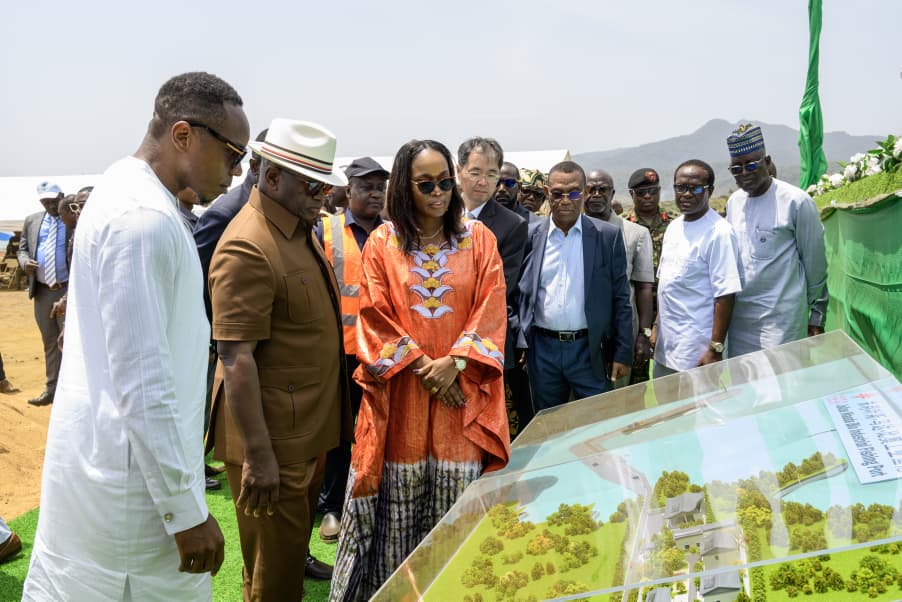
Sierra Leonean President Julius Maada Bio (2nd, L) views the sand table of a China-aided industrial fishing port during the launch ceremony at Black Johnson Village in the Western Area Rural District, Sierra Leone, April 23, 2026. (Photo provided to People's Daily Online)
The US$55 million project is designed as a comprehensive fisheries hub that will significantly upgrade the nation’s fishing infrastructure. It includes the construction of a 500-meter breakwater, a 160-meter approach causeway, and a harbor basin covering approximately 300,000 square meters. In addition, the port will feature a 3,000-gross-ton berth for ocean-going fishing vessels and a 70-meter stepped berth, along with dredging works to ensure navigability and operational efficiency.
Supporting infrastructure will also be developed, including a fishing port office building, a modern fish trading market, and essential utilities such as water supply systems, electricity, and wastewater treatment facilities. The total building area is estimated at about 1,216 square meters. Upon completion, the facility will offer services such as fish landing, primary processing, cold storage, warehousing, and supply support for both industrial and artisanal fishing vessels under 3,000 tons.
The port is expected to handle up to 20,000 metric tons of fish annually and generate more than US$60 million in revenue each year. It will also serve as a hub for value-added activities such as fish processing, ice production, and net manufacturing, contributing to reduced post-harvest losses and improved efficiency across the fisheries value chain.
Speaking at the ceremony, Chinese Ambassador to Sierra Leone, Zhao Yong, emphasized the long-standing cooperation between China and Sierra Leone in the fisheries sector, noting that the partnership has spanned over four decades. He highlighted that Sierra Leone’s fish exports to China have exceeded US$10 million and are expected to grow further, especially with China’s planned zero-tariff policy for 53 African countries starting in May.
Zhao described the project as a catalyst for accelerating the modernization of Sierra Leone’s fishing industry, adding that the facility would accommodate vessels of up to 3,000 tons and significantly increase annual fish production capacity. He reaffirmed China’s commitment to deepening practical cooperation and strengthening bilateral ties through mutually beneficial development initiatives.
The Minister of Finance, Sheku Ahmed Fantamadi Bangura, underscored the economic importance of the fisheries sector, which currently contributes about 7.5 percent to the country’s Gross Domestic Product (GDP). He expressed optimism that the new fishing port would enhance revenue generation and stimulate broader economic growth. He assured stakeholders that the government would provide the necessary support to ensure the timely completion of the project.
Minister of Fisheries and Marine Resources, Princess Dugba, described the project as transformative and critical to national development. She noted that approximately 252 acres of land had been secured for the port and its associated infrastructure. According to her, the facility will not only include a modern fish market and administrative offices but also advanced waste management systems to ensure environmental sustainability.
In his keynote address, President Julius Maada Bio expressed deep appreciation to China for its continued support, describing the partnership as vital to Sierra Leone’s development aspirations. He noted that the port holds personal significance for him, having grown up in a fishing community and having laid early groundwork for ocean governance during his tenure as Minister of Marine Resources three decades ago.
Jin Xiaodong, Project Manager of CRCC Harbour, congratulated stakeholders on the commencement of offshore works and assured that the company would adhere to high standards of safety and quality. He said the project would deliver tangible benefits, including job creation, skills transfer, and improved livelihoods, while ensuring timely completion.
Local community leaders in Black Johnson also welcomed the initiative, expressing optimism about its potential to bring long-term socio-economic benefits. They called for continued community engagement and the development of basic amenities to support the growing population and economic activity in the area.
The Julius Maada Bio Industrial Fishing Port stands as a landmark symbol of China-Sierra Leone cooperation and shared commitment to sustainable development. As the country moves toward harnessing its marine resources more effectively, the project is expected to play a pivotal role in transforming the fisheries sector into a modern, industrialized, and globally competitive industry.
Photos

Related Stories
- Chinese medical team offers free clinic to villagers in Sierra Leone
- Chinese doctors in Sierra Leone restore hope to patient with rare skeletal TB
- Chinese medical team introduces breakthrough pain therapy in Sierra Leone
- Chinese doctors in Sierra Leone save patient from possible amputation
- China's 26th medical team treats over 35,000 patients in Sierra Leone
- China Railway Seventh Group unveils education program, ESG report in Sierra Leone
- China ready to enhance mutual support with Sierra Leone: vice premier
- China, Sierra Leone strengthen economic ties with inauguration of fifth Chinese Chamber of Commerce
- China launches on-site first aid training initiative in Sierra Leone
- Bridging cultures and opportunities: CRSG's Open Day showcases commitment to youth development in Sierra Leone
Copyright © 2026 People's Daily Online. All Rights Reserved.
