



Dongzhai nature reserve marks milestone achievement in crested ibis conservation
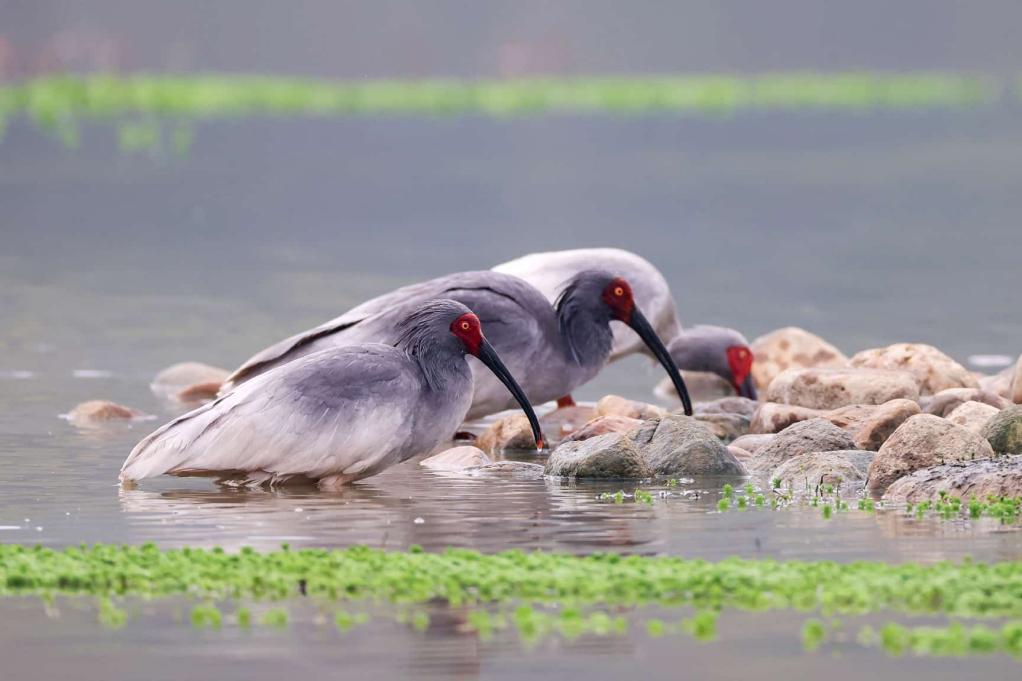
Crested ibises are seen in the Henan Dongzhai National Nature Reserve in Luoshan county, Xinyang, central China's Henan province. (Photo/Xiao Jinsong)
As spring arrives, birdsong fills the air in the Henan Dongzhai National Nature Reserve in Luoshan county, Xinyang, central China's Henan province. Several crested ibises, with their distinctive red beaks, spread their wings and glided gracefully over the lush mountains and lucid waters.
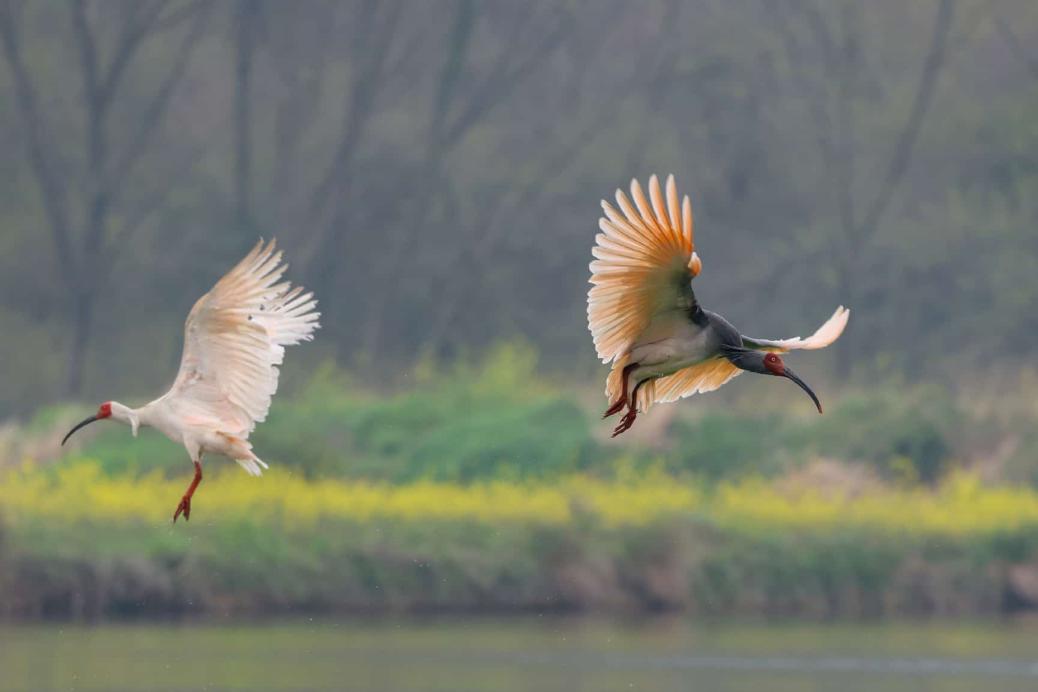
Crested ibises are seen in the Henan Dongzhai National Nature Reserve in Luoshan county, Xinyang, central China's Henan province. (Photo/Xiao Jinsong)
Early each morning, Cai Dejing, deputy director of the reserve's crested ibis breeding station, begins his field patrols. The breeding season, spanning January to June, is his busiest period. He spends long hours meticulously documenting nesting, incubation, and chick-rearing behaviors.
"This year, nesting began four days earlier than last year. That's a good sign, as it usually means a higher breeding success rate," Cai explained.
Established to protect rare forest birds and their mountain habitats, the reserve hosts 356 bird species, 74 of which are nationally protected. It attained national-level status in 2001.
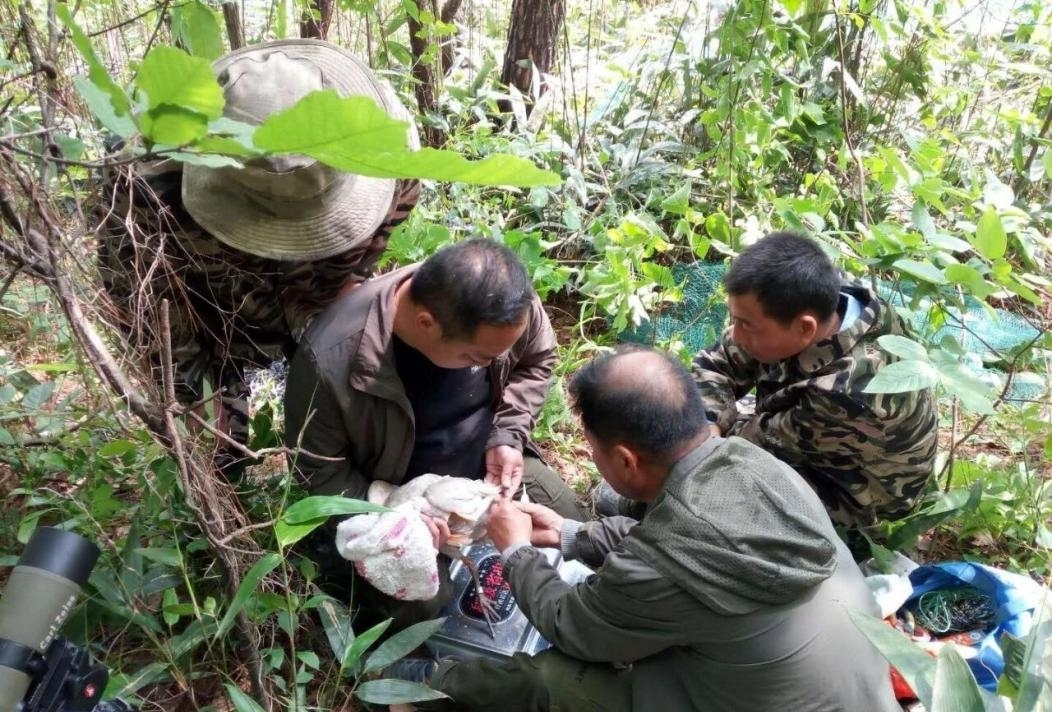
Staff at the Henan Dongzhai National Nature Reserve in Luoshan county, Xinyang, central China's Henan province, examine a young crested ibis's growth. (Photo provided by the Henan Dongzhai National Nature Reserve)
The crested ibis, known as the "Oriental Gem," is critically endangered. Dongzhai shares the crucial north-south climate transition zone found in Yangxian County, Shaanxi Province -- the original rediscovery site for the species. Benefiting from a warm, humid climate and a healthy forest ecosystem, Dongzhai was officially designated China's first crested ibis reintroduction site in 2006.
In 2007, 17 crested ibises were introduced. Reserve staff provided meticulous care, including scheduled feeding and detailed records. These efforts yielded significant results: the reserve has since bred 344 ibises in captivity. Crucially, the wild population now produces over 100 chicks annually, with the total wild population exceeding 700 birds.
"Crested ibises are highly sensitive to environmental conditions. The establishment and steady growth of its wild population are clear signs of the sound ecological foundation in Luoshan county, which provides an ideal home for crested ibises to thrive and reproduce from generation to generation," said Li Yongqiang, director of the Reserve.
At the breeding station stands a striking structure, a circular aviary. Inside, it recreates a near-natural habitat, complete with ponds, wetlands, streams, rice paddies, dry land, and trees.
"This enclosure stands 32 meters tall and spans 2,850 square meters, designed to mimic the crested ibis's natural habitat. Here, the birds practice flying, foraging and evading predators to gradually adapt to the wild," Cai explained.
He noted that introducing breeding stock, captive breeding and pre-release training only form part of the conservation chain; the actual release into the wild is the critical step that measures success.
Dongzhai's first release occurred in October 2013, with 34 human-raised birds taking flight. Six subsequent releases have returned a total of 133 ibises to the wild. To monitor the population, a dedicated team conducts year-round observations. Each new bird is ringed for identification and tracked using binoculars and satellite devices.
Monitoring data clearly documents the population's growth: 56 chicks were naturally bred in 2022, 89 in 2023, and the number surpassed 100 for the first time in 2024, remaining above 100 again in 2025.
"This shows that the population of crested ibises in the Dabie Mountains has fully adapted to the wild and achieved self-sustaining reproduction and expansion," Li said.
The ibis's return has spurred significant socioeconomic benefits. A thriving bird-watching economy has taken shape. The reserve has trained a team of more than 30 professional bird guides, established 69 bird-watching and photography sites, and developed 66 lodging and dining facilities. Each year, the area receives over 30,000 birdwatchers, including more than 10,000 dedicated bird photographers.
The bird-watching business now generates revenue of over 50 million yuan ($7.32 million) annually, creating more than 2,000 jobs, with each employee earning an additional 20,000 yuan per year on average.
"We used to live off the mountains. Now, by guarding these 'national treasures,' our lives keep getting better and better," a local villager said.
As incomes have risen, so too has environmental awareness. Wang Ke, head of the breeding station, noted that the reserve regularly organizes public education activities. Local residents not only actively protect the ibises but also take part in monitoring efforts reporting nesting sites, roosting locations, and breeding activities to the reserve.
The reserve has also established long-term partnerships with institutions such as Beijing Normal University, Beijing Forestry University, and the Institute of Zoology of the Chinese Academy of Sciences. Together, they conduct research on the crested ibis's genetic mechanisms, reproductive behavior, and disease prevention, forming a virtuous cycle in which scientific research supports conservation and conservation, in turn, advances research.
In December 2022, Luoshan county shared Dongzhai's experience in crested ibis conservation with the world at the second phase of the 15th meeting of the Conference of the Parties to the UN Convention on Biological Diversity (COP15).
"Wild-born crested ibis chicks have exceeded 100 for two consecutive years. The wild population is expected to reach 1,000," Cai said.
Photos
Related Stories
- Wild baby otter spotted in Ergune Wetland
- NPC deputies, CPPCC members highlight green as defining feature of a Beautiful China
- China's key terrestrial wild animal, plant species see steady growth amid better ecological environment
- Improved water ecology transformed into economic benefits in Kaizhou district, Chongqing
- Bridge over Yangtze River sets new standards for ecological protection
- The Shuangliu Yangtze River Bridge: an engineering feat with ecological sensitivity
- A Yangtze riverside chemical maker's decade-long turn toward high-quality, green growth
- China's ecological transition gains momentum, contributes to global climate action
- 'Home of Crested Ibis' leverages ecological resources for sustainable prosperity
- Once-degraded SW China lake sees record bird diversity after ecological boost
Copyright © 2026 People's Daily Online. All Rights Reserved.
