



Improved water ecology transformed into economic benefits in Kaizhou district, Chongqing
In winter, Hanfeng Lake National Wetland Park in Kaizhou district, southwest China's Chongqing municipality, presents a scene of serene beauty. Sunlight dances on the shimmering lake, while the distant mountains are draped in a soft haze, together composing a landscape that unfolds like a classic Chinese ink painting.
"What used to be a barren shoal has now become a treasure trove. Who would have imagined it could generate income through 'carbon credits'?” said local resident Chen Guanjun.
The "carbon credits" Chen referred to was China's first transaction for a carbon sink generated by reservoir and water ecosystems. .
On June 16, 2025, 8,784 tons of carbon sink assets from Hanfeng Lake National Wetland Park were purchased by China Three Gorges New Energy Huainan Photovoltaic Power Generation Co., Ltd. for 703,000 yuan ($101,083).
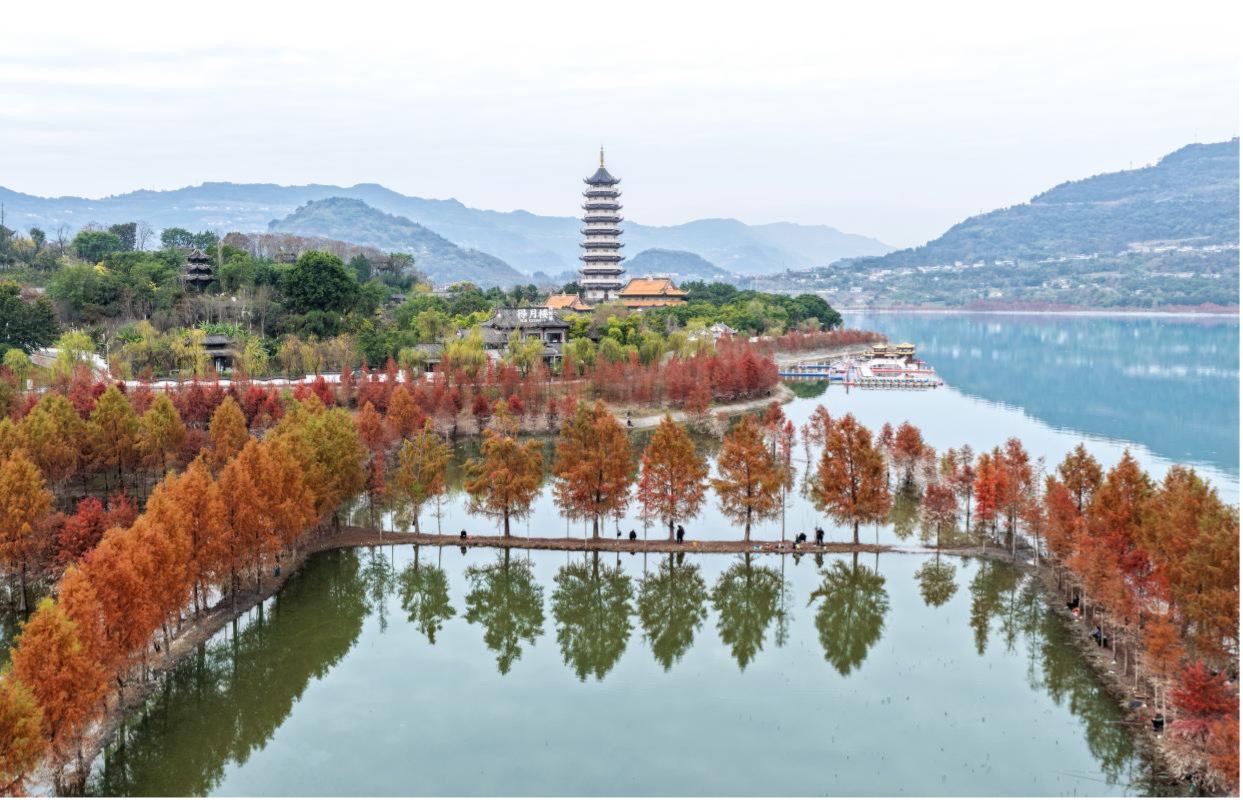
Photo shows Hanfeng Lake National Wetland Park in Kaizhou district, southwest China's Chongqing municipality. (Photo/Tan Changfan)
The deal marked a significant step forward in China's efforts to explore mechanisms for realizing the value of water ecological products through hydraulic engineering projects.
Why was it possible for water ecosystems at Hanfeng Lake to be monetized? The answer lies in nearly two decades of sustained ecological restoration.
Hanfeng Lake is an inland artificial lake formed as part of the Three Gorges Project, the world's largest water conservancy project. Covering a water area of 15 square kilometers, it created a fluctuation zone of nearly 42.78 square kilometers. A water-level variation of more than 20 meters led to alternating wet and dry conditions, which once resulted in soil erosion, vegetation degradation, and a decline in biodiversity.
"In 2008, Kaizhou district built a water-level regulation dam at the Wuyangba area downstream of the district's urban area, reducing the lake's water-level fluctuation from more than 20 meters to less than 5 meters,” said Li Peifu, deputy head of the district's water resources bureau, pointing toward the regulation dam in the distance. "This laid the groundwork and created the necessary conditions for subsequent ecological restoration."
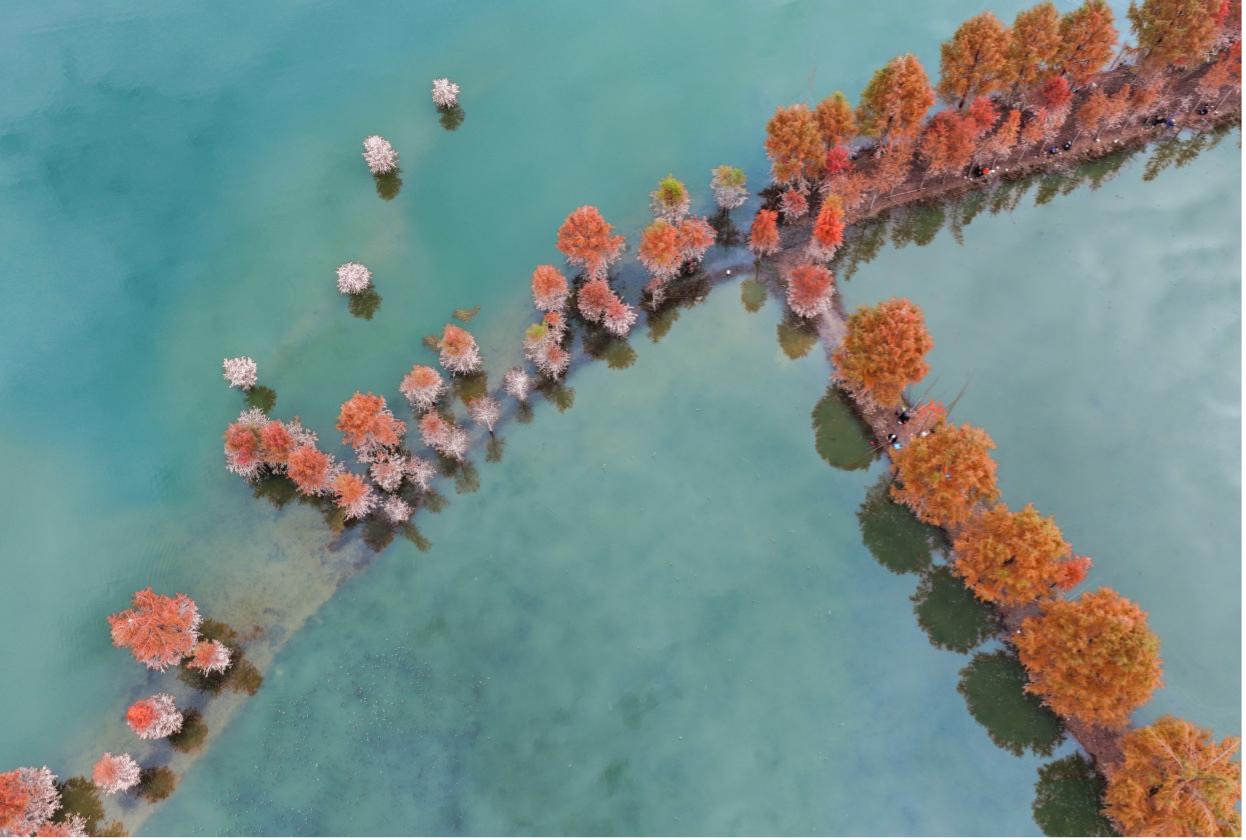
Photo shows Hanfeng Lake National Wetland Park in Kaizhou district, southwest China's Chongqing municipality. (Photo/Tan Changfan)
Kaizhou District has invested a total of 2.49 billion yuan in follow-up funds related to the Three Gorges Project, adopting a zoned approach under a "three-pronged governance" model that integrates engineering treatment areas, ecological restoration areas, and conservation areas.
In engineering treatment areas, projects such as water-level regulation dams and concrete slope protection were constructed to stabilize shorelines and reduce soil erosion. In ecological restoration areas, wetlands were rebuilt to enhance biodiversity. In conservation areas, native ecosystems were preserved and disturbance minimized.
After nearly 20 years of sustained efforts, the area has been transformed into an ecological haven. Winter water levels create submerged "forests," while summer brings lotus-filled ponds and habitats for over 20,000 migratory birds annually, including endangered Chinese mergansers.
Lucid waters and lush mountains now yield tangible value. "Dense wetland vegetation acts as a significant 'carbon reservoir' due to its sequestration capabilities," Li noted. Since 2022, Kaizhou district has explored the trading of carbon sinks generated by reservoir and water ecosystems.
On the one hand, satellite remote sensing monitoring has been combined with ground sampling surveys to calculate the carbon sink assets of the fluctuation zone within Hanfeng Lake National Wetland Park, as well as designated land areas involved in ecological treatment projects around the wetland.
On the other hand, through a mechanism integrating vegetation-based carbon sequestration, soil carbon enhancement, hydrological emission reduction, and biological synergy, the district has planted evergreen broadleaf trees and other aquatic plants, regularly released aquatic animals, and developed a digital management platform. These measures have enabled carbon sequestration while systematically enhancing the carbon sink capacity of the fluctuation zone's ecosystem.
Based on scientific calculations conducted by the Chongqing Institute of Green and Intelligent Technology of Chinese Academy of Sciences, carbon sequestration in just 8.32 square kilometers of restored areas reached 8,784 tons between 2023 and 2024 -- equivalent to the carbon absorption capacity of 26.68 hectares of forest.
After asset valuation by a professional assessment institution, the 8,784 tons of carbon sink assets were listed for sale and ultimately purchased by China Three Gorges New Energy Huainan Photovoltaic Power Co., Ltd.
Why was the company willing to buy the carbon sinks?
"By purchasing water ecosystem carbon sink products and obtaining carbon credit certificates, we can ease the pressure of carbon emission controls during future capacity expansion," said Wei Liangru, the company's general manager. "They can also be used for carbon asset reserves and value-added management, helping build momentum for long-term development.”
Through a carbon sink transaction, the aquatic ecosystem of Hanfeng Lake has been transformed into a "carbon credit," bringing tangible ecological benefits to Kaizhou district. The revenue generated from this transaction will be specifically allocated to the maintenance of Hanfeng Lake's ecological restoration projects and the continuous monitoring of its carbon sequestration capacity.
"This is not a simple transaction, but a process that converted the benefits of water ecological restoration into quantifiable carbon assets," said Liu Zimin, a professor at the College of Economics and Management at Southwest University in Chongqing.
The deal, he noted, marked the establishment of a full value-conversion chain in the Yangtze River basin, which links ecological restoration, carbon sink accounting, market transactions, and the reinvestment of funds.
It offered a replicable model for realizing the value of water ecosystems in reservoirs nationwide and opened up a new pathway for ecological restoration and carbon sink capacity enhancement in the Yangtze River Economic Belt, Liu added.
Photos



Related Stories
- Bridge over Yangtze River sets new standards for ecological protection
- The Shuangliu Yangtze River Bridge: an engineering feat with ecological sensitivity
- A Yangtze riverside chemical maker's decade-long turn toward high-quality, green growth
- China's ecological transition gains momentum, contributes to global climate action
- 'Home of Crested Ibis' leverages ecological resources for sustainable prosperity
Copyright © 2026 People's Daily Online. All Rights Reserved.
