



The Shuangliu Yangtze River Bridge: an engineering feat with ecological sensitivity
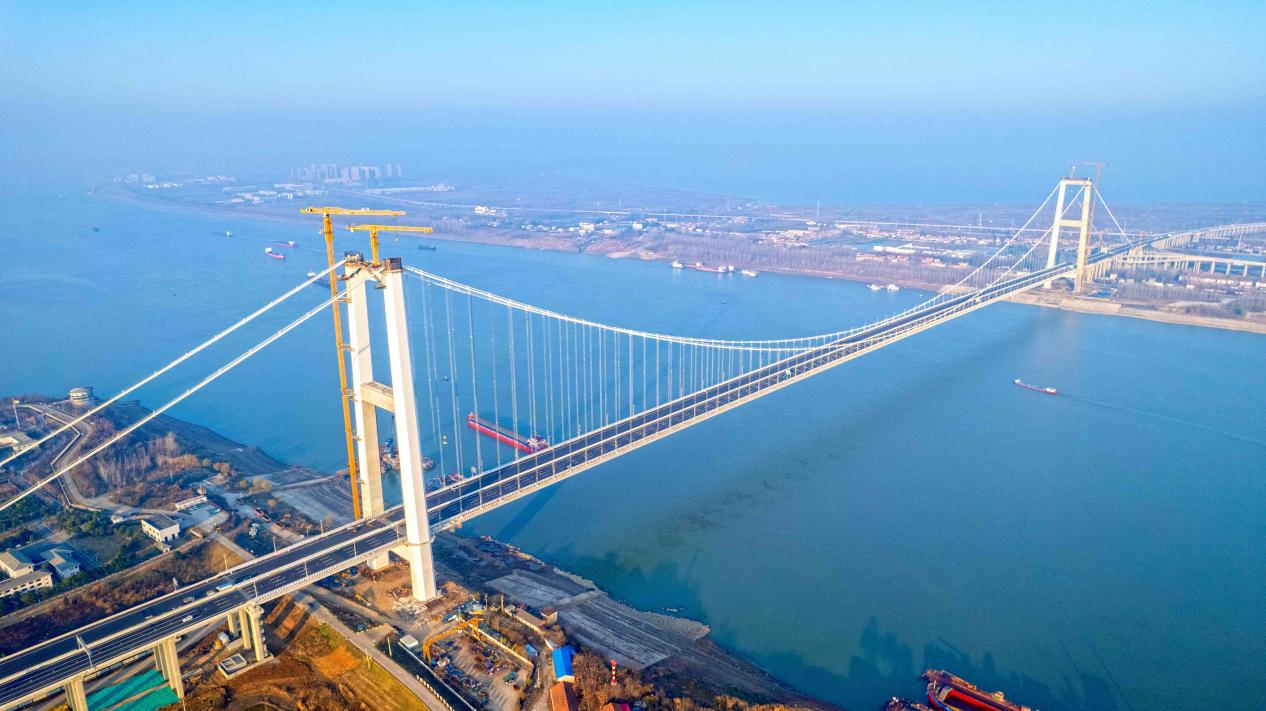
The Shuangliu Yangtze River Bridge in Wuhan, central China's Hubei province, is under construction, Dec. 28, 2025. (Photo/Ma Erhu)
The Yangtze River, China's longest river, flows through Wuhan, the capital city of Hubei province in central China. Spanning its northern bank in the middle reaches, the Shuangliu Yangtze River Bridge connects Wuhan with neighboring Ezhou, strengthening regional integration.
As Peng Xiaobin, the bridge's designer and deputy chief engineer of the Hubei Communications Planning and Design Institute, stood on the newly completed structure, he pointed skyward: "Look, that's a grey heron, and over there is an egret." His enthusiasm reflected the project's dual success: engineering excellence and ecological conservation.
As Wuhan's 12th bridge across the Yangtze, the Shuangliu Bridge stretches 35.043 kilometers. Its route traverses the Zhangdu Lake Wetland Nature Reserve -- a critical habitat for the endangered Yangtze finless porpoise.
In December 2025, experts at a conference organized by the China Highway and Transportation Society hailed the bridge as a benchmark for Chinese engineering and a model of ecological preservation.
A key question emerged during planning: How could bridge construction protect the Yangtze's fragile ecosystem?
The answer gleams under the winter sun -- a 400-meter-long, fully enclosed protective structure along the bridge's northern approach. "This sound barrier was specifically designed for the wetland birds," Peng explained. Standing 6.38 meters high and spanning 34 meters, this "shield for birds" represents a first in Yangtze River bridge engineering.
The Zhangdu Lake Wetland lies along the East Asia-Australasia flyway, a vital migratory corridor. To minimize disruption, Peng's team prioritized ecological considerations from the outset. Collaborating with ornithologists and analyzing a decade of bird activity data, they conducted extensive field observations. "After numerous revisions, we added an extra curve to the northern approach," Peng noted, acknowledging the significant cost increase this entailed.
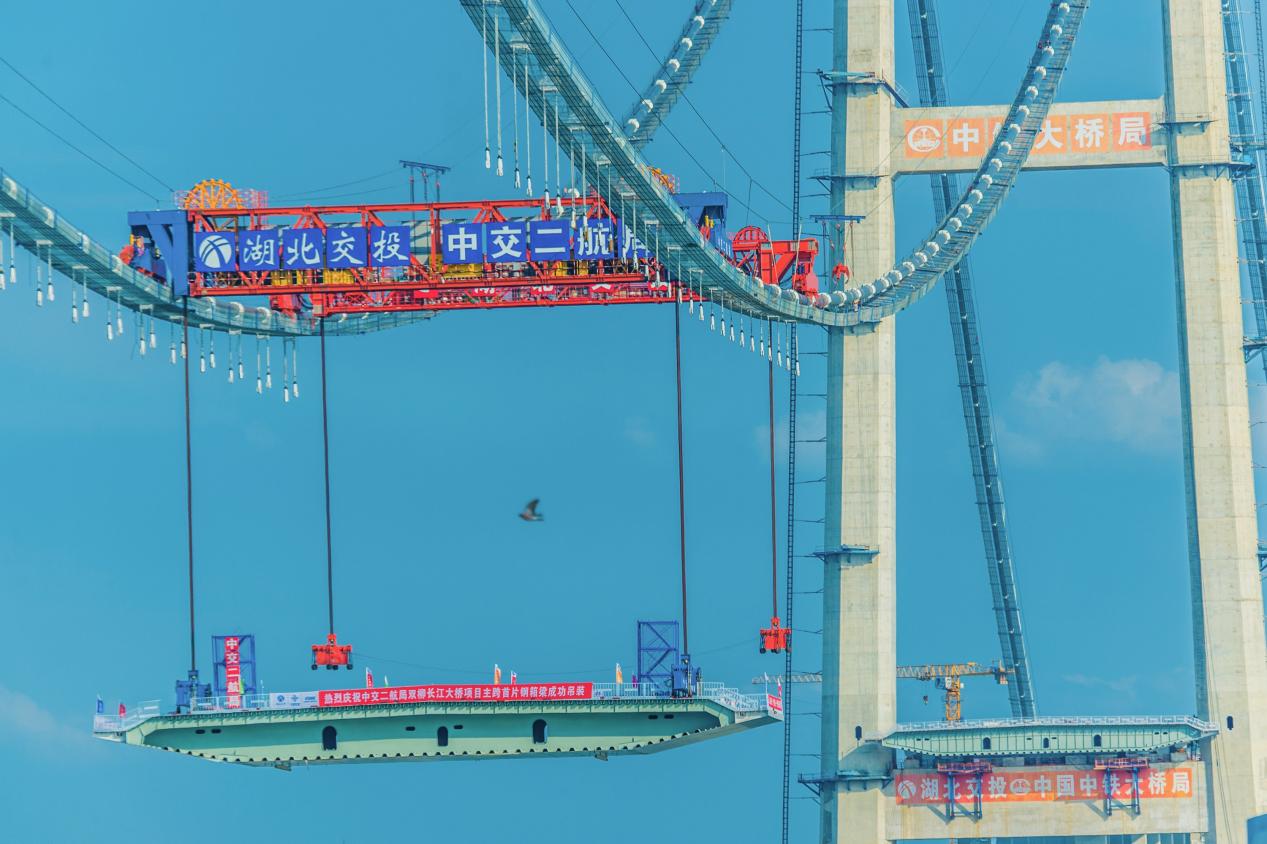
The first box girder of the Shuangliu Yangtze River Bridge is being installed, June 13, 2025. (Photo/Zhao Guangliang)
To address noise generated after the bridge opens to traffic, Peng and his team decided to build a fully enclosed sound barrier on the bridge deck closest to the migratory route. The barrier was completed before the migration season. Today, noise levels outside the barrier are kept at 50 to 55 decibels during the day and 40 to 45 decibels at night, effectively fitting the wetland's birds with "noise-canceling headphones."
From the main span of the bridge, the broad Yangtze shimmered in the sunlight. "You can even see finless porpoises playing here," said Chen Cheng, chief engineer of the Shuangliu Yangtze River Bridge project at CCCC Second Harbor Engineering Co., Ltd.
About two kilometers downstream from the main bridge lies a river bend where finless porpoises are frequently seen. To avoid disrupting their habitat, the bridge was designed to cross the river in a single span.
"The main bridge is a single-span steel box girder suspension bridge," Chen explained. "Not a single pile was driven into the river. Both the north and south approach bridges were built entirely on land, completely avoiding in-water construction."
During construction, work schedules were adjusted to avoid peak activity periods of finless porpoises and other aquatic species. Temporary structures such as trestles were erected during the dry season, followed quickly by the completion of tower foundations and caps. All steel box girders were prefabricated in sections at a factory, transported by specialized vessels, and then hoisted into place using cable cranes.
"In this way, workers only needed to weld the joints at height, and the entire girder installation process did not disturb the river," Chen said.
Over the more than three years of construction, the bridge and the finless porpoises have "grown together." Surveys by the Institute of Hydrobiology of the Chinese Academy of Sciences showed that the finless porpoise population in the bridge section of the Yangtze River has increased from five or six individuals when construction began in 2022 to a stable group of about 20 today.
On the main bridge deck, long drainage pipes can be seen on both sides, each connected to an intelligent flow monitoring system. The system automatically identifies discharged liquids. Rainwater mixed with oil residues is directed into oil-separation and sedimentation tanks before release, while leaked or polluted wastewater is diverted into emergency containment pools and handled by qualified hazardous waste treatment companies.
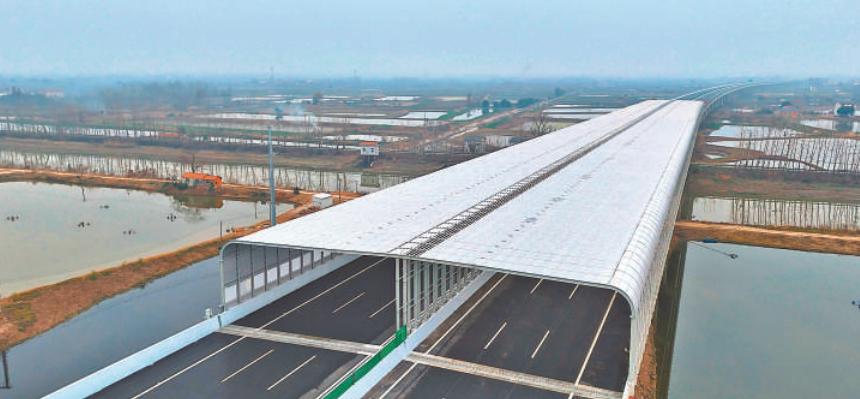
Photo shows the fully enclosed sound barrier of the Shuangliu Yangtze River Bridge. (Photo provided by Hubei Communications Investment Group Co., Ltd.)
The Shuangliu Yangtze River Bridge has now passed completion inspection. Once opened to traffic, travel time between Xinzhou in Wuhan and Ezhou will be reduced from 90 minutes to just five.
"By prioritizing conservation over unchecked development, we have found a balance between ecological protection and economic development," said Wang Xihua, an executive with Shuangliu Yangtze River Bridge Co., Ltd. under Hubei Communications Investment Group Co., Ltd. "Our goal is to achieve a genuine win-win between economic and ecological benefits."
Photos
Related Stories
- A Yangtze riverside chemical maker's decade-long turn toward high-quality, green growth
- China's ecological transition gains momentum, contributes to global climate action
- 'Home of Crested Ibis' leverages ecological resources for sustainable prosperity
- Once-degraded SW China lake sees record bird diversity after ecological boost
- Harnessing power of water and sand: China's wisdom in managing Yellow River
- Helping fish navigate dams: one engineer's mission to restore the Yangtze River ecosystem
- Father and son devoted over 30 years to protecting the Yunnan golden hair monkeys
- Revitalizing forest communities through science and technology in the Lesser Khingan Mountains
- Sound ecological environment generates economic benefits in E China's Jiangxi
- Man transforms barren hills into thriving Torreya grandis forests in E China's Anhui
Copyright © 2026 People's Daily Online. All Rights Reserved.
