



Bridge over Yangtze River sets new standards for ecological protection
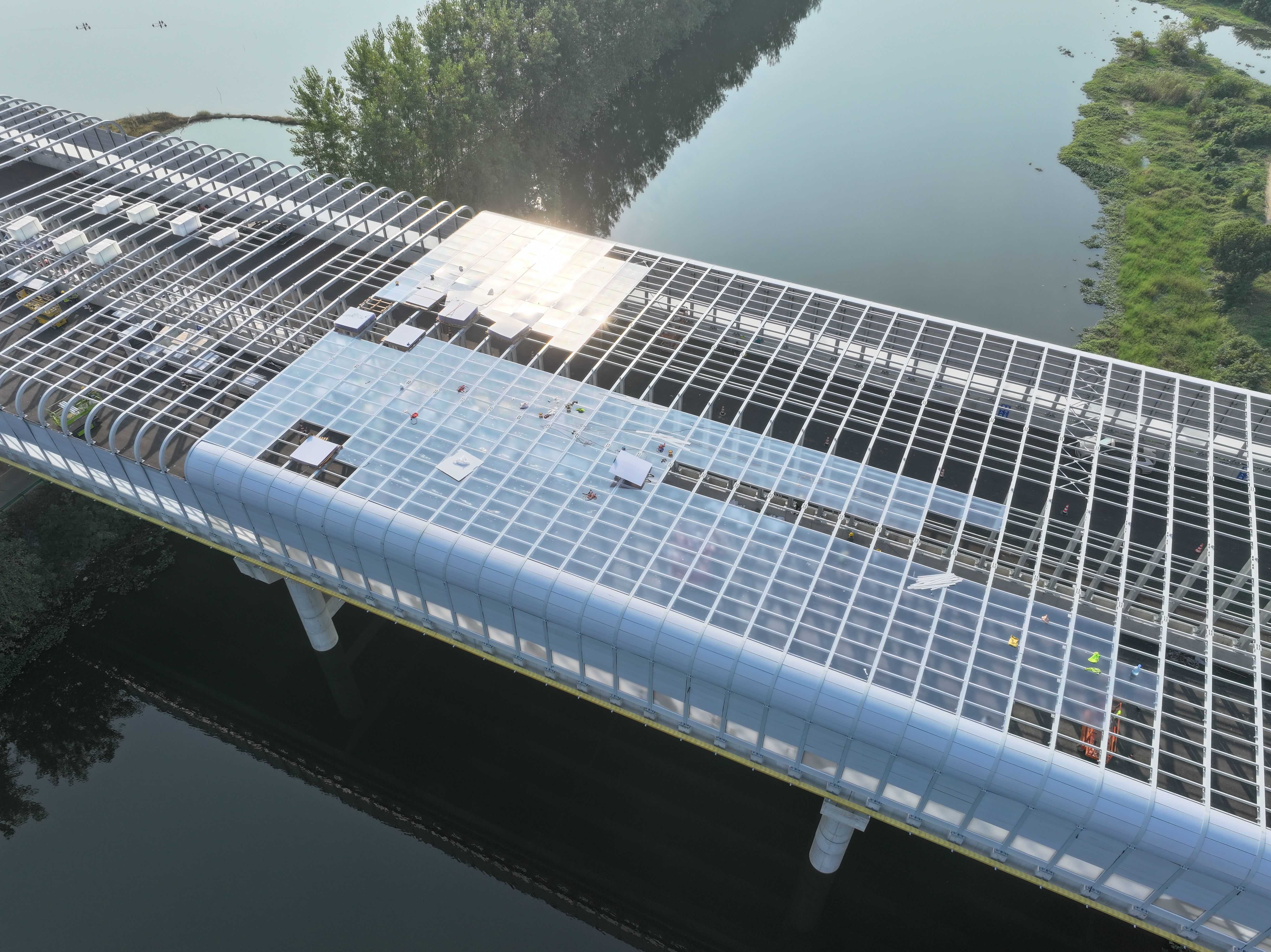
Photo shows an enclosed noise barrier under construction on the Shuangliu Yangtze River Bridge in central China's Hubei Province. (Photo/Changjiang Daily)
The Shuangliu Yangtze River Bridge, linking Wuhan and Ezhou in central China's Hubei Province, recently passed its acceptance inspection. From design to construction, the project prioritized protecting the Yangtze River's environment and biodiversity.
As Wuhan's 12th Yangtze River bridge, it spans 35 kilometers, passing through the Zhangdu Lake Wetland Nature Reserve and crossing waters frequently visited by Yangtze finless porpoises, a species under first-class national protection.
The bridge sets a benchmark for both Chinese engineering and environmental protection, experts and scholars agreed at an academic conference organized by the China Highway & Transportation Society in December 2025.
A 400-meter-long fully enclosed noise barrier was built for birds at the Zhangdu Lake wetland, said Peng Xiaobin, project designer and deputy chief engineer of Hubei Communications Planning and Design Institute Co., Ltd.
The barrier stands 6.38 meters high and 34 meters wide, Peng said, adding that it is the first such bird noise barrier on a Yangtze River bridge.
Since the Zhangdu Lake Wetland Nature Reserve lies along the East Asian-Australasian Flyway, one of the world's great flyways for migratory birds, the team revised the bridge design multiple times, ultimately deciding to introduce an additional curve.
This new design significantly increased construction costs and was initially rejected, Peng noted.
"Our team and the developers consulted bird protection experts, obtained 10 years of data on wetland bird activity and conducted repeated site visits. Everyone agreed that ecological considerations must take priority," Peng said.
Peng and his team went through eight further design iterations, with each version keeping the bridge as far away from the wetland as possible.
Anticipating that traffic noise would affect wetland birds, Peng's team decided to build a fully enclosed noise barrier along the bridge deck near the migratory route.
Within the barrier zone, daytime noise levels are maintained at 50 to 55 decibels and drop to 40 to 45 decibels at night, well within the comfort range for birds.
A river bend where Yangtze finless porpoises frequently appear lies about 2 kilometers downstream from the main bridge.
"The main bridge is a single-span steel box girder suspension bridge that required no river pilings. The approach bridges on both banks were built entirely on land, fully avoiding in-water construction," said Chen Cheng, chief engineer for the project at CCCC Second Harbor Engineering Co., Ltd.
During construction, multiple measures were adopted to minimize potential impacts on Yangtze finless porpoises.
According to surveys by the Institute of Hydrobiology of the Chinese Academy of Sciences, the Yangtze finless porpoise population in the Shuangliu Yangtze River Bridge section has grown from five or six individuals when construction began in 2022 to about 20 today.
Long drainage pipes run along both sides of the bridge deck, their ends connected to intelligent flow-monitoring devices.
"The monitoring system automatically identifies the type of fluid flowing through the pipes. Rainwater with oil residue enters an oil-water separation pool for settling before discharge. Leaked fluids or contaminated wastewater enter an emergency pool for treatment by qualified hazardous waste disposal contractors," explained Fu Gang, director of the safety and environmental protection department at Hubei Communications Investment Group Shuangliu Yangtze River Bridge Co., Ltd.
Beyond the main bridge, 25 such deck runoff collection systems have been installed throughout sensitive areas, including the Zhangdu Lake Wetland Nature Reserve.
"This system not only prevents direct runoff discharge but also addresses the technical challenge of automatically identifying and collecting contaminated runoff during hazardous chemical incidents," Fu said.
"We prioritize comprehensive protection over large-scale development, seeking a balance between ecological preservation and economic growth to achieve both environmental and economic benefits," said Wang Xihua, Party secretary of Hubei Communications Investment Group Shuangliu Yangtze River Bridge Co., Ltd.
Photos
Related Stories
- The Shuangliu Yangtze River Bridge: an engineering feat with ecological sensitivity
- A Yangtze riverside chemical maker's decade-long turn toward high-quality, green growth
- China's ecological transition gains momentum, contributes to global climate action
- 'Home of Crested Ibis' leverages ecological resources for sustainable prosperity
- Once-degraded SW China lake sees record bird diversity after ecological boost
- Harnessing power of water and sand: China's wisdom in managing Yellow River
- Helping fish navigate dams: one engineer's mission to restore the Yangtze River ecosystem
- Father and son devoted over 30 years to protecting the Yunnan golden hair monkeys
- Revitalizing forest communities through science and technology in the Lesser Khingan Mountains
- Sound ecological environment generates economic benefits in E China's Jiangxi
Copyright © 2026 People's Daily Online. All Rights Reserved.
