

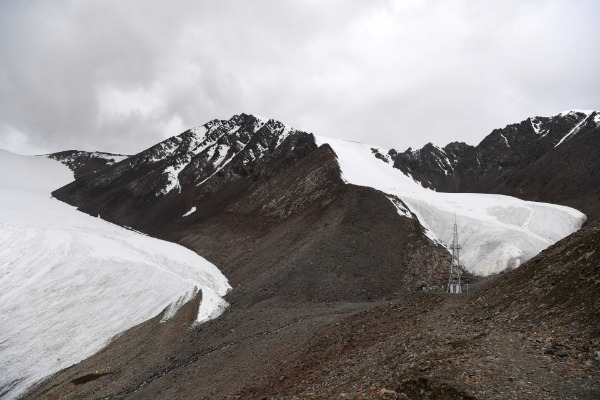
Glaciers are known as "solid reservoirs" and play an important role in supplementing and regulating river runoff.[Photo/Xinhua]
Years after mining, grazing and tourism were banned in a glacier reserve of Northwest China's Xinjiang Uygur autonomous region, wild animals have returned to celebrate the improving environment of the reserve.
About 130 km from the regional capital of Urumqi, Glacier No. 1 in the Tianshan Mountains at an altitude of 3,850 meters is closer to a city than any other glacier in the world.
A series of snow leopard observation activities around the glacier carried out by wildlife protection volunteers since 2015 found that the number of large animals in the area has been increasing visibly.
The number of snow leopards has stabilized at more than 20, said Xing Rui, head of a local volunteer organization for wildlife conservation, adding that bears that had disappeared since the 1990s have reappeared, and the numbers of wild sheep, red deer and wild boar are also increasing rapidly.
Glaciers are known as "solid reservoirs" and play an important role in supplementing and regulating river runoff. An observation station set up in 1959 has found that the glacier has been receding since the 1960s.
Experts warn that Glacier No. 1 will melt completely in 50 years at the current rate of ablation, and residents in the lower reaches of the glacier will face the risk of water shortage.
 |

 Award-winning photos show poverty reduction achievements in NE China's Jilin province
 People dance to greet advent of New Year in Ameiqituo Town, Guizhou
 Fire brigade in Shanghai holds group wedding
 Tourists enjoy ice sculptures in Datan Town, north China
 Sunset scenery of Dayan Pagoda in Xi'an
 Tourists have fun at scenic spot in Nanlong Town, NW China
 Harbin attracts tourists by making best use of ice in winter
 In pics: FIS Alpine Ski Women's World Cup Slalom
 Black-necked cranes rest at reservoir in Lhunzhub County, Lhasa
 China's FAST telescope will be available to foreign scientists in April