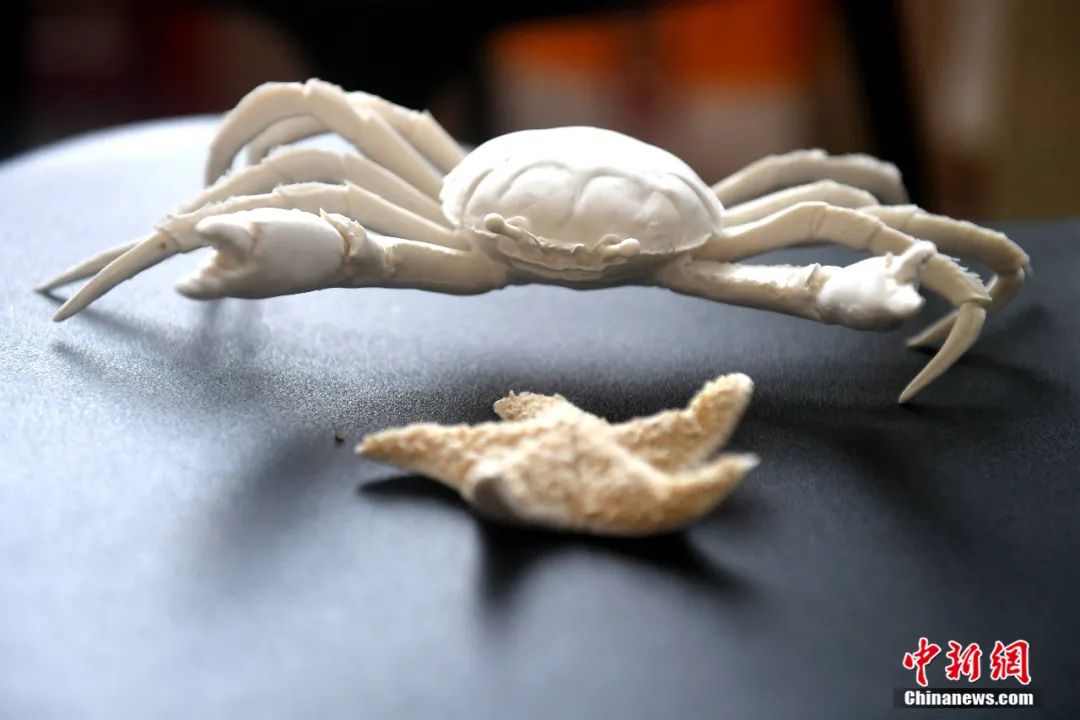

Huang Yaqi, a local village doctor from Meizhou Island in Putian, southeast China's Fujian province, is one of earliest intangible cultural heritage inheritors of Mazu beliefs and customs, and is able to "create" hundreds of tributes resembling marine animals using dough.
Mazu beliefs and customs, which originated in Meizhou Island, are one of the first examples of beliefs and customs in China becoming world heritages.
Huang Yaqi used to make these tributes by mixing glutinous rice flour, honey, peanut oil and water with flour. Nowadays, thanks to a greater choice of raw materials, he has begun mixing flour with white latex and styrofoam, allowing his works to be preserved for several years longer than before.
Huang Yaqi has been making the tributes for nearly 40 years. "I can make more than 300 kinds of sea animals, and I am most familiar with 160 of them, as they have been imprinted in my heart," he said, adding that making crocodile tributes presents the most difficult challenge for him, as people have higher expectations of the animal tributes they are most familiar with.
In Huang Yaqi's eyes, the fishermen's wisdom contained in the Mazu tributes highlights the perfect combination of Mazu culture and food culture, and also represents the crystallization of marine culture into Meizhou local culture.
 |  |

 Award-winning photos show poverty reduction achievements in NE China's Jilin province
 People dance to greet advent of New Year in Ameiqituo Town, Guizhou
 Fire brigade in Shanghai holds group wedding
 Tourists enjoy ice sculptures in Datan Town, north China
 Sunset scenery of Dayan Pagoda in Xi'an
 Tourists have fun at scenic spot in Nanlong Town, NW China
 Harbin attracts tourists by making best use of ice in winter
 In pics: FIS Alpine Ski Women's World Cup Slalom
 Black-necked cranes rest at reservoir in Lhunzhub County, Lhasa
 China's FAST telescope will be available to foreign scientists in April