

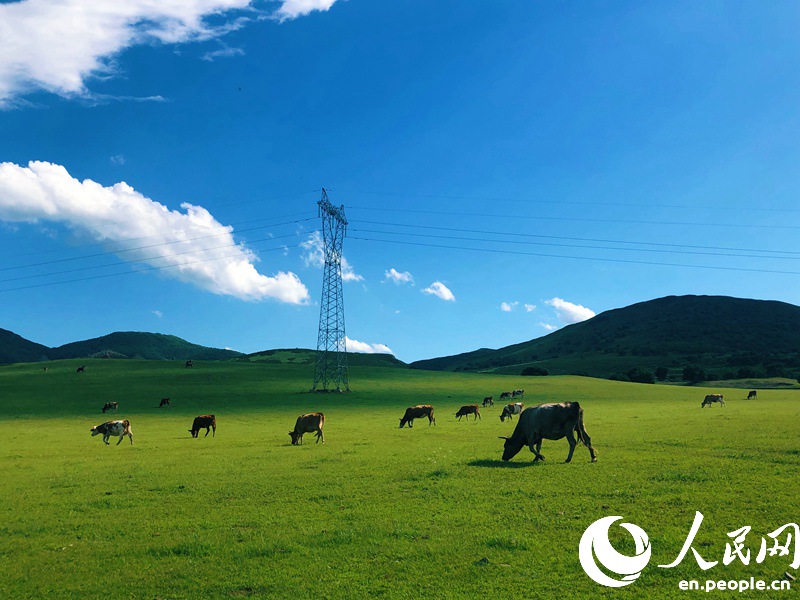
Cultural tourism is booming in Inner Mongolia. [Photo by Kou Jie]
Culture and nature matter
After decades of effort, people in Inner Mongolia have successfully restored many grasslands to their former beauty. Many locals have seized the opportunity to develop cultural tourism, 43-year-old Honggorbaatar being one of them.
Before 2017, Honggorbaatar was a herdsman with over 1,200 sheep. Overgrazing destroyed parts of his grassland, leaving sandy spots scattered over the emerald hills, while keeping sheep didn't provide a steady income.
"The local authorities issued orders prohibiting grazing, telling us the importance of protecting the environment. In 2017, I sold all my sheep and opened a cultural resort on the Horqin Grassland," said Honggorbaatar.
Honggorbaatar has created many cultural tourism programs for visitors, including horse riding, Mongolian engraving, Mongolian food tasting and Mongolian wrestling.
After two years of development, Honggorbaatar's cultural resort can now generate a net profit of 450,000 RMB per year, while low-income families nearby have also worked for him, earning at least 100 RMB per day.
"Last year, I've helped four low-income families escape poverty. One of the young boys who worked for me now has his own art studio, encouraging more people to earn money from traditional Mongolian culture," said Honggorbaatar.
"By opening the cultural resort, I've not only protected the environment, but have also promoted our culture. I like to make friends from all over the world, as this also provides me a chance to know the outside world," he added.
 |

 Award-winning photos show poverty reduction achievements in NE China's Jilin province
 People dance to greet advent of New Year in Ameiqituo Town, Guizhou
 Fire brigade in Shanghai holds group wedding
 Tourists enjoy ice sculptures in Datan Town, north China
 Sunset scenery of Dayan Pagoda in Xi'an
 Tourists have fun at scenic spot in Nanlong Town, NW China
 Harbin attracts tourists by making best use of ice in winter
 In pics: FIS Alpine Ski Women's World Cup Slalom
 Black-necked cranes rest at reservoir in Lhunzhub County, Lhasa
 China's FAST telescope will be available to foreign scientists in April