

A teacup with snowball blossoms from the collection of the Meissen Porzellan-Museum, Germany.[Photo provided to China Daily]
Porcelain from China, and then Japan, became very popular in the royal courts of Europe. August der Starke (1670-1733), the king of Poland and elector of Saxony in Germany, was a big fan of Chinese porcelain. Under his instruction, alchemist Johann Friedrich Bottger deciphered the secret to manufacturing porcelain and established the first porcelain production line in Meissen, a town to the north of Dresden, in 1710. Meissen soon became the European home of porcelain.
Daniela Antonin, head of the Hetjens-German Museum of Ceramics in Dusseldorf, brought more than 100 objects from the museum's collection, as well as from the Meissen Porzellan-Museum, to Shanghai.
Participating in the exhibition in Shanghai "allowed us to learn about porcelain from China and Japan, and their impact on German porcelain art", Antonin says.
 |  |

 Award-winning photos show poverty reduction achievements in NE China's Jilin province
 People dance to greet advent of New Year in Ameiqituo Town, Guizhou
 Fire brigade in Shanghai holds group wedding
 Tourists enjoy ice sculptures in Datan Town, north China
 Sunset scenery of Dayan Pagoda in Xi'an
 Tourists have fun at scenic spot in Nanlong Town, NW China
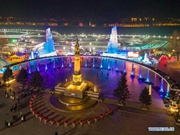 Harbin attracts tourists by making best use of ice in winter
 In pics: FIS Alpine Ski Women's World Cup Slalom
 Black-necked cranes rest at reservoir in Lhunzhub County, Lhasa
 China's FAST telescope will be available to foreign scientists in April