
Fish:
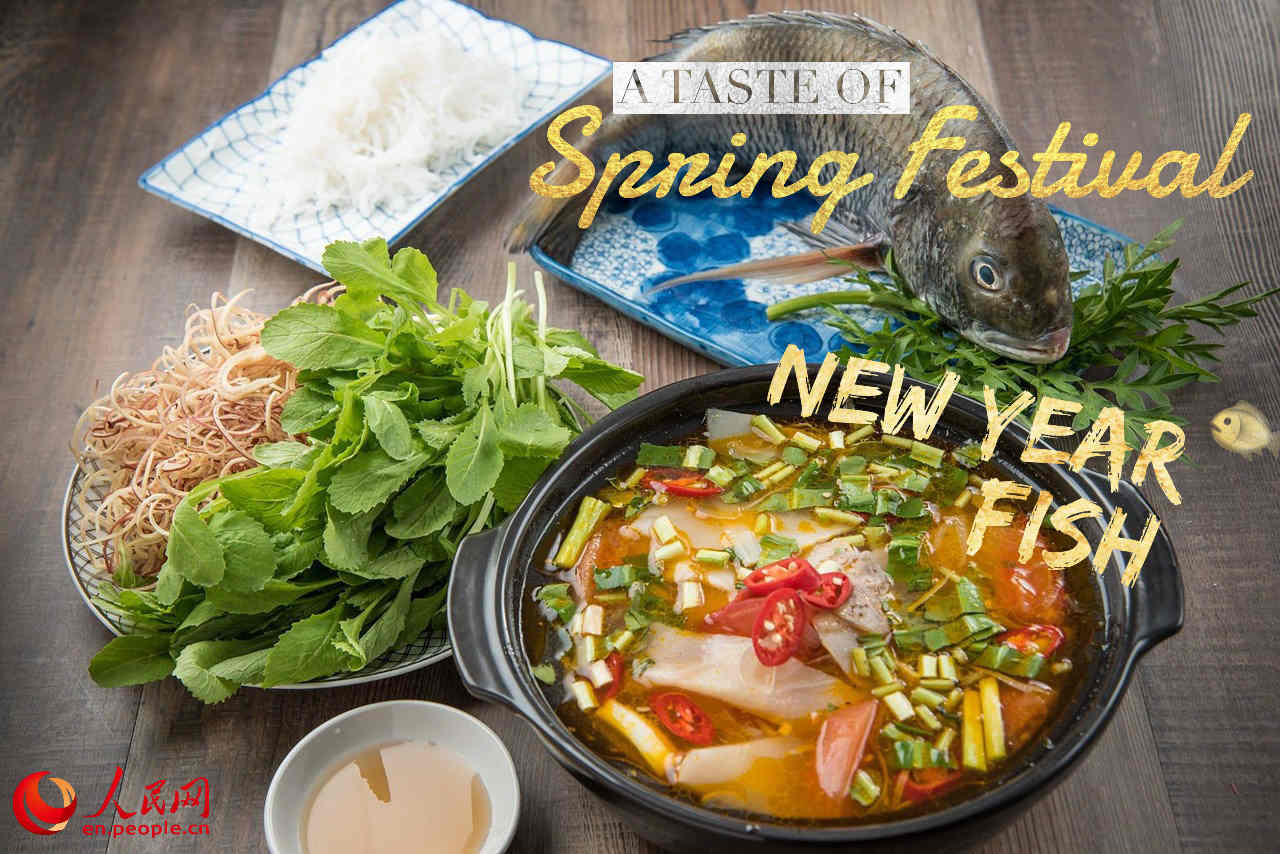
New year fish
For every Chinese family, fish is an indispensable part of the reunion dinner. In Chinese, fish has the same pronunciation as 余 (yu), which means surplus. For Chinese people, it is always good to have saved something by the end of the year, so that more good fortune will follow.
The typical blessing of the fish dish is 年年有余, an idiom wishing people a surplus of food and money in the new year. It is also essential to choose the right type of fish. The Crucian carp and Chinese mud carp are most often used in the reunion dinner, as the first character of crucian carp (鲫鱼, jìyú) sounds like the Chinese word 吉 (jí, good luck), while the Chinese word for mud carp has a similar pronunciation to the word for gift.
When eating the fish dish, the head and the tail must be left intact. This practice echoes the Chinese idiom 有头有尾, with the literal meaning “having both head and tail,” which represents the idea of concluding the unfinished, as well as moving towards a positive start.
During the reunion dinner, the fish head must be placed toward elders or distinguished guests to show respect, while those sitting facing the head and tail of the fish should drink and toast together, to bring good luck to all family members.
Flavor: sweet, salty or spicy
Cooking method: boil, fry or steam
Cultural Connotation: a symbol of surplus
 |  |

 Award-winning photos show poverty reduction achievements in NE China's Jilin province
 People dance to greet advent of New Year in Ameiqituo Town, Guizhou
 Fire brigade in Shanghai holds group wedding
 Tourists enjoy ice sculptures in Datan Town, north China
 Sunset scenery of Dayan Pagoda in Xi'an
 Tourists have fun at scenic spot in Nanlong Town, NW China
 Harbin attracts tourists by making best use of ice in winter
 In pics: FIS Alpine Ski Women's World Cup Slalom
 Black-necked cranes rest at reservoir in Lhunzhub County, Lhasa
 China's FAST telescope will be available to foreign scientists in April