

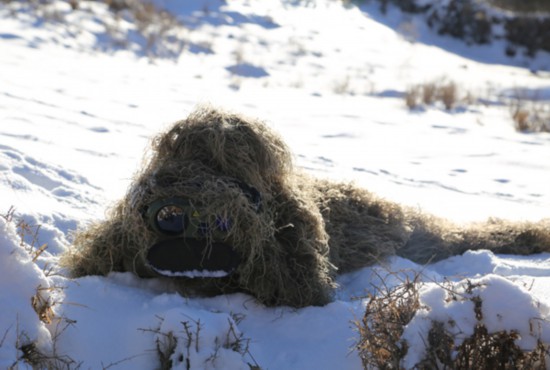
(Photo/Wang Hongqiang)
A 77th Group Army brigade of the People’s Liberation Army (PLA) recently conducted professional training for selected snipers on a snow-covered plateau, home to harsh and complex environments, xinhuanet.com reported on Jan. 5.
The training was carried out under a combat mode that integrated sniping and counter-sniping, in which the snipers shot at moving targets while “hostile snipers,” played by instructors, hid in the battlefield, ready to “kill” them at any moment.
“This training is primarily used to improve the overall quality of the snipers, not just the capacity for precise shooting,” said instructor Gao Xubo, noting that the high altitudes, low temperatures, unfamiliar territory, complex environments, and unknown enemies all test the snipers' capabilities.
As the training was conducted on snowy ground, the snipers could easily be targeted by instructors thanks to footprints left in the snow.
“Snipers must remain cautious and act carefully, for in this snow-covered area, even a tiny mistake could lead to their discovery,” said observer Guo Yongwang. He disclosed that to polish their sniping capabilities and make no mistakes in actual operation, the elite snipers often had to lurk, entirely still, for long periods in the freezing cold.
“This training is not only a combat exercise, but also a demonstration which intends to set up the orientation and standard of troop training and combat preparations,” said Teng Yiquan, the general training leader.
 |

 Award-winning photos show poverty reduction achievements in NE China's Jilin province
 People dance to greet advent of New Year in Ameiqituo Town, Guizhou
 Fire brigade in Shanghai holds group wedding
 Tourists enjoy ice sculptures in Datan Town, north China
 Sunset scenery of Dayan Pagoda in Xi'an
 Tourists have fun at scenic spot in Nanlong Town, NW China
 Harbin attracts tourists by making best use of ice in winter
 In pics: FIS Alpine Ski Women's World Cup Slalom
 Black-necked cranes rest at reservoir in Lhunzhub County, Lhasa
 China's FAST telescope will be available to foreign scientists in April