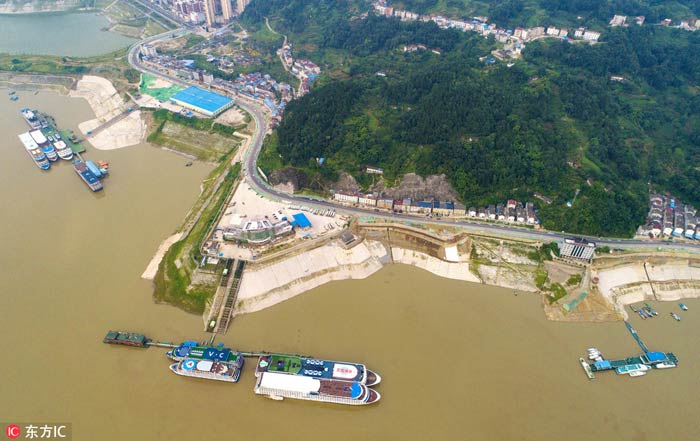
What used to be a barren port cluttered with cargoes along Yangtze River is now a grassy space.
To restore the banks along the Yangtze River, a special renovation project was kicked off in May to enhance utilization of waterfront resources at some ports along China’s longest river in Yueyang City of central China’s Hunan province
The bank of the Yangtze River, with its rich resources, is essential for industrial agglomeration and economic development. However, a number of ports and wharves along the river suffer production efficiency and capacity problems.
Chenglingji Port—one of the eight deep water harbors in Yueyang, is a key area of ecological renovation. A number of its wharves will be closed due to environmental pollution or because they lack approval or have low traffic volume. Meanwhile, new wharves can no longer be approved by ports, as local authorities encourage public wharves at core ports, news portal ThePaper reported.
The rectification measures at Chenglingji are part of Hunan’s efforts to protect the bank of the Yangtze River. Over the years, the province has shut down 39 illegal sand and stone wharves and reclaimed over 10 kilometers of shoreline.
Eleven operators at ports have been pulled out so far, and eight have been partially withdrawn. By June 30, all 42 berths were closed.
By 2020, the total amount of ports on the riverbank is expected to be limited to around 10 kilometers and 11 wharves will be updated to improve quality.
(Wang Tianhao contributed to the story)
 |

 Award-winning photos show poverty reduction achievements in NE China's Jilin province
 People dance to greet advent of New Year in Ameiqituo Town, Guizhou
 Fire brigade in Shanghai holds group wedding
 Tourists enjoy ice sculptures in Datan Town, north China
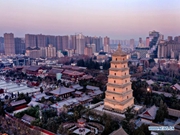 Sunset scenery of Dayan Pagoda in Xi'an
 Tourists have fun at scenic spot in Nanlong Town, NW China
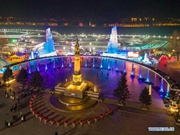 Harbin attracts tourists by making best use of ice in winter
 In pics: FIS Alpine Ski Women's World Cup Slalom
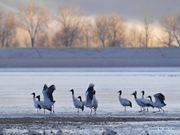 Black-necked cranes rest at reservoir in Lhunzhub County, Lhasa
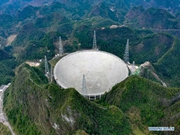 China's FAST telescope will be available to foreign scientists in April