

3. Results
Since our research aimed to find out the different emotional language choice of bilinguals/multilinguals on S-T words, endearment expression (specifically on love expression) and bad/difficult memories recalls, answers of these following three questions are specifically analyzed:
1. Do swear and taboo words in your different languages have the same emotional weight for you?
2. Does the phrase "I love you" have the same emotional weight for you in your different languages? Which language does it feel strongest in?
3. If you were to recall some bad or difficult memories, what language would you prefer to discuss them in and why?
Question 1 belongs to the second part of the questionnaire, which is a close-ended rating-scale question. Participants could choose among ‘Not Strong’ ‘Little’ ‘Fairly Strong’ ‘Very Strong’ and ‘Not Applicable’. Question 2 and 3 are open-ended questions.
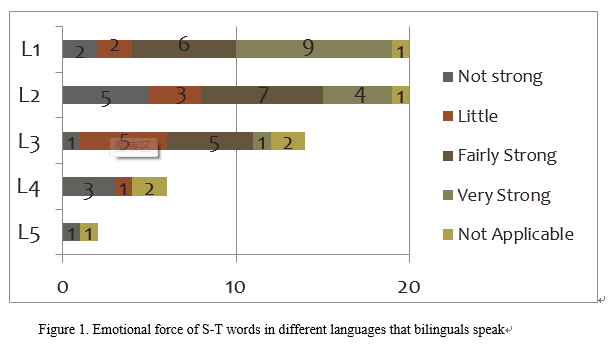
Figure 1 shows the result of emotional force of S-T words in different languages that bilinguals speak in. As the data showed, 9 participants out of 20 (45%) considered S-T words in L1 have a strongest emotional force. 6 participants considered those words are fairly strong. 2 participants felt little emotional force of S-T words in L1, while same amount of participants felt S-T words in L1 are not strong. 1 participant chose ‘Not applicable’. She chose not applicable because her first language is Tatar, which is only used with her family member.
Question 2 is an open-end question, asking for the emotional express of endearment by the phrase ‘I love you’, in different languages. Figure 2 shows the general proportion of different opinions of participants on the usage of ‘I love you’. 12 participants (60%) considered that the expression in their first language has stronger emotional weight than any other languages they speak. 7 participants (35%) see the expression in L1 and L2 has the same emotional weight. 1 (5%) participant thought that the expression has a stronger emotional weight in L2 than it in L1.
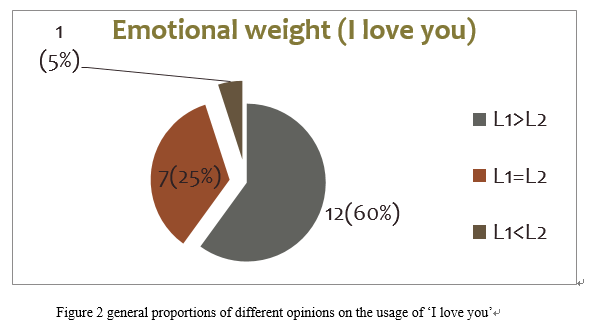
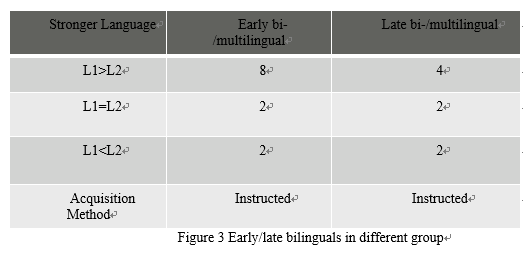
Figure 3 shows the percentage of early bilinguals and late bilinguals in different groups. In the first group, bilinguals who consider ‘I love you’ is stronger in L1 (L1>L2), 8 participants (67%) are early bilinguals, 4 (33%) are late bilinguals. In the second group (L1=L2), which includes 4 participants, 50% of participants are early bilinguals, and 50% late bilinguals. In the third group (L1<L2), it shows the similar proportion of early and late bilinguals. All the participants learnt their L2 in instructed context.
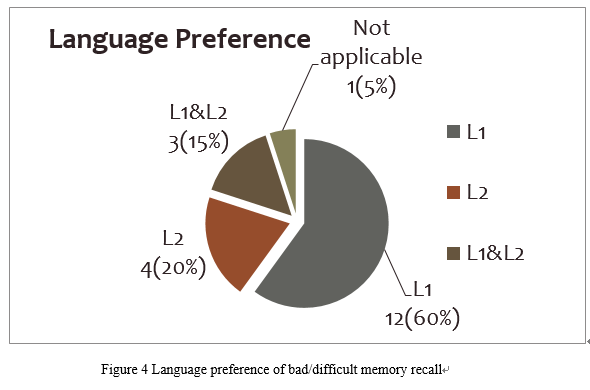
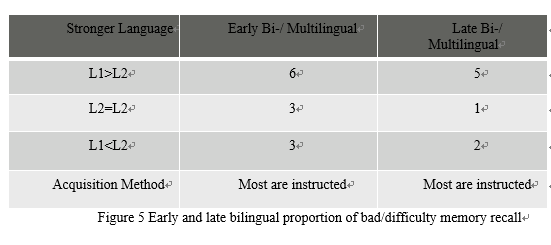
Question 3 asked about the preferred language for bad or difficult memory recall for participants. Figure 4 showed the data of preferable language. 12 participants (60%) prefer their L1, 4 participants (20%) L2, 3 participants (15%) both L1 and L2, and 1 participant chose not applicable.
Figure 5 shows the proportion of early and late bilinguals in different groups. In the L1>L2 group, 6 participants are early bilingual and 5 late bilinguals. L1=L2 group contains 3 early bilinguals and 2 late bilinguals. L1<L2 group contains 3 early bilinguals and 1 late bilinguals.
 |  |

 Award-winning photos show poverty reduction achievements in NE China's Jilin province
 People dance to greet advent of New Year in Ameiqituo Town, Guizhou
 Fire brigade in Shanghai holds group wedding
 Tourists enjoy ice sculptures in Datan Town, north China
 Sunset scenery of Dayan Pagoda in Xi'an
 Tourists have fun at scenic spot in Nanlong Town, NW China
 Harbin attracts tourists by making best use of ice in winter
 In pics: FIS Alpine Ski Women's World Cup Slalom
 Black-necked cranes rest at reservoir in Lhunzhub County, Lhasa
 China's FAST telescope will be available to foreign scientists in April