

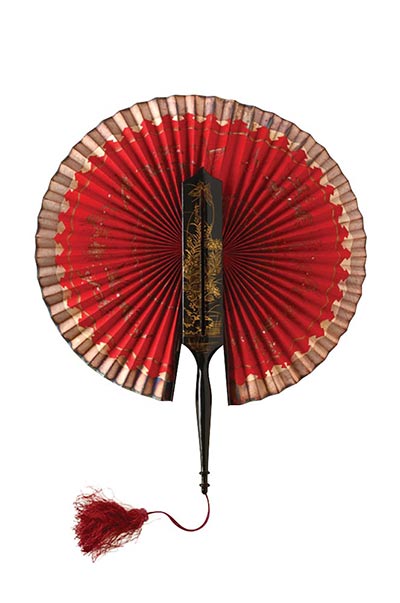
[Photo/The Fan Museum]
Eastern and Western cultures alike have embraced the traditional handheld fan, not only as a temperature-cooling instrument, but also as an accessory that adds a delicate silhouette to a look. For a long time in Europe, these beautiful items were must-have accessories in high society and a true fashion statement for women.
The earliest hand fan was called flabellum and first appeared in ancient Egypt as a tool to keep insects away – an example was found in the tomb of Tutankhamun. In its modern incarnation for air flow, handheld fans were first seen in Japan around the 6th century CE. However, it wasn't until the 17th century, when huge quantities of folding fans were exported from China and Japan to Europe, that they became true fashion staples. In that era, nobility and royalty had multiple fans for a variety of uses – one in the morning, another at night, yet another in the street and yet another for important occasions.
In 1709, the Worshipful Company of Fan Makers was incorporated in London under the Royal Charter of Queen Anne. Its aim was to help expand the local fan business – paper styles were developed and many artists painted on them, creating a plethora of artworks.
 |

 Award-winning photos show poverty reduction achievements in NE China's Jilin province
 People dance to greet advent of New Year in Ameiqituo Town, Guizhou
 Fire brigade in Shanghai holds group wedding
 Tourists enjoy ice sculptures in Datan Town, north China
 Sunset scenery of Dayan Pagoda in Xi'an
 Tourists have fun at scenic spot in Nanlong Town, NW China
 Harbin attracts tourists by making best use of ice in winter
 In pics: FIS Alpine Ski Women's World Cup Slalom
 Black-necked cranes rest at reservoir in Lhunzhub County, Lhasa
 China's FAST telescope will be available to foreign scientists in April