



Why 'sense of safety' offered by China is drawing global attention
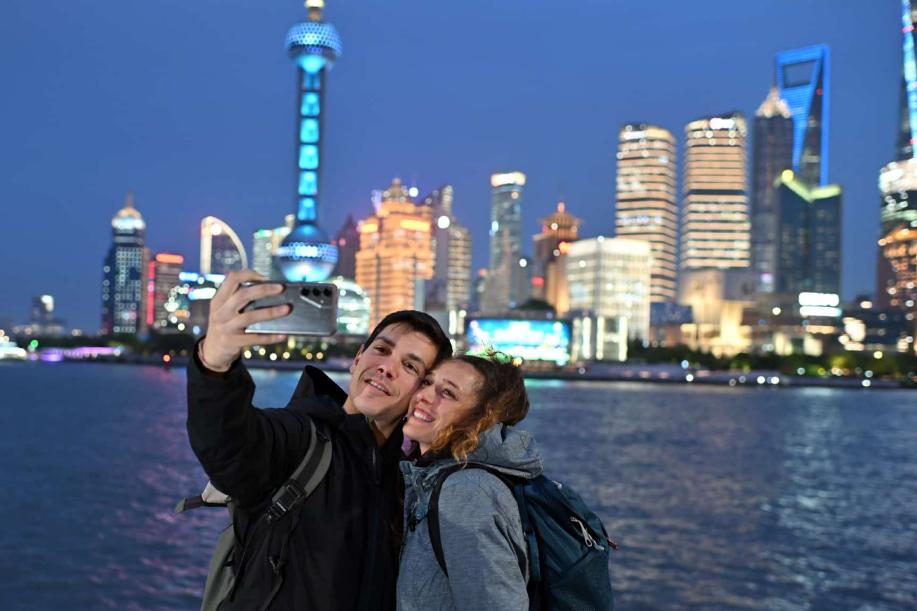
Foreign tourists pose for a picture in Shanghai. (Photo/Weng Qiyu)
International influencers living in China are sparking cross-cultural dialogue through candid videos showcasing everyday security in the country. Their unscripted moments have popularized a new term: the "Chinese sense of safety," generating widespread discussion across global social media platforms.
What do these videos show? Late-night snack runs without a second thought. Fruit vendors napping beside unattended stalls. Laptops left on café tables, still there hours later. Packages stacked along the street, untouched. For many viewers, these ordinary scenes feel anything but ordinary.
So, how safe is China? The data offer part of the answer.
In 2025, the number of criminal cases filed in China dropped by 12.8 percent year on year, reaching the lowest level of this century. China remains one of the countries with the lowest rates of homicide, violent crime, and gun- and explosives-related offenses in the world. Public satisfaction with safety reached 98.23 percent, staying above 98 percent for six consecutive years.
Internationally, according to Gallup's Global Safety Report 2025, China has been ranked as the third safest place globally and fourth in the law and order Index, both ahead of several Western countries.
Yet for many foreign influencers, what feels even more remarkable than the statistics is how ordinary safety seems to Chinese people in daily life. It is so deeply embedded that many barely notice it.
As one overseas netizen even joked, "China is very safe, except for people trying to lose weight. One careless night snack, and you end up with 'happy fat.'"
So where does this widely noted sense of safety come from?
First, it comes from governance.
In China, public safety is not a privilege reserved for a few, but a universal public good shared by all. Kong Fanbin, dean of the Huazhi Institute for Global Governance at Nanjing University, argues that an integrated governance system involving multiple social forces provides strong support for high-level public security.
From the immediate response mechanism to public appeals that delivers prompt solutions to people's demands, to refined grid-based meticulous management that integrates human patrols and technical prevention, every governance measure is well-regulated and people-focused.
Such initiatives bolster public security, lay a solid foundation for enhancing people's sense of gain and happiness, and make the general public feel genuinely safe and reassured.
Second, it comes from trust.
"The 'Chinese sense of safety' is also rooted in profound cultural traditions," said He Mingxing, professor at the School of International Journalism and Communication at Beijing Foreign Studies University.
The Chinese nation has long cherished the age-old virtues of "no one picks up lost articles on the road, nor do people bolt their doors at night", while emphasizing harmony and mutual care.

Foreign tourists shop in a store in Xi'an, northwest China's Shaanxi province. (Photo/Xue Gang)
In real life, this trust is reflected in two ways.
One is trust in public institutions. "Many Western countries struggle to understand the relationship between police and the public in China," He noted. "In some places, even approaching a police car might trigger a warning. Here, to ask for help from police officers is one of the most instinctive thoughts ordinary people have."
The other is the trust shared among strangers. Someone may call to remind you that your car door is unlocked. A neighbor may bring over food that was mistakenly delivered to their home. As one foreign influencer put it: "In China, I learned how to trust again."
Third, this sense of safety comes from development.
Chinese people understand that security is the foundation of development, while development is the guarantee of security.
"With the steady advancement of Chinese modernization, people's sense of safety has become increasingly solid," said Lu Jiehua, professor at the School of Population and Health at Renmin University of China.
In 2025, China's per capita disposable income rose by 5 percent year on year, in line with overall economic growth. Guided by the principle of "investing in people," China has built the world's largest education, social security, and health care systems. Fairer social protection, more balanced public services, more inclusive basic livelihood services, and better access to diversified social services have all strengthened people's confidence in the future.
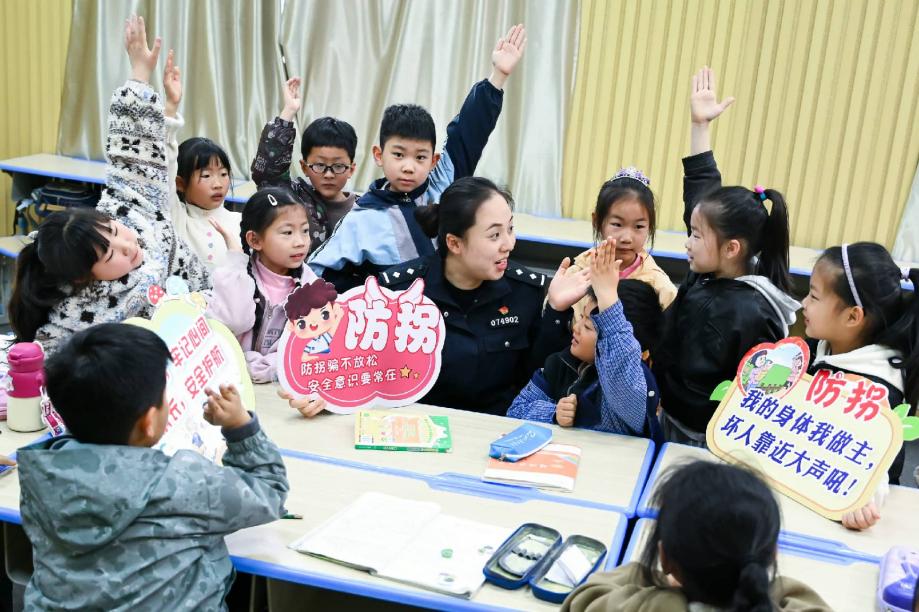
A safety education campaign for children covering anti-abduction awareness and drowning prevention is held by the police bureau in Hexian county, Ma'anshan, east China's Anhui province, April 2. (Photo/Qin Zuquan)
Taken together, it all comes down to China's governance.
The "Chinese sense of safety" is built upon a solid "safety net," Lu said. "It reflects the remarkable effectiveness of China's governance and highlights the institutional strengths of the country," he added.
At a time when the international landscape is marked by turbulence and overlapping risks, China's combination of stability and steady development is drawing attention -- not only for how it supports the lives of its 1.4 billion people, but also for the sense of certainty it offers to the world.
In recent years, from the rise of "China Travel" as a global social media trend, to growing expressions of wanting to "become Chinese," and now to the widespread fascination with the "Chinese sense of safety," more and more foreigners are experiencing the country firsthand, often revising earlier assumptions in the process.
Official data show that in the first quarter of this year, the number of foreign visitors entering China visa-free rose by nearly 30 percent year on year -- another sign that the country's opening up, stability, and sense of safety continue to resonate far beyond its borders.
Photos




Related Stories
- Why is 'Chinese way of security' so 'unbelievable' to many foreign visitors?
- China issues national standard to enhance power bank safety
- China stresses increased efforts to ensure workplace safety, prevent fires
- State Council to oversee probe into fatal explosion in N China's Shanxi Province
- China's top procuratorate stresses severely punishing crimes of human trafficking, endangering workplace safety
- China reports decline in workplace fatalities, enhanced disaster resilience in 2025
- China strengthens efforts to improve workplace safety, fire prevention
- Chinese authorities urge boosted food safety measures during summer, flood season
- Chinese vice premier stresses workplace safety
- China stresses efforts to curb occurrence of serious accidents
Copyright © 2026 People's Daily Online. All Rights Reserved.
