



Wheat seedlings thrive on southern edge of Taklimakan Desert
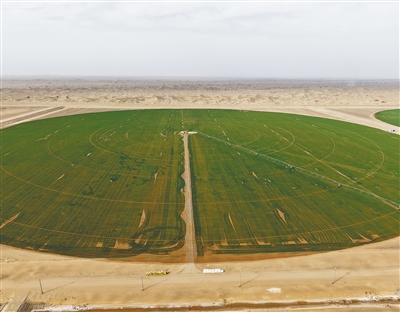
Photo shows a wheat planting base on the southern edge of the Taklimakan Desert, China's largest desert, in northwest China's Xinjiang Uygur Autonomous Region. (People's Daily/Shang Rongzheng)
At a wheat planting base covering more than 8,200 mu (about 547 hectares) in Kunyu city, located on the southern edge of the Taklimakan Desert in northwest China's Xinjiang Uygur Autonomous Region, wheat seedling survival rates remain above 90 percent.
Removing the need for manual irrigation, pointer-type sprinkler irrigation machines, each over 380 meters long, are used to irrigate the fields.
"These machines, alongside our drones that patrol the fields, mean I don't need to spend as much time out here, and the crops are growing well," said Li Daoqing, the planting base manager.
Li explained that the base is divided into 12 round plots, with sprinkler irrigation machines positioned at the center of each field. Once the parameters are set and fertilizers are added, the machines operate automatically, requiring minimal manual labor.
Li explained that the machine, when operating at its maximum speed, takes 9.5 hours to finish one irrigation cycle, as the seedlings need water and nutrients to recover after winter. As the plants grow taller, irrigation and fertilization frequency decline, leading to a corresponding decrease in the machine's rotation speed. By that stage, it takes approximately 36 hours to complete a full cycle around the field.
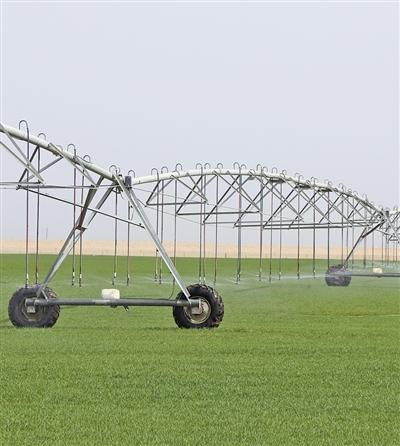
A pointer-type sprinkler irrigation machine waters seedlings at a wheat planting base on the southern edge of the Taklimakan Desert, China's largest desert, in northwest China's Xinjiang Uygur Autonomous Region. (People's Daily/Shang Rongzheng)
Li began using the equipment six months ago. In 2024, Kunyu city flattened continuous stretches of dunes to convert them into farmland, aiming to boost agricultural output and reduce desertification. It entrusted the newly reclaimed land to an agricultural investment company for management.
According to Cui Gangchuang, head of the planting base, his field research found that sprinkler irrigation is more effective in protecting wheat seedlings in arid regions with limited rainfall and frequent sandstorms. Traditional sprinklers often require frequent socket changes during operation, necessitating at least one person to oversee the process. By contrast, the pointer-type sprinkler irrigation system has significantly improved efficiency and reduced the workforce requirements.
Cui explained that the pointers continuously rotate, spraying water to keep the soil moist. During sandstorms, displaced sand quickly settles on the damp soil at the edges of the farmland. Once trees are planted and begin to grow, they will help reduce the impact of sandstorms.
Photos



Related Stories
- Foreign trade of China's Xinjiang surges in first two months
- 5 seconds, 1 tree: Greening the Taklimakan Desert with Chinese tech
- Tech innovation turns Xinjiang's saline-alkali land into "golden desert" for high-value fruit
- Tech innovation turns Xinjiang's saline-alkali land into "golden desert" for high-value fruit
- China's Kuqa City attracts visitors to experience living history
- Agricultural supply manufacturers in China's Xinjiang work at full capacity for spring farming
- Manas in China's Xinjiang steps up improvement of sheep breeding
- Conservationist dedicates decades to protecting Przewalski's horses in NW China's Xinjiang
- Shehuo gala held in Urumqi, NW China's Xinjiang
- Xinjiang Story: Powering up Xinjiang's winter boom
Copyright © 2026 People's Daily Online. All Rights Reserved.
