



New landscape of opening up reflected in world's first port to handle 1.4 billion tons
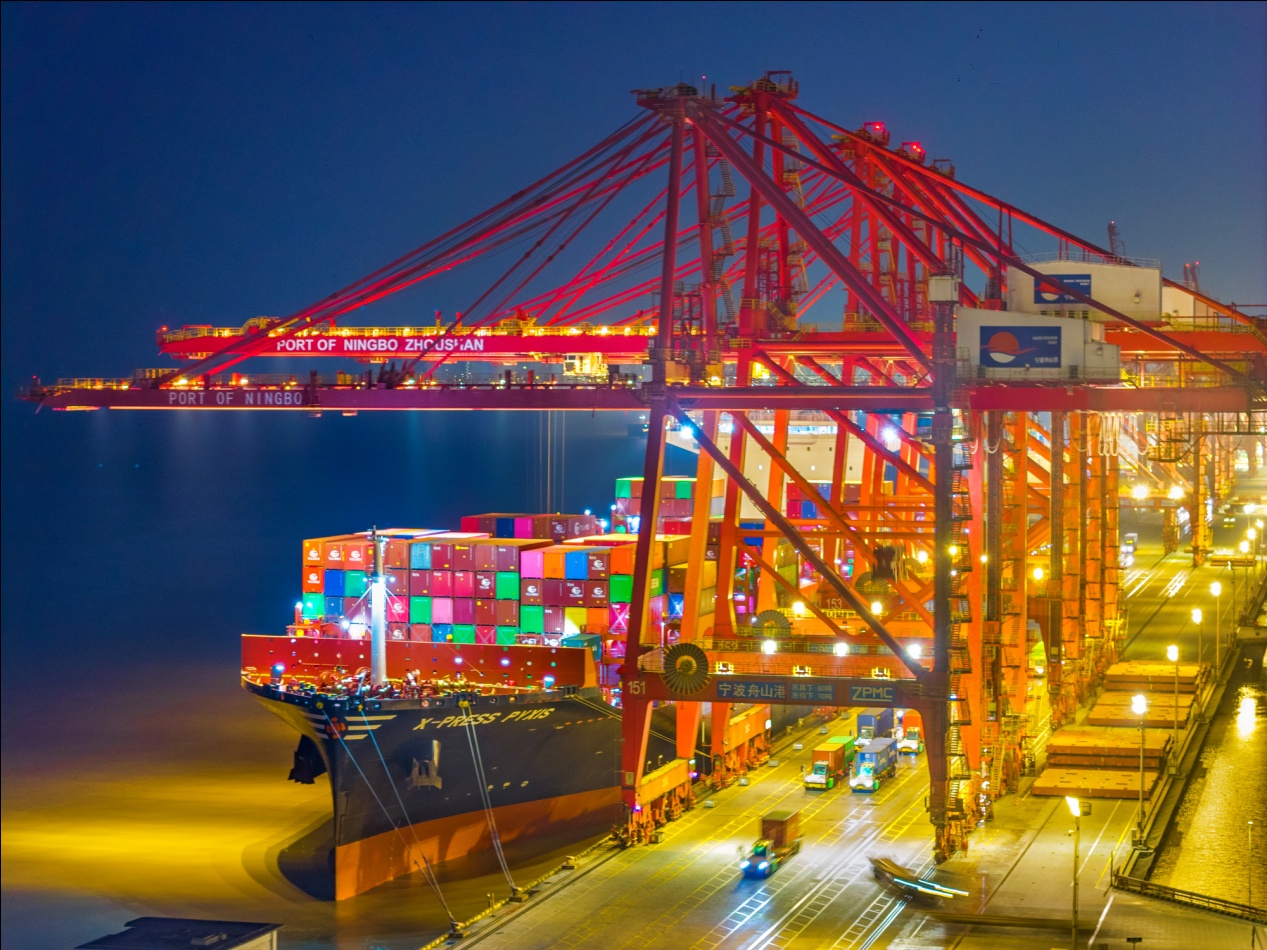
Photo shows a container terminal in the Beicang port area of Ningbo-Zhoushan Port in east China's Zhejiang province. (Photo/Hu Xuejun)
Ningbo-Zhoushan Port, located in east China's Zhejiang province, recently released its 2025 performance results, marking a significant global milestone. The port achieved a total cargo throughput of more than 1.4 billion tons, securing its position as the world's busiest port for 17 consecutive years. It also became the first port globally to enter the "1.4-billion-ton" club.
This accomplishment is particularly noteworthy given the challenging global context of economic headwinds, complex geopolitical dynamics, and shifting trade policies. Achieving this milestone reflects remarkable foresight in strategic planning and a profound shift in development philosophy.
The conditions that once supported an extensive, volume-driven model of imports and exports have changed, making it necessary to develop new ideas to guide development under the new circumstances, Chinese President Xi Jinping stressed when visiting Ningbo-Zhoushan Port during an inspection tour in Zhejiang province in 2020.
Shortly after, he proposed building a new pattern of development that is focused on the domestic economy and features positive interplay between domestic and international economic flows. The development of Ningbo-Zhoushan Port over the past six years exactly mirrors China's new landscape of high-level opening up.
China's trade focus has transitioned from volume expansion to quality enhancement. Ningbo Port's 2025 export data reveals this shift: shipments of the "new trio" (new energy vehicles, lithium-ion batteries, and photovoltaic products) rose 76.3 percent year on year, while exports of industrial robots surged 113 percent. Concurrently, high-tech imports grew 13.5%, demonstrating China's upgraded market opportunities and expanding global value.
Despite pandemic disruptions and tariff escalations, Ningbo-Zhoushan Port achieved a historic breakthrough with container throughput exceeding 40 million TEUs (twenty-foot equivalent units) . New energy vehicles illustrate this trend. Exports through Ningbo Port rose 305.8 percent year on year, with more than 700 vehicles shipped overseas every day on average.
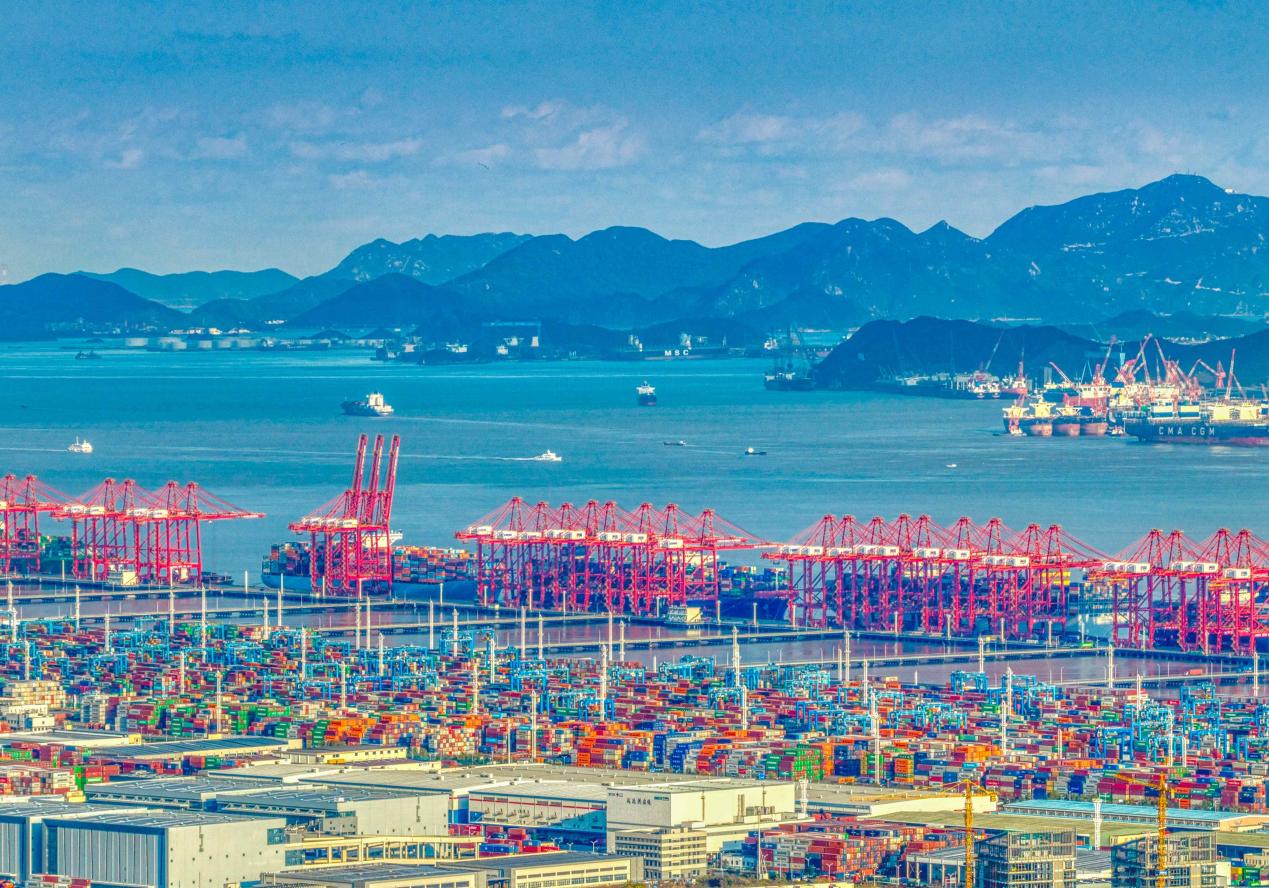
Photo shows container yards and a terminal in the Meishan port area of Ningbo-Zhoushan Port in east China's Zhejiang province. (Photo/Hu Xuejun)
Behind these figures lies the solid strength of highly competitive industrial clusters. In 2025, Ningbo newly recognized 2,666 high-tech enterprises in its first batch alone, with cluster effects continuing to gain momentum and driving comprehensive upgrading from technology to products and along the entire industrial chain. A large number of enterprises are connecting with global markets via Ningbo-Zhoushan Port, securing their position in global industrial chains through strong competitiveness.
The shift from an opening-up model centered on the flow of production factors to one that emphasizes rule-setting and standards alignment highlights the steady progress of institutional opening up.
From exploring rules for cross-border data flows in bulk commodity trading to improving mechanisms for international maritime arbitration and commercial mediation, Ningbo-Zhoushan Port -- backed by the China (Zhejiang) Pilot Free Trade Zone -- has remained at the forefront of institutional opening up.
Today, the port is working with Germany's ports of Hamburg and Wilhelmshaven, as well as Spain's Port of Valencia, to jointly build green shipping corridors and explore unified green standards "from terminal to terminal." It has also established platforms such as the Maritime Silk Road Port Cooperation Forum to promote international cooperation among friendly ports. From proactive alignment to joint standard-setting, China's voice and influence in international rule-making continue to grow.
The evolution from a "cargo transport channel" to an "opening-up hub" underscores the expanding network of mutually beneficial partnerships.
On Jan. 8, the container vessel MSC Jessinia, on its maiden voyage of a new Australia-bound route, berthed at the Chuanshan Port Area of Ningbo-Zhoushan Port. The port now operates more than 300 shipping routes, connecting over 700 ports in more than 200 countries and regions worldwide. Its port connectivity index consistently ranks second globally.
As the port's global partnerships expand, market structures are diversifying. In 2025, Zhejiang recorded import-export growth with over 180 countries and regions. Its trade with Belt and Road partner countries exceeded 3 trillion yuan ($430.19 billion) for the first time, up 8.7 percent year on year.
On a broader scale, China is strengthening links with more partners, expanding the convergence of shared interests, and injecting fresh momentum into economic globalization through opening up and cooperation.
Ningbo-Zhoushan Port offers a clear case in point: China's resolve to open up remains unwavering, despite rising unilateralism and protectionism globally. Its openness is becoming more robust, and it is creating new opportunities for the world.
Photos



Related Stories
- Cargo throughput at Huanghua Port reaches 366 million tonnes in 2025
- Cargo throughput at Tangshan Port up 2.53 percent year on year
- Intelligent robots reshape operations at Qingdao Port in E China's Shandong
- China's trade corridor sees surge in cargo volume in 2025
- China's landmark trade corridor cargo volume hits record high in 2025
- Ningbo-Zhoushan Port sees cargo throughput surpassing 1.4 billion tonnes in 2025
- Major east China port handles 1.4 bln tonnes of cargo in 2025
- Beibu Gulf Port of China's Guangxi sees annual container throughput exceed 10 million TEUs
- Shandong's port cargo throughput exceeds 1.9 bln tonnes in 2025
- China-Mongolia border port sees rise in cross-border traffic
Copyright © 2026 People's Daily Online. All Rights Reserved.
