



Intelligent robots reshape operations at Qingdao Port in E China's Shandong
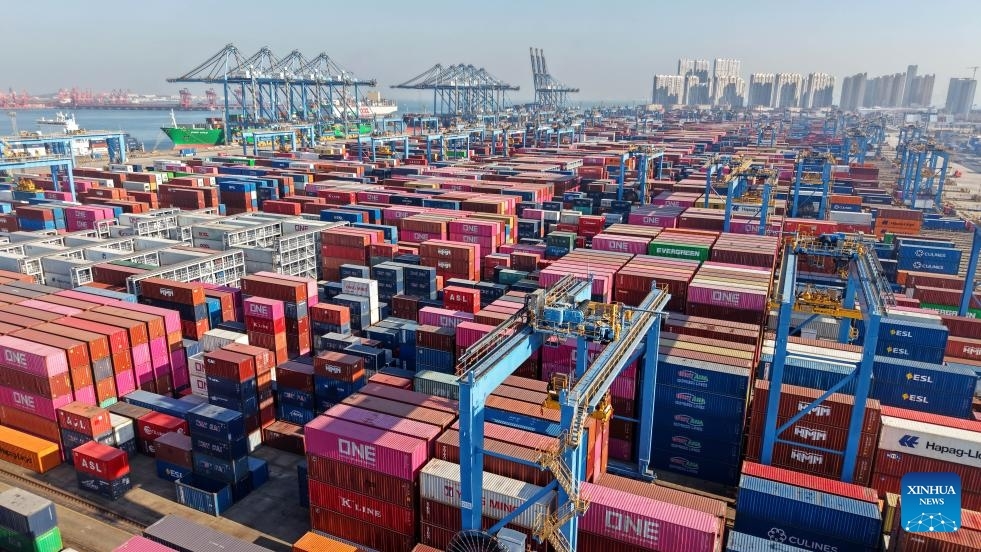
A drone photo taken on Dec. 4, 2025 shows containers waiting for transshipment at the Qianwan Container Terminal of Qingdao Port in east China's Shandong Province. (Xinhua/Li Ziheng)
Intelligent robots are transforming operations at Qingdao Port, a subsidiary of Shandong Port Group, in east China's Shandong Province.
In recent years, the port has developed and deployed nearly 20 types of intelligent robots, charting a path of high-quality development through smart transformation and upgrading. In 2025, the century-old port became one of China's first national pilot bases for artificial intelligence applications in the transportation sector—the only one in the port industry—turning itself into a testing ground for scientific and technological innovation in Chinese ports.
Using shore power when vessels berth is a crucial measure for ports to pursue green development, reducing both fuel consumption and emissions. However, inadequate cable length, limited mobility and complicated operations have long constrained the efficiency of ship-to-shore power connections and berth planning.
"The wharf environment is complex, and with no ready-made equipment available, we resolved to develop our own high-voltage shore power robot," said Zhang Feng, deputy general manager of Qingdao New Qianwan Container Terminal Co., Ltd.
The research team relocated their office to the operational site. After sustained efforts, they successfully developed a new cable-reeling device with twice the cable length of comparable products while reducing its structural volume by 30 percent.
After three months, Qingdao Port's first high-voltage shore power robot was developed. It can navigate flexibly through narrow spaces between quay cranes and vessels, completing cable connections quickly and accurately even when ships berth with positional deviations. In 2025, the robot completed tasks for over 200 vessels with a utilization rate exceeding 60 percent, helping the automated terminal's annual shore power usage surpass 6 million kilowatt-hours, a year-on-year increase of over 85 percent.
Notably, this innovation has since been adopted by multiple ports nationwide, effectively resolving ship shore power connection challenges and providing a replicable solution for the green transformation of ports across China.
Qingdao Port also developed an intelligent tallying robot capable of autonomous movement and panoramic perception, allowing tally clerks to avoid exposure to wind and sun while achieving fully visible, controllable and traceable operations.
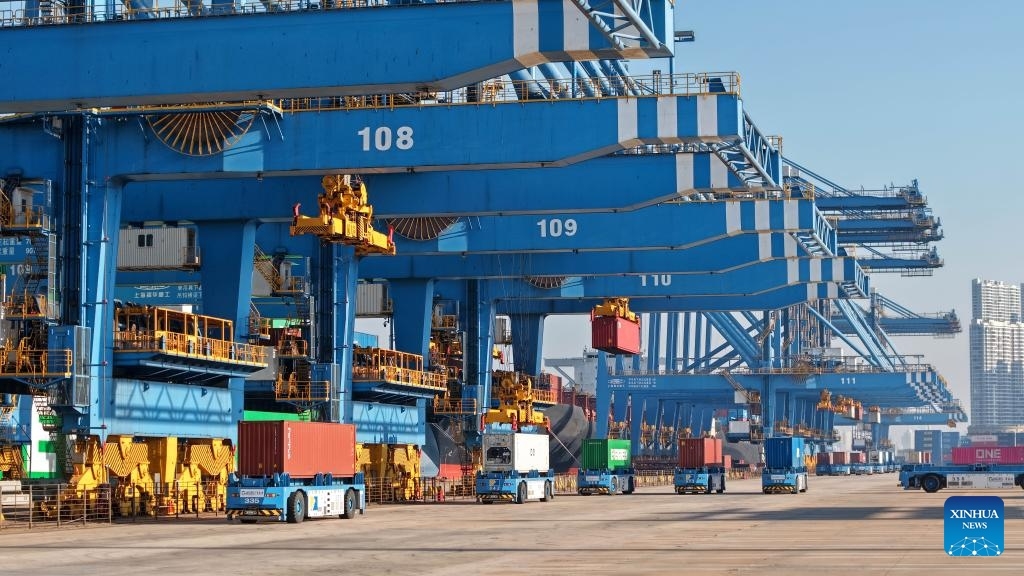
A drone photo taken on Dec. 4, 2025 shows automated guided vehicles transporting containers at a fully automated container terminal of Qingdao Port, east China's Shandong Province. (Xinhua/Li Ziheng)
The research team at Qingdao Ocean Shipping Tally Co., Ltd. adopted a tracked system design. Zang Wensheng, manager of the company's information technology department, led the team to work on-site, repeatedly observing road conditions, adjusting structures and optimizing materials. After dozens of attempts, they developed a high-traction track system that successfully adapted to various surfaces, including concrete and steel plates, achieving "all-scenario mobility."
The team also equipped the robot with multiple independently adjustable omnidirectional cameras and developed intelligent visual scheduling algorithms to automatically recognize cargo markings at different positions, training the system on data from tens of thousands of cargo identifiers. They built a triple-safeguard system using wired, wireless and self-organizing networks, ensuring that even if conventional wireless signals are interrupted, backup links immediately take over, guaranteeing real-time, secure data transmission and seamless operations.
"In the past, I walked over 20,000 steps during a single shift. Now I can monitor multiple work sites effortlessly. Labor intensity has dropped dramatically, while accuracy and efficiency have improved significantly," said Gao Fangyu, who has spent most of a career working in tallying at Qingdao Port. Since the intelligent tallying robot was deployed, tallying time per shipment has been reduced by 30 percent, personnel exposure to field risks has decreased by over 90 percent, and information accuracy has approached 100 percent.
At the grain terminal in Qingdao Port's Dongjiakou port area, intelligent inspection robots have provided vital support. They conduct automatic inspections daily along preset routes at more than three times the frequency of manual inspections, reducing manpower input by 40 percent and belt conveyor failures by 25 percent, ensuring continuous and stable grain transport while cutting both labor and maintenance costs.
Qingdao Port's intelligent transformation is injecting strong momentum into building China's strength in transportation and revitalizing the port with new vitality in the global shipping sector.
Photos



Related Stories
- China's trade corridor sees surge in cargo volume in 2025
- China's landmark trade corridor cargo volume hits record high in 2025
- Ningbo-Zhoushan Port sees cargo throughput surpassing 1.4 billion tonnes in 2025
- Major east China port handles 1.4 bln tonnes of cargo in 2025
- Beibu Gulf Port of China's Guangxi sees annual container throughput exceed 10 million TEUs
Copyright © 2026 People's Daily Online. All Rights Reserved.
