



Guizhou's agricultural processing rate surges to 70 pct over five years
Output from the primary sector surpassed 300 billion yuan ($43 billion) in southwest China's Guizhou Province over the past five years, while the agricultural processing rate rose from 51 percent in 2020 to 70 percent in 2025, according to a provincial government work report delivered at the fourth session of the 14th Guizhou Provincial People's Congress, which opened in Guiyang on Jan. 27
The agricultural processing rate is a key indicator of overall production capacity. Over the past five years, Guizhou has shifted its approach to agricultural development, improving efficiency in agriculture, boosting farmers' incomes and injecting new vitality into rural areas.
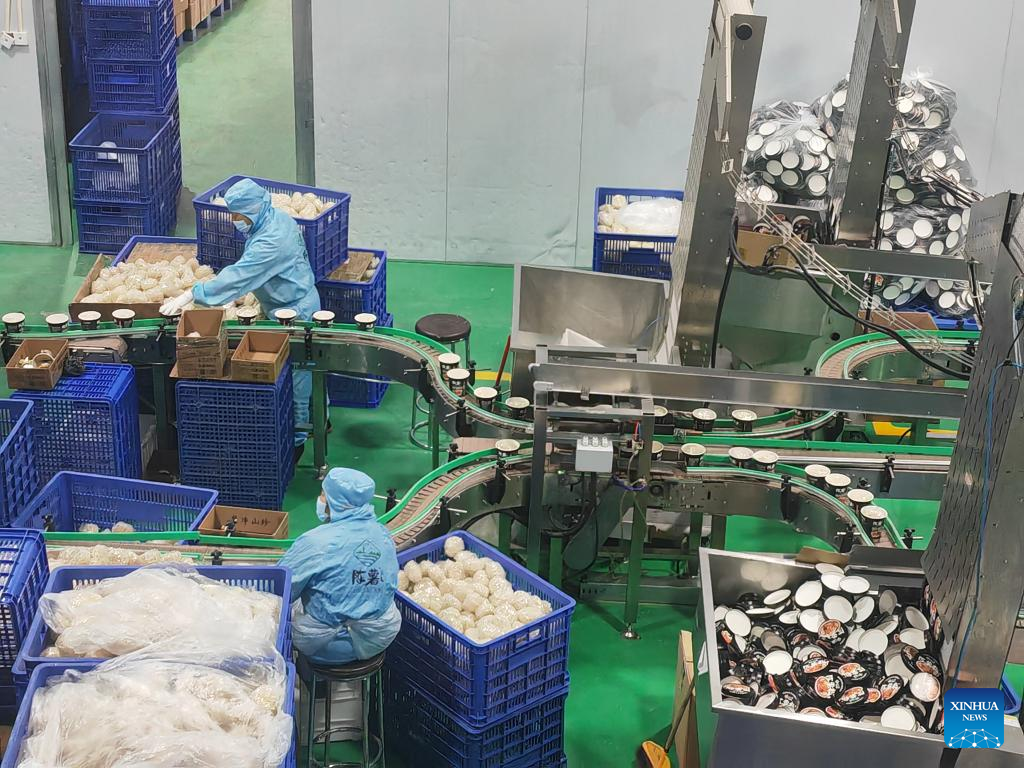
Workers pack sweet potato noodles at a production line of a rural food factory in Sinan County, southwest China's Guizhou Province, Feb. 11, 2025. (Xinhua/Xiang Dingjie)
The province implemented responsibility systems for farmland protection and food security, and launched initiatives to enhance grain and oil production, storage and processing capabilities. For five consecutive years, Guizhou exceeded national targets for grain planting area and output, with grain yield per unit area recording an average annual growth rate of 1.9 percent. The province fulfilled its grain and oil reserve targets ahead of schedule during the 14th Five-Year Plan period (2021-2025).
Looking ahead to the 15th Five-Year Plan period (2026-2030), the report sets an ambitious target for Guizhou to post an average annual growth rate of about 3.5 percent in agricultural output.
In 2026, Guizhou will prioritize improving the quality and efficiency of its agricultural sector. To strengthen the supply of major agricultural products, the province will vigorously develop modern facility-based agriculture and smart agriculture. It will consolidate and upgrade 800,000 mu (53,333 hectares) of vegetable production areas and step up efforts to address winter and spring shortages of tomatoes, peppers, potatoes and eggplants.
The province will also ensure stable pork and livestock supplies, advance construction of six facilities each raising 1 million laying hens and promote integrated dairy farming and processing.
In developing specialty agricultural industries, Guizhou will focus on variety improvement, quality enhancement, brand building, standardized production and market expansion. The province will actively develop its signature industries, including tea, chili peppers, beef cattle, traditional Chinese medicinal herbs and edible fungi.
Tailoring measures to local conditions, it will accelerate development of the non-timber forest economy, strengthen the forestry industry and continue upgrading deep-processing capabilities for agricultural products. Output value from specialty agricultural industries is expected to grow by about 4 percent.
Photos



Related Stories
- Plum blossom garden opens to public in Guian New Area, SW China
- Football star Ronaldinho to visit SW China's Guizhou for Village Super League
- Rare black-necked cranes flock to SW China's Guizhou in record numbers
- 100 years of health | Meitan's quiet path to longevity
- China's Guiyang renovates old commercial zones to boost consumption
- 'Southern Snow Town' draws tourists to Guizhou Province
- How SW China mountain county stitches its way into global game
- Guiyang-Pingtang Expressway to operate in southwest China's Guizhou
- Zhaoxing Dong village sees influx of tourists as Dong New Year approaches
- Ethnic New Year celebrations in China draw global visitors
Copyright © 2026 People's Daily Online. All Rights Reserved.
