



County in SW China's Sichuan cultivates thriving konjac industry
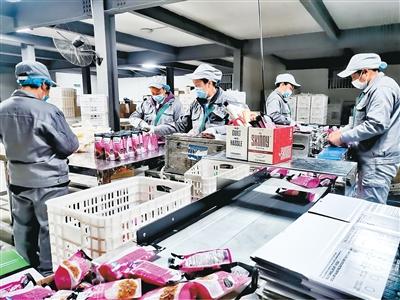
Workers are busy packaging konjac jelly products at a workshop of Sichuan Sentaiyuan Biotechnology Co., Ltd. in Muchuan county, Leshan city, southwest China's Sichuan Province. (Photo courtesy of the convergence media center of Muchuan county)
In Muchuan county, Leshan city, southwest China's Sichuan Province, konjac has been processed into over 100 products, including konjac rice, konjac noodles, konjac knots and konjac jelly, and exported to more than 60 countries and regions.
In Shuiyue village, Dibao township, Muchuan county, Deng Changwen has planted 30 mu (2 hectares) of konjac, making him a well-known major grower.
Konjac is particularly demanding in terms of its growing environment. Wang Mingcai, another villager in Shuiyue, has been growing konjac for three years and has accumulated considerable experience. "To help konjac thrive, you first need good varieties," he said.
"In recent years, agricultural and rural authorities have vigorously promoted new bulbil konjac varieties such as Muyu No. 1, which offer stronger resistance to droughts and floods," Deng said.
At the county's bulbil konjac tissue culture laboratory center, newly cultivated konjac seedlings are sprouting tender shoots. "In recent years, we've collaborated with institutions such as Southwest University and the Leshan Academy of Agricultural Sciences to breed new varieties, including Muyu No. 1. These varieties are now in the planting trial stage and will soon be widely promoted," said Zhou Ming, the center's director.
When Wang first began growing bulbil konjac, he was at a loss due to a lack of experience. At this critical moment, the Muchuan Konjac Association organized experts to visit fields and teach cultivation techniques.
Through training programs organized by agricultural and rural authorities and the Muchuan Konjac Association in recent years, Wang and Deng have mastered a range of new techniques.
In recent years, a konjac industry cluster has gradually taken shape in Muchuan county.
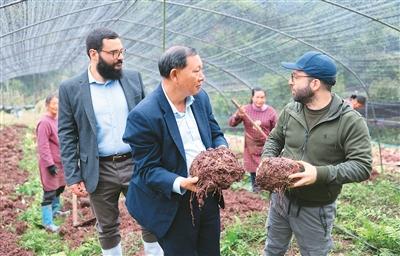
Foreign merchants experience konjac harvesting in a greenhouse at a konjac planting base in Muchuan county, Leshan city, southwest China's Sichuan Province. (Photo/Lan Xiang)
The county has built standardized konjac planting bases by launching policies to support farmers in constructing steel-frame greenhouses, building drainage and irrigation channels, and installing drip irrigation equipment.
"We provide cost subsidies of about 30 percent for farmers building greenhouses, as well as subsidies based on storage capacity for those constructing pools," said Lie Shazi, deputy director of Muchuan county's agriculture and rural affairs bureau. Over the past five years, the local government has invested more than 60 million yuan (about $8.51 million) in konjac base construction, leveraging over 400 million yuan in private capital.
Muchuan county has also focused on mechanism innovation. To build a konjac planting base, Huayuan village in Dibao township established a village collective enterprise to invest in road construction, with government departments providing financial subsidies. "We encourage village collective investment to strengthen the collective economy," Lie said. Muchuan's standardized konjac planting bases now cover more than 11,000 mu.
The final measure is technology empowerment. In the county's China Konjac Science and Technology Demonstration Park, greenhouses host variety displays and seed breeding.
"For newly bred varieties, we conduct planting trials in the park," said Liao Yixing, secretary-general of the Muchuan Konjac Association. The park is also exploring new planting methods, such as intercropping corn with konjac, to increase yields per unit area.
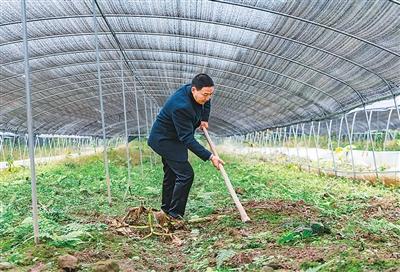
Deng Changwen, a major konjac grower, harvests konjac in Shuiyue village, Dibao township, Muchuan county, Leshan city, southwest China's Sichuan Province. (Photo/Yang Xiong)
With industrial support, Muchuan konjac has become a national geographical indication product. Brand building is also advancing.
An intellectual property operation center will soon be established in the county. "Once completed, the center will provide unified management and professional operation of konjac-related intellectual property rights in the region, further enhancing the Muchuan konjac brand," Lie said.
Annual konjac food industry conferences have been held consecutively. "Each year, the conference attracts numerous food companies and sales firms from Europe, America and elsewhere to Muchuan to learn about konjac cultivation and processing," Liao said.
Today, Muchuan's konjac planting area has reached 35,000 mu, with comprehensive output value exceeding 500 million yuan. A complete industrial chain led by leading enterprises for deep konjac processing and export has also taken shape.
Inside Sichuan Sentaiyuan Biotechnology Co., Ltd. in Muchuan, multiple konjac deep-processing production lines are in operation. The company has built a digital production workshop. "We've developed over 100 konjac products and can process more than 10,000 tonnes of fresh konjac annually," said Liu Lei, the company's head.
"We also organize teams to continuously develop new products," Liu noted, adding that the company has applied for more than 40 technical patents of various types.
With the support of professional trading companies, the firm's export volume has exceeded $20 million for consecutive years, Liu said.
Photos
Related Stories
- 2025 Sichuan Winter Tourism Season kicks off
- China's Sichuan province seeks partnerships in Bulgaria
- Qiang New Year celebrated in Wenchuan, China's Sichuan
- Qiang New Year festival celebrated in SW China's Sichuan
- Yading scenic spot in China's Sichuan in best viewing season
- SW China's Ganzi Tibetan Autonomous Prefecture boosts tourism with natural scenic advantages
- Young people swap desk plants for miniature landscapes as niche hobby turns bestseller
- 8th World Sichuan Cuisine Conference held in Leshan, SW China
- Rural courier site in SW China's Sichuan hits 83,000 daily parcels
- Acrobatic performance staged at Jinqin Tea House in Chengdu, China's Sichuan
Copyright © 2026 People's Daily Online. All Rights Reserved.
