


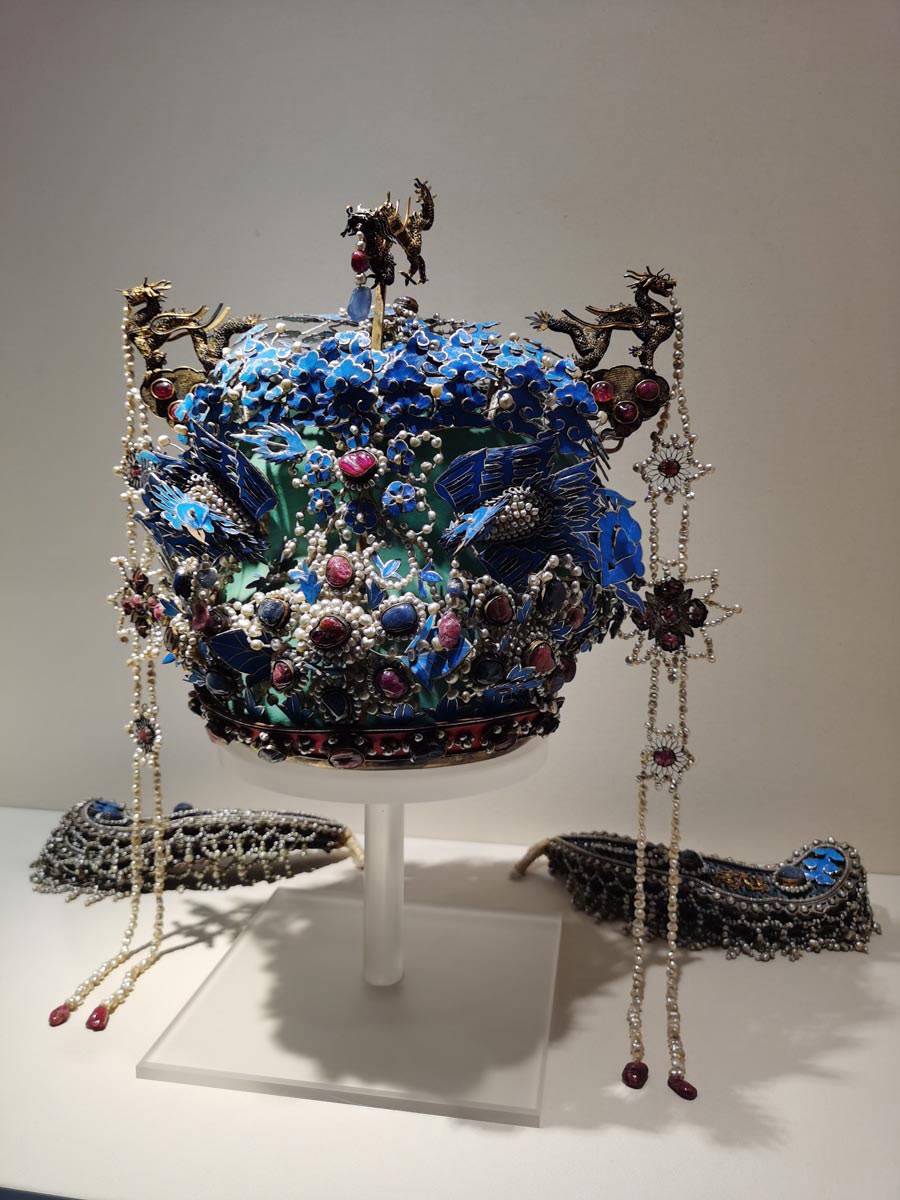
The coronet Dai Zhenzhen can be seen wearing at her wedding is a replica of a Ming Dynasty relic, featuring three dragons and two phoenixes. [Photo provided to China Daily]
The ceremony lasted 30 minutes, and, like a seasoned period-film director who knows how to fictionalize history for dramatic effect, Dai tinkered with a few of the details.
"In real life the throwing of dried longan and peanuts was performed by the bride and her parents in the bridal chamber, but I found the ritual so fascinating that I decided it should be performed in public."
One ritual performed behind closed doors at her wedding, in line with reality, was jiaomian, in which the bride clears any facial hair she has, which is said to suggest a "smooth and happy marriage". Dai did this before she left home.
"In the main ceremony I wore an embroidered robe with a dark indigo vest, a phoenix coronet, which ordinary people wore only at weddings during the Ming Dynasty," Dai says.
The coronet was a replica of the one owned by Ming empress Xiaojing (1565-1611), called sanlongliangfengguan, meaning a coronet of three dragons and two phoenixes.
 |  |

 Award-winning photos show poverty reduction achievements in NE China's Jilin province
 People dance to greet advent of New Year in Ameiqituo Town, Guizhou
 Fire brigade in Shanghai holds group wedding
 Tourists enjoy ice sculptures in Datan Town, north China
 Sunset scenery of Dayan Pagoda in Xi'an
 Tourists have fun at scenic spot in Nanlong Town, NW China
 Harbin attracts tourists by making best use of ice in winter
 In pics: FIS Alpine Ski Women's World Cup Slalom
 Black-necked cranes rest at reservoir in Lhunzhub County, Lhasa
 China's FAST telescope will be available to foreign scientists in April