

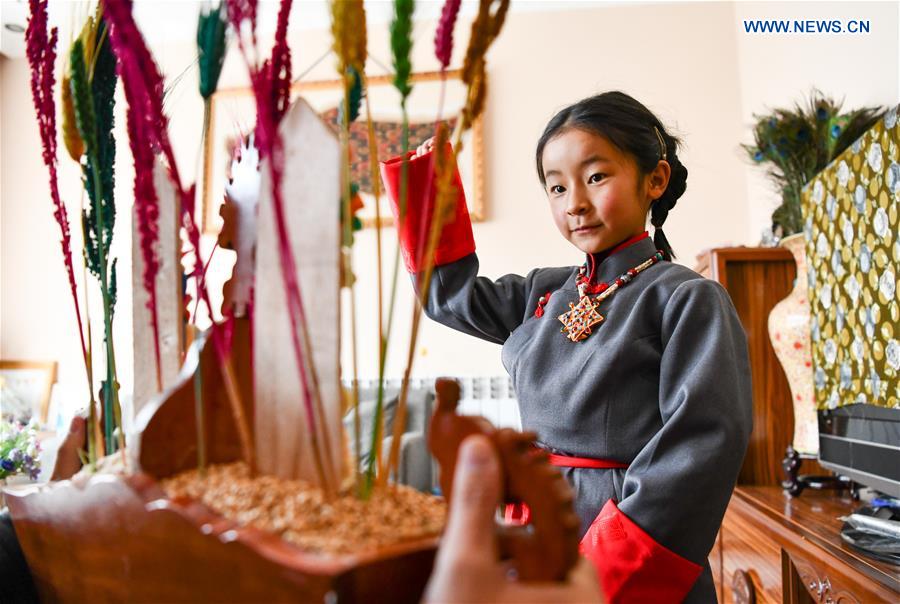
A child wearing traditional costumes eats traditional food for the Tibetan New Year in Lhasa, southwest China's Tibet Autonomous Region, Feb. 24, 2020. The Tibetan New Year, a traditional festival of the Tibetan ethnic minority, falls on Monday this year. China is in a tough battle against the novel coronavirus outbreak, which has claimed 2,592 lives and infected 77,150 on the Chinese mainland by the end of Feb. 23. Though Tibet only reported one confirmed case and has not seen new reports of the novel coronavirus infection for over three weeks, local authorities are still on high alert. Earlier on Feb. 19, authorities in Tibet called on citizens not to hold or participate in group activities during the Tibetan New Year. (Xinhua/Jigme Dorje)
LHASA, Feb. 24 (Xinhua) -- Putting on new festive costumes and setting the table for a big New Year's feast, Yangjen Drolkar and his wife in Lhasa, southwest China's Tibet Autonomous Region, are ready to celebrate the Tibetan New Year, which falls on Monday, in the traditional manner.
Only the room seems emptier.
"We decided not to let my son and his child come over to celebrate together," said Yangjen Drolkar. "Staying at home is making a contribution amid the epidemic. Everyone in the country being safe and sound beats anything else in the new year."
China is in a tough battle against the novel coronavirus outbreak, which has claimed 2,592 lives and infected 77,150 on the Chinese mainland by the end of Feb. 23.
Though Tibet only reported one confirmed case and has not seen new reports of the novel coronavirus infection for over three weeks, local authorities are still on high alert.
Earlier on Feb. 19, authorities in Tibet called on citizens not to hold or participate in group activities during the Tibetan New Year, a traditional festival of the Tibetan ethnic minority.
The district-level governments under the administration of Lhasa suspended gathering activities during the festival.
And the city of Shannan in the region posted an initiative on its official account on WeChat, a popular Chinese social media platform, calling on its citizens not to visit relatives or friends, nor to hold gatherings during the Tibetan New Year.
Nyima Tsering, a volunteer in a community in Lhasa's Chengguan District, is busy writing down a long list of commodities purchased by local residents.
Over 2,700 people from 934 households live in the community, and the unified ordering service can help reduce personnel flow amid the epidemic.
In addition, a total of 231 direct selling stores and vehicles have been set up in Lhasa and nearby regions for the convenience of citizens buying daily necessities during the festival.
Local residents even amused themselves by making zanba, a traditional Tibetan staple food of roasted barley flour as part of the celebration.
"Though we're geographically separated, our hearts are connected. A call or a message is enough to express our blessings to each other," said Nyima Tsering, who extended new year greetings to relatives in other places via WeChat.
 |

 Award-winning photos show poverty reduction achievements in NE China's Jilin province
 People dance to greet advent of New Year in Ameiqituo Town, Guizhou
 Fire brigade in Shanghai holds group wedding
 Tourists enjoy ice sculptures in Datan Town, north China
 Sunset scenery of Dayan Pagoda in Xi'an
 Tourists have fun at scenic spot in Nanlong Town, NW China
 Harbin attracts tourists by making best use of ice in winter
 In pics: FIS Alpine Ski Women's World Cup Slalom
 Black-necked cranes rest at reservoir in Lhunzhub County, Lhasa
 China's FAST telescope will be available to foreign scientists in April