

 |
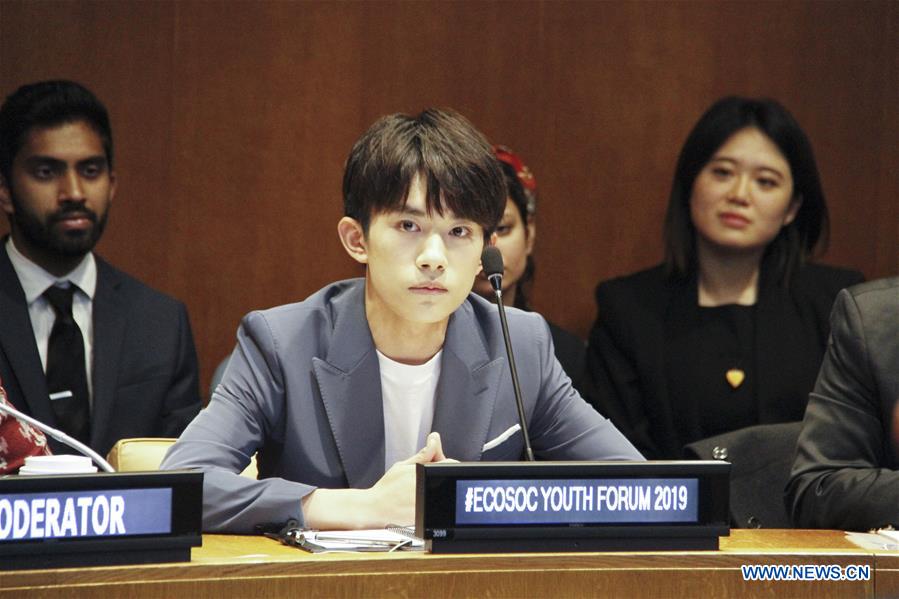
| Chinese singer Yi Yangqianxi (front), who is a World Health Organization (WHO) China special envoy for health, attends the Asia and Pacific session of the United Nations Economic and Social Council Youth Forum, at the UN headquarters in New York, April 8, 2019. Yi Yangqianxi on Monday shared his vision of promoting health among young people, citing his experiences working with the World Health Organization (WHO). (Xinhua/Xie E) |
UNITED NATIONS, April 8 (Xinhua) -- Chinese singer Yi Yangqianxi on Monday shared his vision of promoting health among young people, citing his experiences working with the World Health Organization (WHO).
At the Asia and Pacific session of the ongoing UN Economic and Social Council Youth Forum, Yi said that to build a healthier society, "we need to start with our own personal action, make healthy choices" and "we can make an effort to reach out to those who need support, including children and teenagers."
As a WHO China special envoy for health, the teenage idol has been working with the UN health agency in China since 2017 on promoting healthy lifestyles among young people. He has also been working through his fund since 2017 to support disadvantaged children.
Speaking to his fellow forum participants, he said "we are very lucky to be here" for speaking "not only for ourselves but also for children and teenagers who have difficulty participating fully in their society because of illness (or) lack of resources."
In addition, he said there are almost 7 million "left-behind children" in rural China, citing official data, and that many of them are facing physical and mental health problems in their daily lives.
He added that the Child Companion Plan, a project he champions, tries to address these issues.
Yi called upon the international community to work together toward the goal. "Our goal is give all these children a better and healthier future."
 |

 Award-winning photos show poverty reduction achievements in NE China's Jilin province
 People dance to greet advent of New Year in Ameiqituo Town, Guizhou
 Fire brigade in Shanghai holds group wedding
 Tourists enjoy ice sculptures in Datan Town, north China
 Sunset scenery of Dayan Pagoda in Xi'an
 Tourists have fun at scenic spot in Nanlong Town, NW China
 Harbin attracts tourists by making best use of ice in winter
 In pics: FIS Alpine Ski Women's World Cup Slalom
 Black-necked cranes rest at reservoir in Lhunzhub County, Lhasa
 China's FAST telescope will be available to foreign scientists in April