
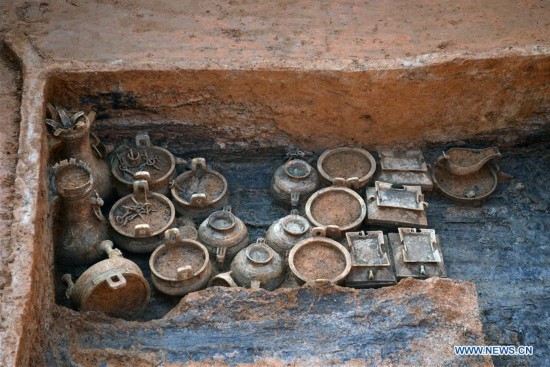
File photo shows bronze vessels unearthed in the archaeological site in Jingshan County, central China's Hubei Province. Over half a century ago, nearly 100 pieces of bronze vessels were unearthed in the site, leading to the discovery of an unrecorded ancient state -- Zeng State, dating back about 2,700 years. As more relics were uncovered, the mystery of the state gradually came to light. Last year, a bronze pot was discovered, proving that metal used to be transported from the south to the capital of the Zhou dynasty in the north. Archeologists believe that the large scale of bronze relics found in the remains indicates the Zeng State was most probably in charge of the smelting, production and transportation of bronze utensils of the Zhou Dynasty. The findings in Jingshan site was announced one of the six greatest archeological discoveries of the country in 2017 by the Chinese Academy of Social Sciences. The six findings contain information on human activity over a time span of more than 40,000 years. (Xinhua)
BRONZE FOUND
Over half a century ago, nearly 100 pieces of bronze vessels were unearthed in Jingshan County in central China's Hubei Province, leading to the discovery of an unrecorded ancient state -- Zeng State, dating back about 2,700 years.
As more relics were uncovered, the mystery of the state gradually came to light. Last year, a bronze pot was discovered, proving that metal used to be transported from the south to the capital of the Zhou dynasty in the north.
Archeologists believe that the large scale of bronze relics found in the remains indicates the Zeng State was most probably in charge of the smelting, production and transportation of bronze utensils of the Zhou Dynasty.

File photo shows tombs in the archaeological site in Jingshan County, central China's Hubei Province. Over half a century ago, nearly 100 pieces of bronze vessels were unearthed in the site, leading to the discovery of an unrecorded ancient state -- Zeng State, dating back about 2,700 years. As more relics were uncovered, the mystery of the state gradually came to light. Last year, a bronze pot was discovered, proving that metal used to be transported from the south to the capital of the Zhou dynasty in the north. Archeologists believe that the large scale of bronze relics found in the remains indicates the Zeng State was most probably in charge of the smelting, production and transportation of bronze utensils of the Zhou Dynasty. The findings in Jingshan site was announced one of the six greatest archeological discoveries of the country in 2017 by the Chinese Academy of Social Sciences. The six findings contain information on human activity over a time span of more than 40,000 years. (Xinhua)
 |  |

 Award-winning photos show poverty reduction achievements in NE China's Jilin province
 People dance to greet advent of New Year in Ameiqituo Town, Guizhou
 Fire brigade in Shanghai holds group wedding
 Tourists enjoy ice sculptures in Datan Town, north China
 Sunset scenery of Dayan Pagoda in Xi'an
 Tourists have fun at scenic spot in Nanlong Town, NW China
 Harbin attracts tourists by making best use of ice in winter
 In pics: FIS Alpine Ski Women's World Cup Slalom
 Black-necked cranes rest at reservoir in Lhunzhub County, Lhasa
 China's FAST telescope will be available to foreign scientists in April