German powerhouse hails benefits of China as the nation strives to lift up manufacturing industry
Sitting on a total GDP of more than $11.3 trillion, which keeps rising at an estimated rate of 6.8 percent by World Bank, China’s every move matters and, more often than not, can cause a ripple effect across the globe.
Even the nation’s shopping habits are reshaping consumption patterns worldwide, including the participation of the annual online shopping spree on November 11, or “Singles Day,” which was started in 2009 by the $60-billion e-commerce giant Alibaba.
But China’s ambitions go far beyond such bags of tricks. In 2013, it introduced the Belt and Road development strategy, which is becoming a global catchphrase.
On Siemens’ annual Innovation Day event at its Munich headquarters, the term was raised by CEO Joe Kaeser.
“Now China is going to the export and the regions will be ‘Belt and Road.’ I will pretty much bet on this concept going forward. It is for every country, every business, every person, and every company. China is a good place to be and what we’ve been doing is paying out,” Kaeser said at the opening forum on December 15.
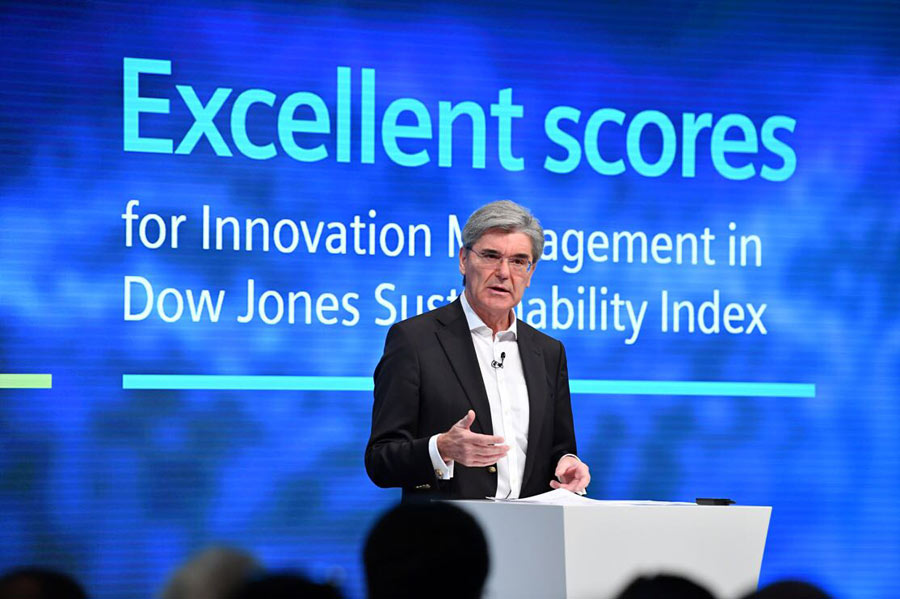
(CEO Joe Kaeser addresses the Siemens Innovation Day on Dec.15 in Munich. Photo courtesy of Siemens)
The Belt and Road Initiative taps the second phase of a country’s development as it emerges from energy development and moves on to infrastructure and manufacturing industries to better quality of life, observed Siemens CTO Roland Busch.
“It’s more than just connecting infrastructure, because people can build upon the grid connection to create value chains for higher, greater value industries afterward,” he said.

(CTO Roland Busch at the Siemens Innovation Day event on Dec.15 in Munich. Photo courtesy of Siemens)
In an interview with People’s Daily Online on December 15, Busch pointed out that China’s manufacturing industry was lagging behind its service industry, which was on a faster track.
On the digital economy front, China is no doubt a world leader – and an enormous one, whose online retail trade volume equals the combined total of France, Germany, Japan, the UK, and the US, according to a latest McKinsey report, which also found that China attracted $77 billion in venture capital investment in 2014-16, mostly in digital technologies.
Meanwhile, China has stressed that the government has never shifted its focus away from the real economy and it expects the digital economy to support real growth, Miao Wei, minister of the Ministry of Industry and Information Technology, said in an article published in the People’s Daily earlier in December.
A similar pattern is observed in Germany and other nations too, said Busch.
The digital economy in Germany is on the fast track, with a double-digit growth rate. The total online retail trade volume exceeded $52 billion in 2016. Market research analysts predict that 30 percent of the brick-and-mortar retailers will close their doors by 2020, Der Spiegel reported.
According to data by Accenture, one-fifths of the world’s GDP came from digital technology, capital, and services, which will generate $2 trillion of additional global economic output by the year 2020.
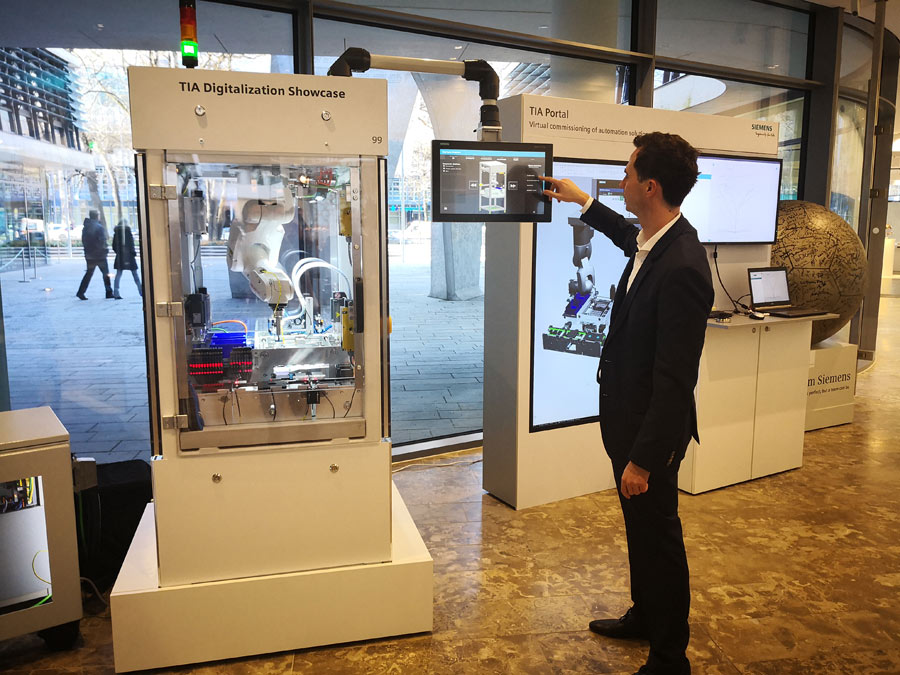
(An engineer operates on Siemens TIA software showcase on Dec.15 in Munich. Photo: Jiang Jie/People's Daily Online)
Yet, like other economies including Germany, many Chinese manufacturing companies have been slow to embrace digitization, Jan Mrosik, CEO of Siemens Digital Factory Division, told People’s Daily Online. “It is very important for them and this is why the government-initiated ‘Made in China 2025’ helps them to learn about digitization and get going in this regard.”
Unveiled in 2015, “Made in China 2025” marked the first 10-year action plan designed to transform China from the “world’s factory” into a manufacturing leader.
“There is a big growth coming from digital factory business in principle, and we see very strong growth in China in particular, either using our software portfolio, MindSphere or other applications. We have the technology which can make ‘Made in China 2025’ real,” Busch stressed.
In a previous interview with Economic Observer, Ma Yue, Senior Vice President of Schneider Electric China, also stressed the need to better tap into digital and Internet of Things (IoT) services and platforms with data analysis capabilities.
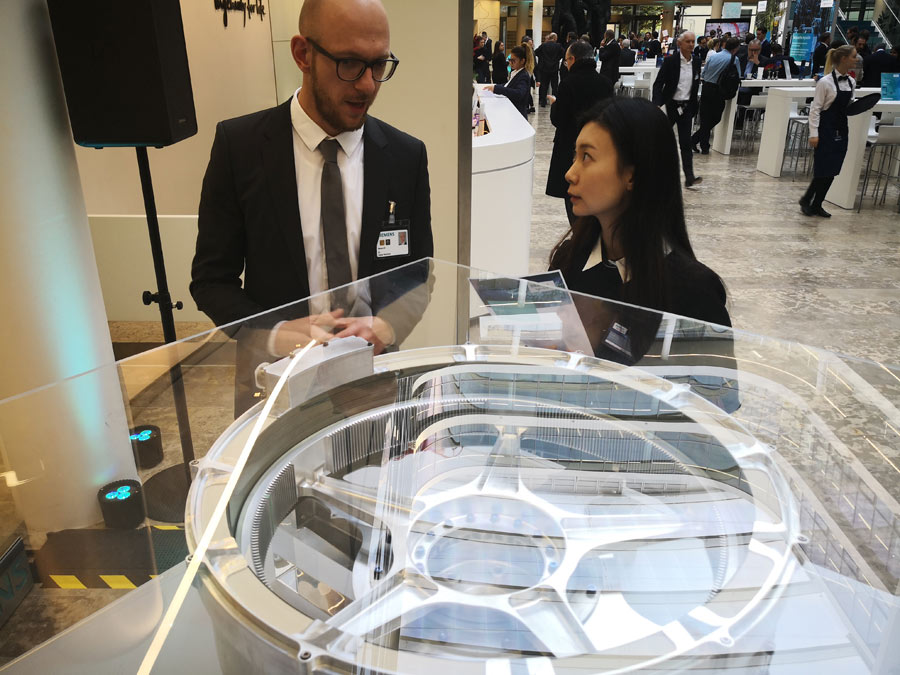
(People look at exhibits at Siemens Innovation Day on Dec.15 in Munich. Photo: Jiang Jie/People's Daily Online)
Siemens’ leading IoT platform, MindSphere, has opened its first experience and demonstration center in Beijing and is gearing up for more cooperation in China. Busch also revealed that the company is thinking of picking a Chinese cloud provider for MindSphere’s future plans to participate in the Chinese market.
For Chinese companies, such digitization means more cost-effective manufacturing. Through digital product design and performance simulation, factories can produce virtual models that allow for more innovation and eliminate rework.
Harbin Turbine, which is based in northeast China, has slashed the cost of drawings and revisions by 20 percent and planning efficiency has been improved by 30 percent thanks to digital software from Siemens.
In central China’s Henan province, AI helps the State Power Investment Corporation by serving as a full-time inspector of 14 generators with a total of 6.8 million kilowatts of electricity at seven power plants. The Siemens-powered AI system can analyze and react to real-time data to prevent power failures, which would be disastrous for the company and society.
Siemens CTO also thought highly of China’s robotics and AI development, saying it will change all industries. “There is so much robotics going on, not only heavy-lifting robots, but those that might replace handiest work,” he noted. “Considering the size of your population and good education system, my prediction is that it will grow very strong in China and you will create an impact, as the government pushes it fast.”

 Award-winning photos show poverty reduction achievements in NE China's Jilin province
 People dance to greet advent of New Year in Ameiqituo Town, Guizhou
 Fire brigade in Shanghai holds group wedding
 Tourists enjoy ice sculptures in Datan Town, north China
 Sunset scenery of Dayan Pagoda in Xi'an
 Tourists have fun at scenic spot in Nanlong Town, NW China
 Harbin attracts tourists by making best use of ice in winter
 In pics: FIS Alpine Ski Women's World Cup Slalom
 Black-necked cranes rest at reservoir in Lhunzhub County, Lhasa
 China's FAST telescope will be available to foreign scientists in April