

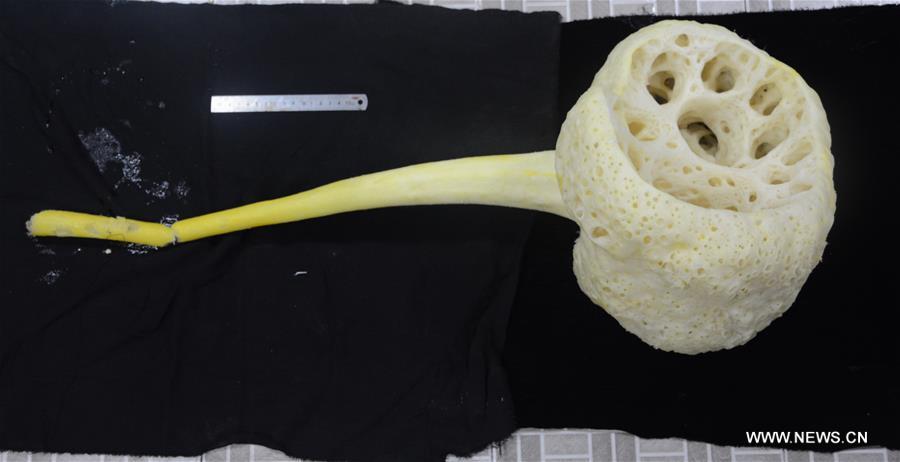
A sponge collected by Chinese scientists is seen on KEXUE (Science) scientific ship at the west of the Pacific Ocean on Aug. 14, 2017. Chinese scientists on Monday started to explore a seamount named Caroline in the west of the Pacific Ocean for the first time, as a remote operated vehicle (ROV) dived to collect videos, information and samples. (Xinhua/Zhang Xudong)
China's remote operated vehicle (ROV) Discovery collected some samples from the Caroline Seamount in the western Pacific Ocean Monday, including a rare yellow sponge 80 centimeters high.
"A sponge as large as this one is rarely seen. Normal sponge is white, but this one is yellow and it is interesting to find out the reasons," said Xu Kuidong, chief scientist aboard the Kexue research vessel. "Kexue" means science in Chinese.
A large delicate Venus' flower basket, a kind of sponge, was also seen among the samples that Discovery collected on Monday. It has a white reticulate body and crystal thorns.
In traditional Asian cultures, Venus' flower baskets were given as wedding gifts because the sponge symbiotically houses two small shrimps, a male and a female, who live out their lives inside the sponge.
Besides, Discovery brought a sea urchin, a sea anemone, a starfish, a shrimp, several corals, two rocks and deep-sea water from the south side of the Caroline Seamount from a depth of 1,500 meters.
As part of the Caroline Ridge in the Pacific Ocean, the Caroline Seamount is located south of the Mariana Trench, the deepest place on Earth, and east of the Yap Trench. It has never been explored before.
 |

 Award-winning photos show poverty reduction achievements in NE China's Jilin province
 People dance to greet advent of New Year in Ameiqituo Town, Guizhou
 Fire brigade in Shanghai holds group wedding
 Tourists enjoy ice sculptures in Datan Town, north China
 Sunset scenery of Dayan Pagoda in Xi'an
 Tourists have fun at scenic spot in Nanlong Town, NW China
 Harbin attracts tourists by making best use of ice in winter
 In pics: FIS Alpine Ski Women's World Cup Slalom
 Black-necked cranes rest at reservoir in Lhunzhub County, Lhasa
 China's FAST telescope will be available to foreign scientists in April