

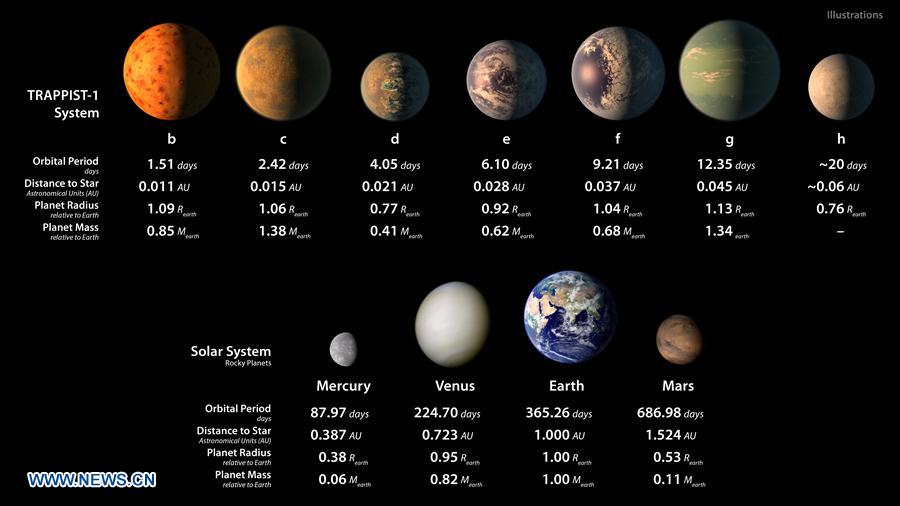
The chart released by NASA on Feb. 22, 2017 shows on the top row, artist concepts of the seven planets of TRAPPIST-1 with their orbital periods, distances from their star, radii and masses as compared to those of Earth; on the bottom row, the same numbers are displayed for the bodies of our inner solar system: Mercury, Venus, Earth and Mars. A compact analogue of our inner solar system about 40 light years away from the Earth has been discovered, NASA announced during a press conference on Wednesday. An international team of astronomers using powerful space telescopes and ground-based observatories have discovered the first known system of actually seven Earth-sized planets orbiting the nearby TRAPPIST-1, which is relatively close to us, in the constellation Aquarius. And three of these planets are firmly located in the habitable zone, the area around the parent star where a rocky planet is most likely to have liquid water. (Xinhua/NASA/JPL-Caltech)
 |

 Award-winning photos show poverty reduction achievements in NE China's Jilin province
 People dance to greet advent of New Year in Ameiqituo Town, Guizhou
 Fire brigade in Shanghai holds group wedding
 Tourists enjoy ice sculptures in Datan Town, north China
 Sunset scenery of Dayan Pagoda in Xi'an
 Tourists have fun at scenic spot in Nanlong Town, NW China
 Harbin attracts tourists by making best use of ice in winter
 In pics: FIS Alpine Ski Women's World Cup Slalom
 Black-necked cranes rest at reservoir in Lhunzhub County, Lhasa
 China's FAST telescope will be available to foreign scientists in April