
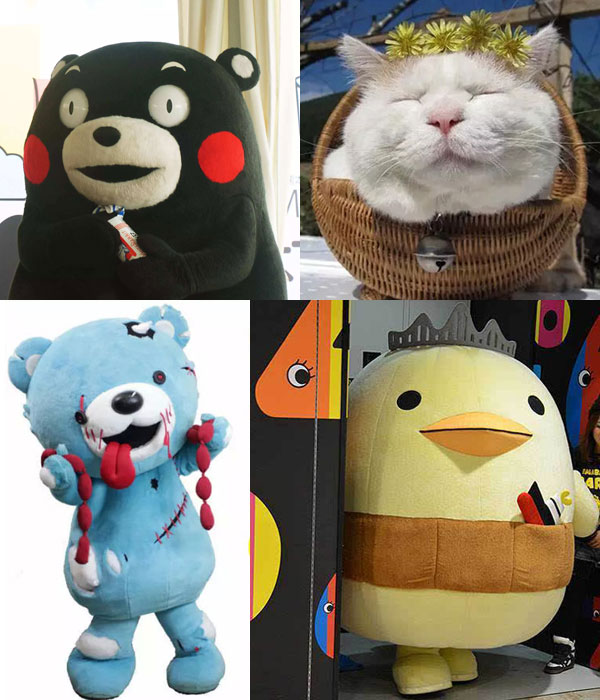
Quite a few Japanese mascots have entered the Chinese market and work well. Among them are Kumamoo (top left) Kumamoto (top right) zombie bear (bottom left) and Ima Barishi (bottom right). [Photo provided to chinadaily.com.cn]
Messenger to promote culture
Reputed to be followers of Kumamon, the Poinko Brothers are just one of the many Japanese web stars in China.
In the past several years, quite a few Japanese mascots have successfully entered the Chinese market and gained a massive number of fans.
Among all of them, the most famous one is Kumamoo. Created by the government of Kumamoto Prefecture, the black bear was born for a campaign to draw tourists to the region after the Kyushu Shinkansen line opened.
At first it was just a mascot but then became a cultural phenomenon.
According to the New Straits Times, the Bank of Japan estimates that in the two years 2012-2013, Kumamon generated $1.10 billion in revenue.
At the same time, some made-in-China cultural products were entering the Japanese market. For instance, a series of "funny" emoji-based bolsters have attracted the attention of Japanese customers through Amazon Japan for its funny shapes.
"Be it cartoon character or emojis, they are turning into the cultural messengers of the nation to promote popular culture and will continue to do so. And it is expected to be a trend," Chen Shuhua, a senior school teacher of Chinese, said.
 |  |

 Award-winning photos show poverty reduction achievements in NE China's Jilin province
 People dance to greet advent of New Year in Ameiqituo Town, Guizhou
 Fire brigade in Shanghai holds group wedding
 Tourists enjoy ice sculptures in Datan Town, north China
 Sunset scenery of Dayan Pagoda in Xi'an
 Tourists have fun at scenic spot in Nanlong Town, NW China
 Harbin attracts tourists by making best use of ice in winter
 In pics: FIS Alpine Ski Women's World Cup Slalom
 Black-necked cranes rest at reservoir in Lhunzhub County, Lhasa
 China's FAST telescope will be available to foreign scientists in April