



Man spends three decades turning Qiong bamboo into thriving industry in SW China's Yunnan
In the hills of southwest China's Yunnan Province, more than 1 million mu (roughly 67,000 hectares) of Qiong bamboo now covers the slopes — the product of three decades of planting that has grown into an industry worth 3.11 billion yuan (about $464 million) and a reliable source of income for local residents.
Dong Wenyuan has helped turn Qiong bamboo into a source of prosperity.

Photo shows fresh Qiong bamboo shoots from Daguan county, southwest China's Yunnan Province. (Photo/Tang Yingping)
In July 1993, Southwest Forestry University sent Dong, then 31, to Daguan county, Yunnan Province, to serve as deputy magistrate for science and technology.
With mountains covering 99 percent of the county, the terrain was steep and rugged, and incomes were low.
Dong Wenyuan (second from right) exchanges technical expertise in a bamboo forest in Daguan county, southwest China's Yunnan Province. (Photo courtesy of the Publicity Department of the Communist Party of China Daguan County Committee)
He tried various crops, but none of them caught on. Then a resident of Mugan town told him about a bamboo growing in the mountains there. Its shoots were tasty, and they sold for a good price.
Dong went into the mountains to see it for himself. What he found was Qiong bamboo — a species endemic to China, and one already protected on the country's first national list of rare and endangered plants, drawn up in 1984.

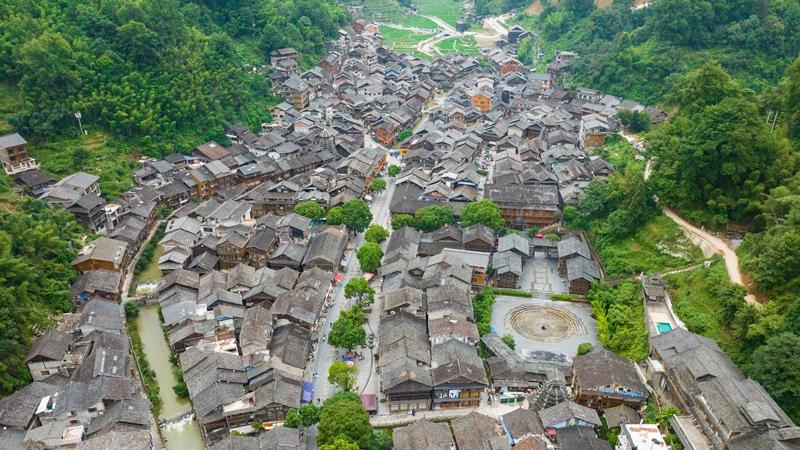
Photo shows an aerial view of bamboo forests in Daguan county, southwest China's Yunnan Province. (Photo/Tang Yingping)
When his temporary reassignment ended in 1995, the university planned to appoint Dong deputy head of a department. He turned the post down three times and went back to teaching. In the spring of 1996, he returned to Daguan.
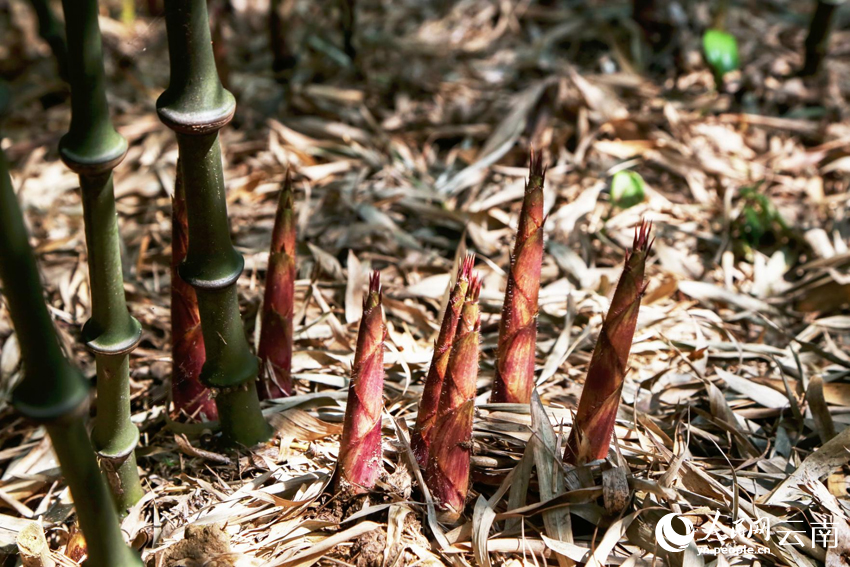
Photo shows Qiong bamboo shoots in a bamboo forest in Daguan county, southwest China's Yunnan Province. (Photo/Tang Yingping)
Dong set up his research base in Daluohanba, a village in Mugan town where Qiong bamboo grew thickest in Daguan.
He stayed there for 10 years.
Through years of observation, Dong identified the soil, light, altitude and planting density best suited to Qiong bamboo.
In 1997, he observed Qiong bamboo in flower. He tracked the process from flowering through seed production and experimented with sowing and seedling cultivation, confirming that the species could reproduce from seed.
But challenges remained. Bamboo grown from seed was weak and slow, needing nearly two years before it could be transplanted to the mountains, where fewer than 40 percent survived.
In the years that followed, Dong earned his doctorate and completed a postdoc, all while continuing his Qiong bamboo experiments in Daguan.
Later, Dong's team developed a containerized seedling technique using a lightweight growing medium, cutting the time to plant-ready seedlings from two years to seven months and raising survival after transplanting from below 40 percent to over 98 percent.
Since then, the techniques for planting, tending and cultivating bamboo have steadily improved.

Photo shows Qiong bamboo furniture made by a local enterprise in Daguan county, southwest China's Yunnan Province. (Photo/Tang Yingping)
Behind Dong's persistence was a team.
In 1989, Southwest Forestry University and Daguan county established an assistance partnership. For more than three decades, officials, researchers and village-based work teams have headed into the Wumeng Mountains, conducting research and advancing Qiong bamboo seedling cultivation, afforestation and tending.
Dong and his team handed over everything they had developed — 21 technologies in all — to Daguan free of charge, and they have kept training local bamboo farmers at no cost ever since.
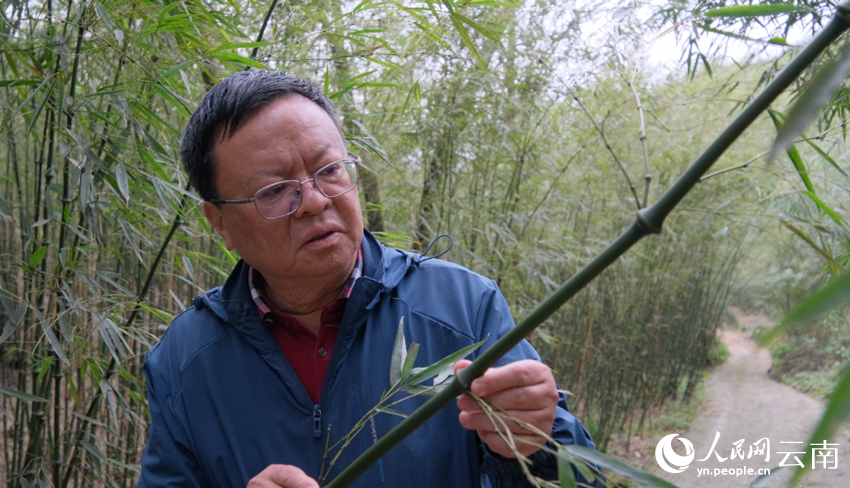
Dong Wenyuan checks the growth of bamboo in a bamboo forest in Mugan town, Daguan county, southwest China's Yunnan Province. (People's Daily Online/Zhuang Zhibin)
Today, Daguan has 21 bamboo shoot processing plants with a combined annual capacity of more than 70,000 tonnes, forming a full industry chain that runs from seedling cultivation through afforestation, tending, processing and sales.
The industry's growth has created more jobs nearby, drawing workers back. In 2023, Daguan launched a program to encourage women who had left for work elsewhere to return and join the bamboo sector.
Over the past three years, more than 8,000 people have come home to Mugan town alone. Among them are over 3,000 women, who now manage bamboo forests or work in processing plants.
Over 33 years, Daguan's Qiong bamboo planting area has grown from 49,000 mu to 1.02 million mu. The industry now provides steady income to 36,600 people who have left poverty behind, and reaches 190,000 residents in all.
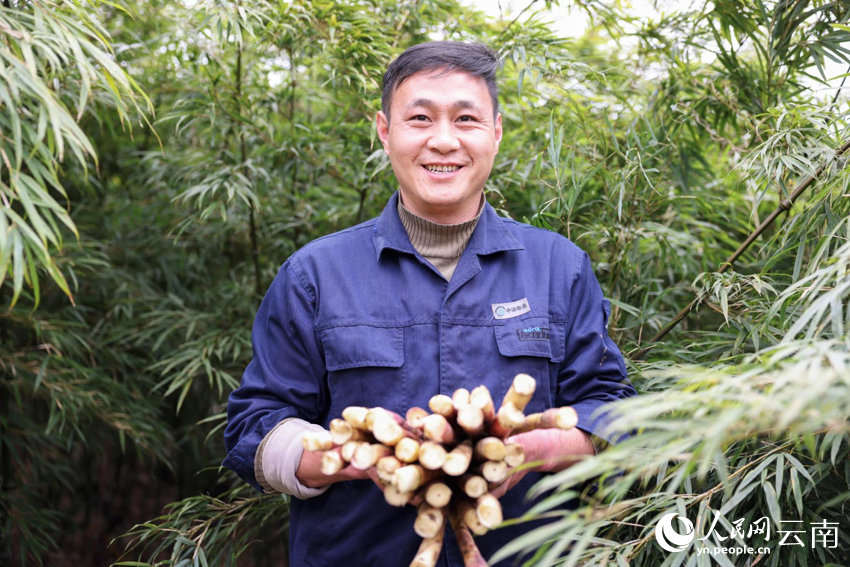
A farmer harvests bamboo shoots in Daguan county, southwest China's Yunnan Province. (Photo/Tang Yingping)
Photos



Related Stories
- E China's Chizhou turns bamboo into thriving low-carbon industry
- Bamboo shoot breaking ground
- Bamboo competition in SW China's Yunnan showcases industry vitality
- Bamboo generates wealth for villagers in SW China's Yunnan
- Bamboo: the tiny giant powering China's plastic replacement drive
- How bamboo is helping curb plastic pollution in China
- Annual output value of China's bamboo industry tops 520 bln yuan
- Bamboo brings ecological, economic benefits to town in E China's Jiangxi
- Bamboo culture revives amid China's eco-friendly endeavors
- Trending in China | Sichuan bamboo fishing rods: The art of angling
Copyright © 2026 People's Daily Online. All Rights Reserved.
