



E China's Chizhou turns bamboo into thriving low-carbon industry
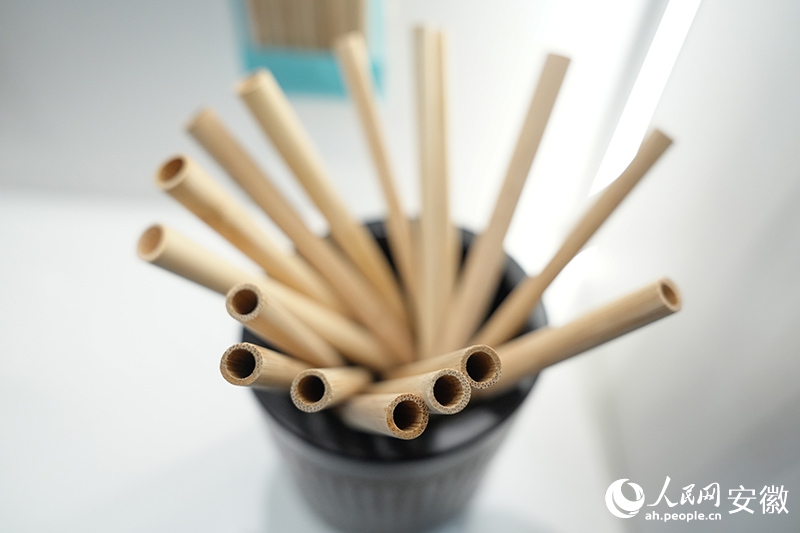
Photo shows bamboo straws made in Chizhou, east China's Anhui Province. (People's Daily Online/Miao Zijian)
Two billion bamboo straws roll out of Chizhou city, east China's Anhui Province, every year, reaching markets across the country and in more than 40 countries and regions worldwide, according to statistics. They displace roughly 6,000 tonnes of plastic products and reduce carbon emissions by 36,000 tonnes.
Behind those numbers lies the city's effort to pioneer ways to turn bamboo waste into valuable resources.
In 2024, Anhui Hongye Group Co., Ltd. (Hongye Group), a leading bamboo enterprise in Chizhou, introduced the country's first complete set of full-bamboo resource pyrolysis equipment.
In Chizhou, these bamboo straws are not just eco-friendly in themselves — the entire production process has achieved low-carbon operations, said Zhao Congwen, head of the industry section at the Chizhou Municipal Forestry Bureau.
A visit to Hongye Group's pyrolysis workshop offers a glimpse of how that claim holds up in practice. Bamboo waste is automatically conveyed through sealed pipelines into a pyrolysis furnace, where it undergoes conversion at high temperatures in an oxygen-free environment.
Wu Gang, head of the company's safety and environmental protection department, explained the cascade of products the process yields. Bamboo shavings, bamboo powder and offcuts are transformed into combustible gas and biomass charcoal powder. The combustible gas is burned to generate steam heat, which is then piped to drying chambers to dry raw bamboo — fully replacing the conventional use of natural gas. The biomass charcoal powder, with a purity exceeding 98 percent, can be further processed into premium activated carbon or used as a negative electrode material for sodium-ion batteries, significantly extending the value chain.
The equipment only consumes a small amount of natural gas during the initial ignition phase, Wu said. Once it reaches stable operation, the heat generated by the pyrolysis of bamboo waste sustains the entire process with no additional natural gas input, significantly cutting production energy consumption.
Technological innovation has delivered tangible ecological and economic benefits. Yang Dezhen, the company's deputy general manager, said the company can now process 50,000 tonnes of bamboo waste annually in an environmentally sound manner, replacing approximately 4.8 million cubic meters of natural gas and directly cutting carbon dioxide emissions by 7,500 tonnes. Thanks to the equipment, the company's bamboo material utilization rate has climbed from 30 percent to more than 95 percent, with zero burning and zero uncontrolled disposal of waste.
Chizhou has established a circular chain running from bamboo waste to clean energy and advanced new materials, anchored by a circular industrial park for the bamboo industry in Guichi district. Three other counties in the city are building similar parks concurrently.
"Photovoltaic power generation serves as a key 'green engine' for the facility," said Zhang Jinfeng, office director of Hongye Group. Leveraging its 240-mu (16 hectares) industrial park, the company has built a distributed solar power station spanning more than 46,000 square meters. The station generates 5 million kilowatt-hours of electricity annually, meeting nearly one-third of the facility's power needs and cutting carbon dioxide emissions by 5,000 tonnes each year.
Hongye Group's achievement of dynamic carbon balance across its factory operations earned it a zero-carbon factory certificate from the China Quality Certification Centre.
"The operation of the company's zero-carbon factory is a landmark outcome of Chizhou's push to advance the green transformation of the bamboo industry and further promote the Bamboo as a Substitute for Plastic Initiative," Zhao said. The official added that Chizhou plans to use the facility as a model to replicate its experience across other bamboo-processing enterprises in the region.
To ensure a stable supply of raw materials for processors, Chizhou has set up more than 20 primary moso bamboo-splitting and rough-processing plants close to the source in villages and towns, forming, together with the city's circular industrial parks, an integrated production system featuring tiered processing, efficient utilization and closed-loop emission reduction.
In 2024, the Chizhou High-tech Industrial Development Zone and Hongye Group signed an agreement to jointly develop a national headquarters base of bamboo circular industrial parks and plan to establish 50 distributed circular industrial parks across bamboo-rich areas nationwide, each supported by around 10 village- and town-level moso bamboo processing plants.
To date, 21 distributed circular industrial parks have been contracted, covering sites in Anqing and Huangshan cities in Anhui; Chun'an county in east China's Zhejiang Province; Suining county in central China's Hunan Province; and Changning county in southwest China's Sichuan Province, among others, with several already completed and in operation.
Photos


Related Stories
- Bamboo shoot breaking ground
- Bamboo competition in SW China's Yunnan showcases industry vitality
- Bamboo generates wealth for villagers in SW China's Yunnan
- Bamboo: the tiny giant powering China's plastic replacement drive
- How bamboo is helping curb plastic pollution in China
- Annual output value of China's bamboo industry tops 520 bln yuan
- Bamboo brings ecological, economic benefits to town in E China's Jiangxi
- Bamboo culture revives amid China's eco-friendly endeavors
- Trending in China | Sichuan bamboo fishing rods: The art of angling
- Trending in China | A world woven in bamboo: Sichuan-style birdcages
Copyright © 2026 People's Daily Online. All Rights Reserved.
