



Bamboo: the tiny giant powering China's plastic replacement drive
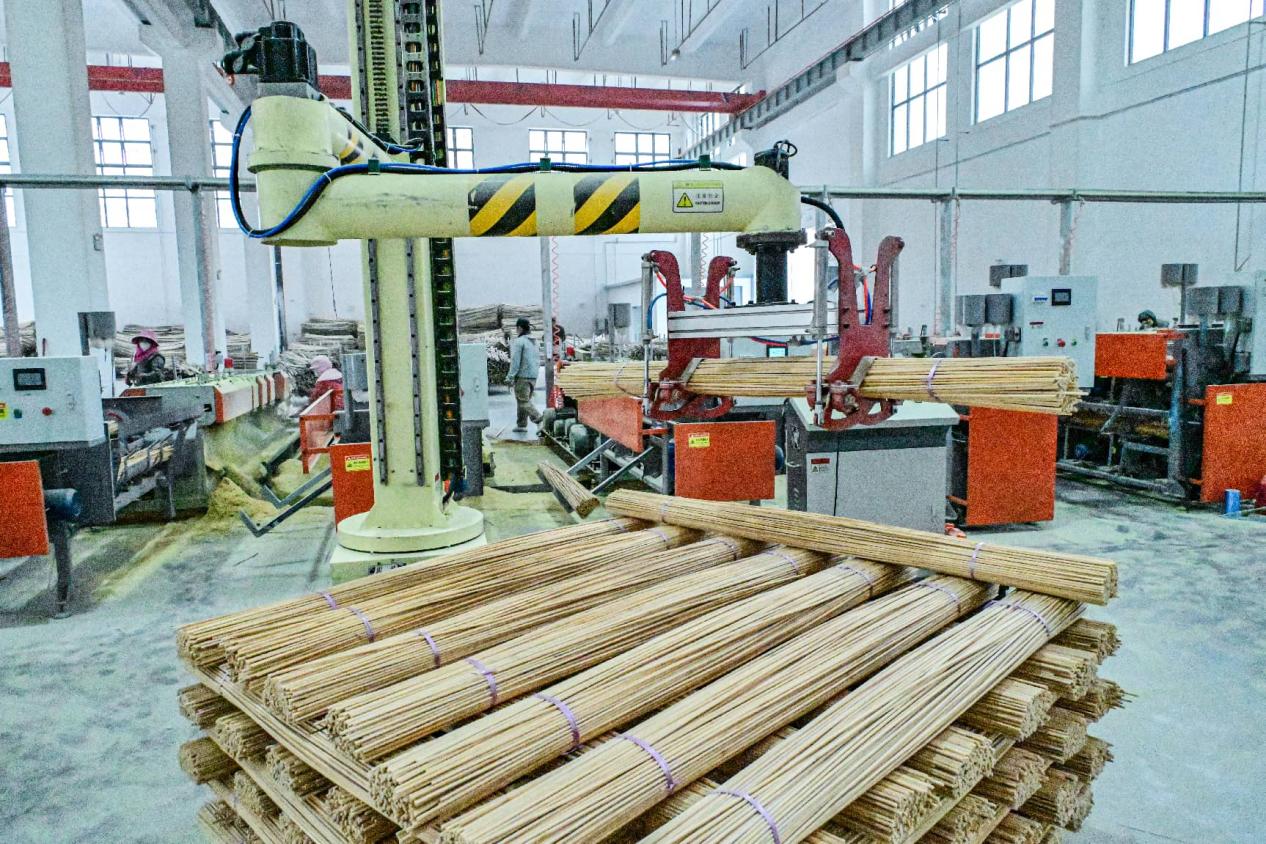
Bamboo materials are produced in a factory in Anqing, east China's Anhui province, as alternatives to plastic products. (Photo/Wang Xianguo)
A drone featuring innovative "bamboo wings" represents a significant advancement in the emerging low-altitude economy.
Earlier this year, a bamboo-based tilt-rotor drone successfully completed its maiden flight in north China's Tianjin municipality, marking a major breakthrough in the application of bamboo-based composite materials in aviation in China.
"Bamboo materials constitute over 25% of the drone's fuselage, with the entire skin structure crafted from high-performance bamboo composites developed in China. This level of bamboo integration is unprecedented globally for fixed-wing drones," said Qin Daochun, director of the International Center for Bamboo and Rattan.
The drone offers advantages in both performance and cost: compared with lightweight, high-strength carbon fiber, the overall weight is reduced by more than 20 percent, while the cost of bamboo strips is only about a quarter that of conventional carbon fiber fabric.
China houses the world's richest bamboo resources, with nearly 8 million hectares of bamboo forests and an annual output of 150 million tons.
In November 2022, China and the International Bamboo and Rattan Organization jointly launched an initiative to deepen global cooperation on replacing plastic with bamboo, aiming to better leverage bamboo's strengths as an alternative to plastic products.
Over the past three years, China's bamboo industry has continued to expand, forming a diversified system with a wide range of products, business models, and distinctive features. To date, the number of bamboo product categories in China has exceeded 15,000, and the industry's annual output value has surpassed 520 billion yuan ($75.35 billion).
Innovation within the sector is evident. Ganzhou Sentai Bamboo & Wood Co., Ltd. in east China's Jiangxi province has developed a bamboo pipe organ. When struck with bamboo mallets, it produces a clear, pleasing sound.
"By combining the mechanical structure of traditional pipe organs with innovative bamboo soundboards and resonance components, we retain the instrument's core performance features while incorporating the unique tonal qualities of bamboo," said Xu He, the company's general manager.
According to Xu, the company also produces more than 1,500 types of high-quality products, including structural bamboo materials for construction, decorative bamboo materials, and indoor and outdoor bamboo furniture and accessories.

Tourists visit a bamboo forest in Changzhou, east China's Jiangsu province. (Photo/Xu Jianghai)
Beyond musical instruments, bamboo is becoming increasingly integrated into daily life and industry. Bamboo tableware and film bags are now widely used in daily life. Bamboo grilles and cooling tower packing materials are increasingly applied in construction and industrial cooling systems, while bamboo fiber composites have been successfully used in automotive interiors. As a green, low-carbon, and biodegradable material, bamboo is finding broader applications and is becoming an important substitute for traditional materials such as plastic and steel.
Technological breakthroughs are continuously expanding the boundaries of bamboo applications. At a construction site in Dazhu county, southwest China's Sichuan province, bamboo-wound composite pipes have been laid into trenches.
"Our independently developed bamboo-winding composite technology enables bamboo to be processed into large-diameter pressure pipes, urban utility tunnels, and even high-speed train carriages," said Ye Ling, chairman of Xinzhou, a company developing bamboo-based composite materials in Zhejiang province, and the developer of the bamboo-wound composite pipes in Dazhu.
"These materials are lightweight yet strong, offer insulation and soundproofing, resist weathering and corrosion, and are cost-effective and easy to install. They can replace high-energy-consumption materials such as steel and cement across a wide range of applications," Ye added.
As a new infrastructure material pioneered in China, bamboo-wound pipes have already been applied on a large scale in municipal, water conservancy, and transportation projects. They have been installed across more than 700 kilometers in 11 provinces, increasing production efficiency by 25 percent while reducing unit costs by 13 percent.
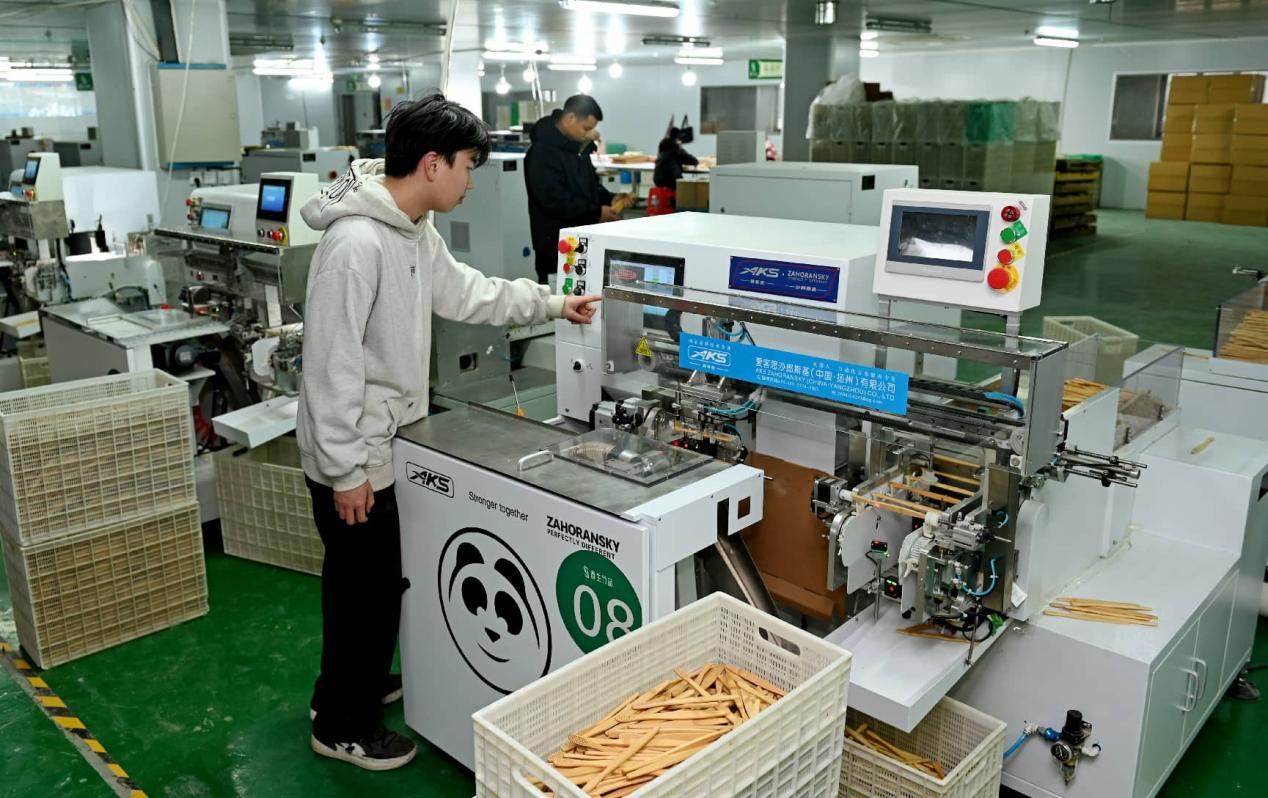
Bamboo tooth brushes are manufactured in a smart workshop of a bamboo processing company in Shaoyang, central China's Hunan province. (Photo/Teng Zhizhong)
Technological innovation remains the core driver of the bamboo industry's transformation. The National Forestry and Grassland Administration has released 37 key technological achievements related to bamboo-for-plastic substitution. From sodium-ion battery hard carbon anode materials to trendy furniture and fashion, new bamboo-based materials are continually breaking traditional boundaries.
Across the value chain, China is building a comprehensive bamboo industry ecosystem: cultivating large-scale producers upstream; strengthening core sectors such as bamboo home products and bamboo fiber goods while developing emerging industries like bamboo-based pharmaceuticals, chemicals, and bioenergy in the midstream; and promoting the integration of bamboo with tourism, wellness, and cultural industries downstream.
Regions across China are leveraging local conditions to build industrial systems that are integrated, multifunctional, and high-value, with a growing number of "whole-bamboo" utilization models that make the most of every part of the plant.
The industry is expanding beyond bamboo shoot processing and basic manufacturing into areas such as bamboo technology, bamboo-related tourism, and bamboo carbon sinks.
In Nanping, southeast China's Fujian province, the total output value of the bamboo industry exceeded 50 billion yuan last year. In Xingwen county, Sichuan province, a bamboo-themed tourist destination attracted 1.8 million visitors in the first half of last year with full-chain experiences.
Currently, China has more than 10,000 bamboo processing enterprises, employing over 29 million people throughout the entire industrial chain.
As the industry upgrades, China is also actively promoting bamboo products, technologies, and equipment overseas, offering Chinese solutions for global efforts to replace plastic and protect the environment.
In Youxi county, Fujian province, 280,000 mu (about 18,667 hectares) of bamboo forests have received FSC (Forest Stewardship Council) certification. A local paper company has developed eco-friendly tableware from bamboo fiber as an alternative to plastic products, with exports rising 35 percent year on year in 2025.
Photos

Related Stories
- How bamboo is helping curb plastic pollution in China
- Annual output value of China's bamboo industry tops 520 bln yuan
- Bamboo brings ecological, economic benefits to town in E China's Jiangxi
- Bamboo culture revives amid China's eco-friendly endeavors
- Trending in China | Sichuan bamboo fishing rods: The art of angling
- Trending in China | A world woven in bamboo: Sichuan-style birdcages
- Bamboo industry flourishes in Anji, E China's Zhejiang
- Selling bamboo to the world: A green industry rises in E China's Jiangxi
- C China's Zhengzhou: One-click global trade drives cross-border e-commerce development
- Chinese town taps bamboo to fuel eco-friendly manufacturing
Copyright © 2026 People's Daily Online. All Rights Reserved.
