



Meihekou in NE China handles 70 percent of world's pine nuts
Meihekou city in northeast China's Jilin Province is not known for growing pine nuts. Yet about 70 percent of the world's pine nuts are now processed and traded there.
In a farmyard-turned-livestream studio in the city's Heishantou town, Li Yue, a young entrepreneur who returned to his hometown, spoke briskly to the camera as he promoted boxed pine nuts to online shoppers, with orders rolling in throughout the broadcast.
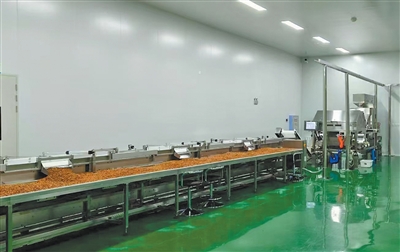
A pine nut processing line operates in Meihekou city, northeast China's Jilin Province. (Photo courtesy of the city's pine nut association)
As the livestream wrapped up, Gao Guangwei, honorary president of the city's pine nut association, arrived with news: the standardized factory in the local industrial park would soon be ready for occupancy. "That's great. Livestreaming, processing and storage will all be connected—there's even more room to grow," Li said.
Pointing to an old wooden nutcracking tool in the corner, Gao recounted how the industry evolved—from cracking nuts by hand to selling them through livestreams.
Located at the foot of the Changbai Mountains and a railway and trading hub in northeast China, Meihekou drew merchants seeking local specialty goods as early as the 1970s and 1980s, when residents first spotted the potential of the pine nut trade. The first generation of local entrepreneurs headed into the mountains to buy pine cones, cracking the shells by hand with small hammers. "Back then, every household would be cracking nuts at night," Gao recalled.
What began as small family workshops has since taken root as a local industry. "I grew up surrounded by pine nutshells—my family has lived off this business for generations," Li said. He tried other jobs, including selling clothes, before returning to the trade he could not leave behind.
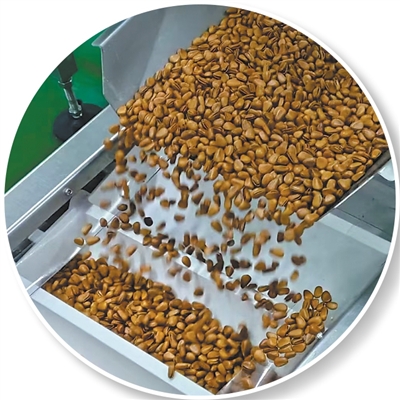
Automated sorting equipment separates pine nuts in Meihekou city, northeast China's Jilin Province. (Photo courtesy of the city's pine nut association)
Early on, Li faced doubts about his prospects as an online seller. He pushed through, refining his product selection and pitch late into the night, with guidance from the association's veterans and local companies on quality and sourcing. He has since become a top livestreamer in the nuts category on a short-video platform, with monthly sales topping 15 million yuan (about $2.2 million) during peak season and creating jobs for dozens of local residents.
That same drive toward modernization is playing out on a larger scale at Jilin Hongyue Food Co., Ltd., where machines hum inside a modern processing plant. Smart sorters remove empty and damaged shells, while automatic cracking, drying and packaging lines run at full speed.
"In the early years, workers cracked and sorted nuts by hand, with a worker processing at most 2.5 kilograms an hour," said Hong Tao, the company's head. "Now, our automated lines handle nearly 150 kilograms an hour, with far more consistent quality and almost no waste."
Hong founded the company in 2017 to push the industry toward deeper processing. It now sources raw materials from Russia, Mongolia and other countries, with products exported to more than 40 countries and regions, including Europe, the Americas and the Middle East. The company's annual output value reaches 160 million yuan.
Hong credits local government support—from help with permits to financing—including a tailored lending program created with local banks to ease financing difficulties for small businesses. In 2025, the city channeled nearly 1.5 billion yuan in financial support to the sector.
Such support has helped the industry scale up citywide. Meihekou is now home to more than 300 pine nut processing companies, 13 of them above designated size, covering the full chain from raw material sourcing to deep processing, branding and international trade. In 2025, the sector's total output value reached 6.2 billion yuan, with import and export volume of 1.03 billion yuan, up 15.8 percent year on year.
Building on its position as a trading hub, Meihekou has upgraded the pine nut industry across the full chain—extending both upstream and downstream, moving toward higher value-added output, and building a more resilient industrial ecosystem.
It has developed dwarf red pine plantations covering 225,000 mu (15,000 hectares), with 35,000 mu already bearing fruit, and developed patented shelling and sorting equipment. It has partnered with institutions such as Jilin Agricultural University to develop pine nut oil and other processed products, extending into biomedicine and cosmetics. It has also enhanced brand building. In September 2025, it hosted an international pine nut conference that drew more than 100 companies. The regional brand of "Meihe Pine Nuts" has gained recognition.
Photos


Related Stories
- "Color walk" gains popularity among young Chinese in Changchun, NE China
- Rose-themed ice installations draw visitors to Changchun
- Heritage ice-fishing ritual draws scores to Jilin lake
- 24th Chagan Lake Ice and Snow Fishing and Hunting Cultural Tourism Festival opens in NE China
- Changchun in China's Jilin sets up ice and snow landscapes to attract tourists
- China's Changchun experiences snowfalls
- 29th Changchun Ice and Snow Festival kicks off in NE China
- NE China's Jilin sees bumper grain harvest
- ROK entrepreneur's optical dream glues closer ties in NE China
- Tourists enjoy autumn scenery in Changchun, NE China's Jilin
Copyright © 2026 People's Daily Online. All Rights Reserved.
