



Small city in NW China becomes major computing power hub
Qingyang, a city in northwest China's Gansu Province with a population of just 2.1 million, is emerging as a "token factory."
As of the end of June, the city's intelligent computing capacity had surpassed 168,000 petaflops, meeting one-fourth of China's computing demand. A single petaflop is equivalent to a quadrillion calculations per second.
Qingyang recorded the fastest growth among China's eight computing power hubs. Intelligent computing accounts for the largest share of its total computing power, and it also has the highest token consumption among the hubs.
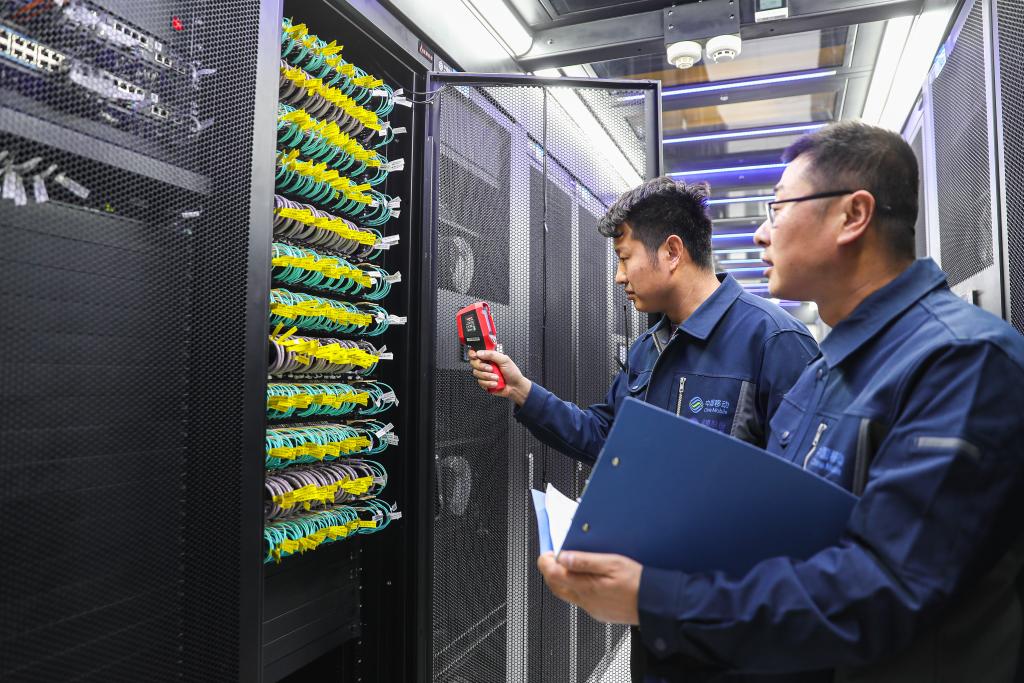
Staff members work at China Mobile's computing center in Qingyang, northwest China's Gansu Province, Jan. 6, 2025. (Xinhua/Lang Bingbing)
In the Qingyang data center cluster, tens of thousands of computing cards run around the clock without interruption. Leading enterprises such as Capitalonline Data Service Co., Ltd., Kingsoft Cloud and Lingqiong Shunlian (Qingyang) Data Technology Co., Ltd. have established operations there, building a large-scale, integrated token computing supply system that supports rapid industrial expansion.
Capitalonline Data Service Co., Ltd. has developed a distinctive service model in Qingyang, building a 10,000-GPU integrated training and inference cluster. It supports full-scale inference workloads for leading large models such as Kimi, GLM and DeepSeek, handling tens of billions of token requests per second and consuming hundreds of billions of tokens daily.
Leveraging its integrated computing network, Qingyang has built a token scheduling system that links domestic and global markets, with a computing resource utilization rate of over 90 percent. It has also established outbound computing corridors to Southeast Asia, Central Asia and Europe, with token services spanning five continents.
Green electricity is a key cost advantage for computing. As a traditional energy-rich city, Qingyang has pioneered a direct supply model that aggregates green power.
Gansu Electric Power Investment Co., Ltd. has built a dedicated 2-million-kilowatt green power plant in Qingyang. Here, on-site electricity prices have been stabilized at 0.398 yuan ($0.06) per kilowatt-hour. This direct supply rate makes per-unit computing costs 35 percent to 45 percent lower than in major eastern Chinese cities and more than 50 percent lower than in Europe and the United States.
The combination of a cost advantage and a technology advantage has rapidly driven industrial clustering in Qingyang. To date, Qingyang has registered 670 digital economy enterprises and established computing partnerships with 53 cities nationwide, forming a full industrial chain covering computing supply, large model R&D, AI applications and token circulation.
Currently, Qingyang's computing services cover regions such as North America, Europe and the Asia-Pacific, supporting overseas operations of companies such as DeepSeek and Minimax. Qingyang is accelerating the construction of a trans-Eurasian computing network, aiming to export 100,000 petaflops of computing power and establish itself as a global hub for China's computing power exports by the end of 2030.
According to Niu Yifei, director of Qingyang's Industry and Information Technology Bureau, Qingyang aims to reach 800,000 standard racks, exceed 300,000 petaflops of computing capacity and 600 billion yuan in core digital economy output by the end of 2030.
Photos



Related Stories
- China accelerates building of national computing power network
- China ranks second in world in terms of computing power
- Scenery of Qianba pasture in China's Gansu
- Olive industry thriving in Wudu District of China's Gansu
- Scenery of sunrise in Dunhuang City, China's Gansu
- Scenery of Aksay in China's Gansu
- Volunteers build green future on sandy land in NW China
- Horse herds move to natural grasslands during plowing season in NW China's Gansu
- Brick carving tradition thrives in Linxia, NW China's Gansu
Copyright © 2026 People's Daily Online. All Rights Reserved.
