



Chinese lifestyle habits fuel global demand for China's products
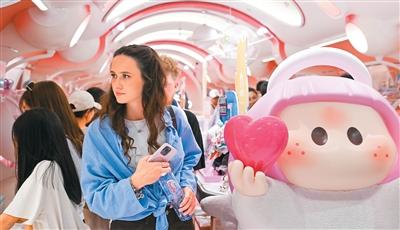
A foreign tourist browses products at a trendy toy store on Nanjing Road Pedestrian Street in Shanghai. (Xinhua/Chen Haoming)
A social media phenomenon celebrating Chinese-style living habits has translated into tangible export growth for a range of everyday Chinese goods, offering a glimpse of how cultural influence can reshape global consumer behavior.
Since the start of this year, videos tagged "Becoming Chinese" have spread rapidly across international social media platforms, with foreign users documenting their adoption of habits long embedded in Chinese daily life, such as drinking hot water and practicing tai chi. The trend has since rippled into the marketplace.
For many foreign consumers, the entry point has been as simple as swapping a cold drink for a warm one. A 25-year-old U.S. citizen began drinking warm water after visiting a traditional Chinese medicine clinic in Los Angeles to treat a chronic stomach complaint. At first it felt unusual, but his condition genuinely improved. "Now I take my thermos flask wherever I go."
Exporters have taken note of the shift. An exporter of thermos flasks and kettles based in Yiwu, east China's Zhejiang Province, said that inquiries from European and American clients have changed over the past year. Previously, foreigners bought thermos flasks mainly to keep drinks cold on outdoor adventures or carry coffee to work, the company's representative said, adding that now they're also asking about heat retention.
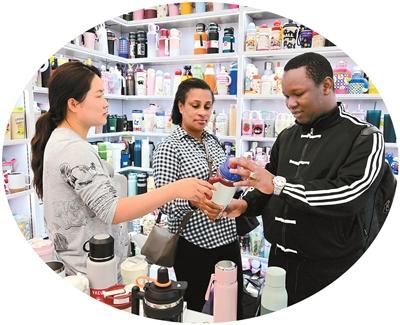
Overseas buyers source thermos flasks from a merchant at the Yiwu International Trade Market, the world's largest wholesale market of small commodities located in Yiwu, east China's Zhejiang Province. (Photo/Shi Bufa)
At a recent press conference held by the State Council Information Office, Wang Jun, deputy head of China's General Administration of Customs, said many foreign internet users have embraced quintessentially Chinese habits — drinking hot water, wearing cotton slippers indoors, and practicing baduanjin, a traditional Chinese aerobic exercise — as a way of expressing their enthusiasm for Chinese culture. What began as an online phenomenon has now generated real-world demand for Chinese goods.
In the first quarter of the year, China exported thermos flasks worth 5 billion yuan (about $735.84 million) and tea worth 2.7 billion yuan, while electric kettles and goji berries used in traditional Chinese medicine each recorded exports of around 200 million yuan, all showing year-on-year growth, Wang said. These everyday items have now reached more than 200 countries and regions, demonstrating both the practicality of Chinese goods and the growing global influence of Chinese culture.
The wellness curiosity extends beyond hot water. A woman based in New York said the "Becoming Chinese" trend led her to explore a broader range of Chinese lifestyle practices, from wearing Chinese-style costumes like cheongsam and mamianqun (horse-faced skirts) to practicing guasha, a traditional Chinese scraping technique aimed at relieving pain.
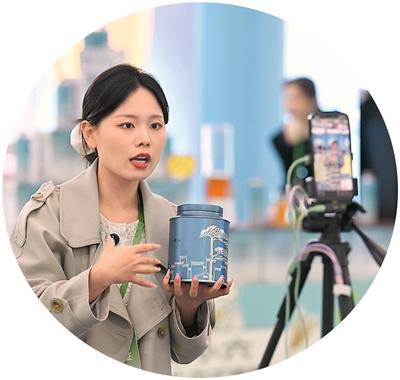
A staff member from an exhibitor promotes tea leaves during a livestream session at the 18th Anhui International Tea Industry Expo held in Hefei, east China's Anhui Province. (Xinhua/Huang Bohan)
Guasha boards are now selling briskly on cross-border e-commerce platforms, with prices ranging from $5 to $50. Several top-selling stores have recorded sales exceeding 10,000 units for a single product over the past month.
Lin Shihua, who runs one such store and has lived in the U.S. for many years, said she markets the boards primarily as beauty tools — a reframing that has resonated with Western consumers. Many American women use them to reduce facial puffiness, she said. "I also include tutorials and acupressure point guides to help customers understand how to use them properly," she added.
While the trend may appear sudden, it reflects years of groundwork. The thermos flask sector offers a telling example. Many globally recognized brands — including STANLEY, Thermos, and YETI — rely substantially on Chinese factories for production.
An industrial cluster spanning Yongkang, Wuyi, and Jinyun in Zhejiang accounts for a commanding share of China's total exports of thermos flasks and kettles, said Xu Liang, head of the public relations department of Zhejiang Feijian Industry and Trade Co., Ltd. Leading manufacturers in the industrial cluster — including Haers, Ansheng, Xiongtai, and Feijian — supply a large share of mid-to-high-end thermos flasks sold under famous European and American brand names.
Feijian itself operates both an original equipment manufacturing arm and its own branded online channels, tailoring products to different tastes: compact and refined for Japanese and South Korean markets, and larger-format for American and European consumers. A pot series incorporating Chinese zodiac motifs, launched by the company several years ago, drew strong interest at international trade fairs.
Innovation is increasingly seen as the key to staying competitive. Yao Huajun, chairman of Everich and Tomic Housewares Co., Ltd., said his company has pursued successive rounds of improvement — first in equipment, then in materials, and now in product structure and function.
Despite the momentum, many enterprises acknowledge that Chinese brands still have work to do in terms of international recognition. "Building a brand means continuously bringing in talent, innovating products, and upgrading technology," Xu said.
Photos




Related Stories
- Young people embrace green lifestyles
- China unveils new quadruped robot capable of carrying adult across rough terrain
- Trending in China | Chinese bellows
- China's booming second-hand market fuels circular economy
- "Toilet revolution" delivers healthier lifestyle, novel ideas to China's western plateau
- "Stove-boiled tea" becomes a hit among young Chinese consumers
- China's appliances increasingly predicting, preparing, interacting
- New batch of national standards takes effect in China
- Time-honored bicycle brand pedals toward high-tech growth
- China revises technical standards to better manage waste electrical products
- Kenyan officials say China offering template for natural products development
- Shiliang of China's Anhui develops distinctive hookah production sector with art glass legacy
- China's top market watchdog to strengthen supervision of infant formula products
- China updates green product rules to tighten oversight
- The new chemistry of "Made in China"
- Chinese small goods illuminate global festivals with innovation, culture
Copyright © 2026 People's Daily Online. All Rights Reserved.
