



Innovation fuels China's manufacturing momentum
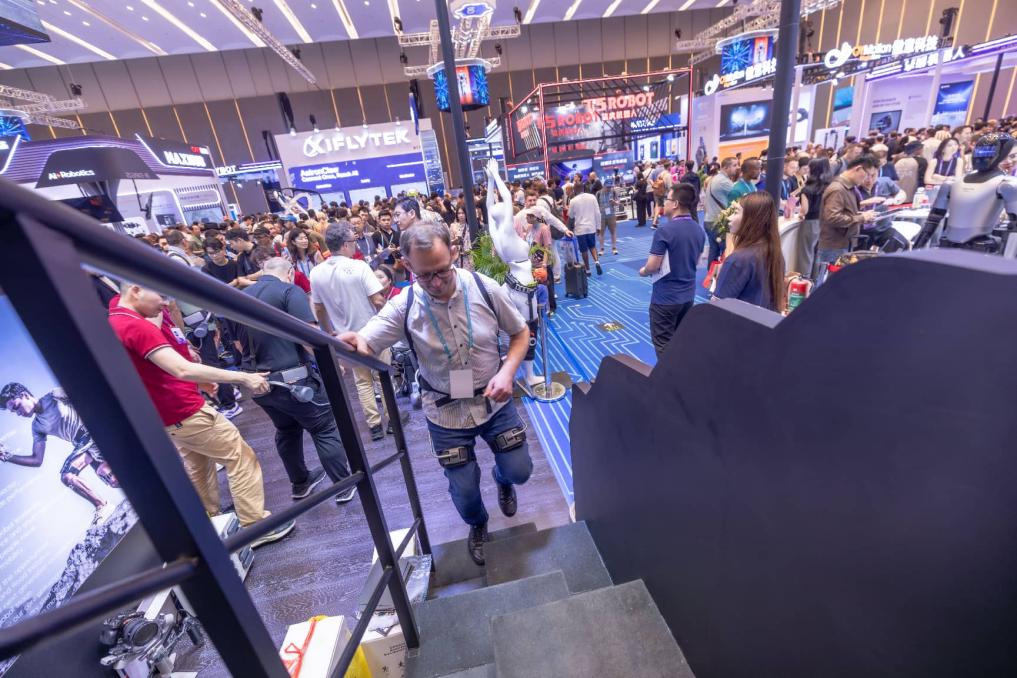
A foreign purchaser climbs stairs with an exoskeleton robot at the 139th edition of the China Import and Export Fair, April 17th. (Photo/Fu Haiyan)
A touching moment at the 139th edition of the China Import and Export Fair, widely known as the Canton Fair, recently went viral on social media both in China and abroad.
Assisted by an exoskeleton robot developed by Hangzhou-based Taixi Robot, an Argentine patient with muscular weakness slowly rose from a wheelchair and took several steps -- a milestone long awaited. Witnesses wept with joy as cutting-edge technology and profound human compassion converged in a powerful moment.
"This is the tangible strength of Chinese smart manufacturing," observed one online commentator.
The critical leap from conceptualization to breakthrough -- the journey from "0 to 1" -- relies on a vibrant, interconnected innovation ecosystem.
The development of exoskeleton robots, once confined to science fiction, spans multiple cutting-edge fields, including artificial intelligence and human-machine interaction. Such advances require years of dedicated research by companies, but breakthroughs are never achieved in isolation. Behind Taixi Robot stands a network of coordinated support: angel investment led by the Zhejiang University Alumni Fund, close collaboration among universities, enterprises, research institutions, and end users, plus a fast-track patent approval pathway launched by Hangzhou's Gongshu district.
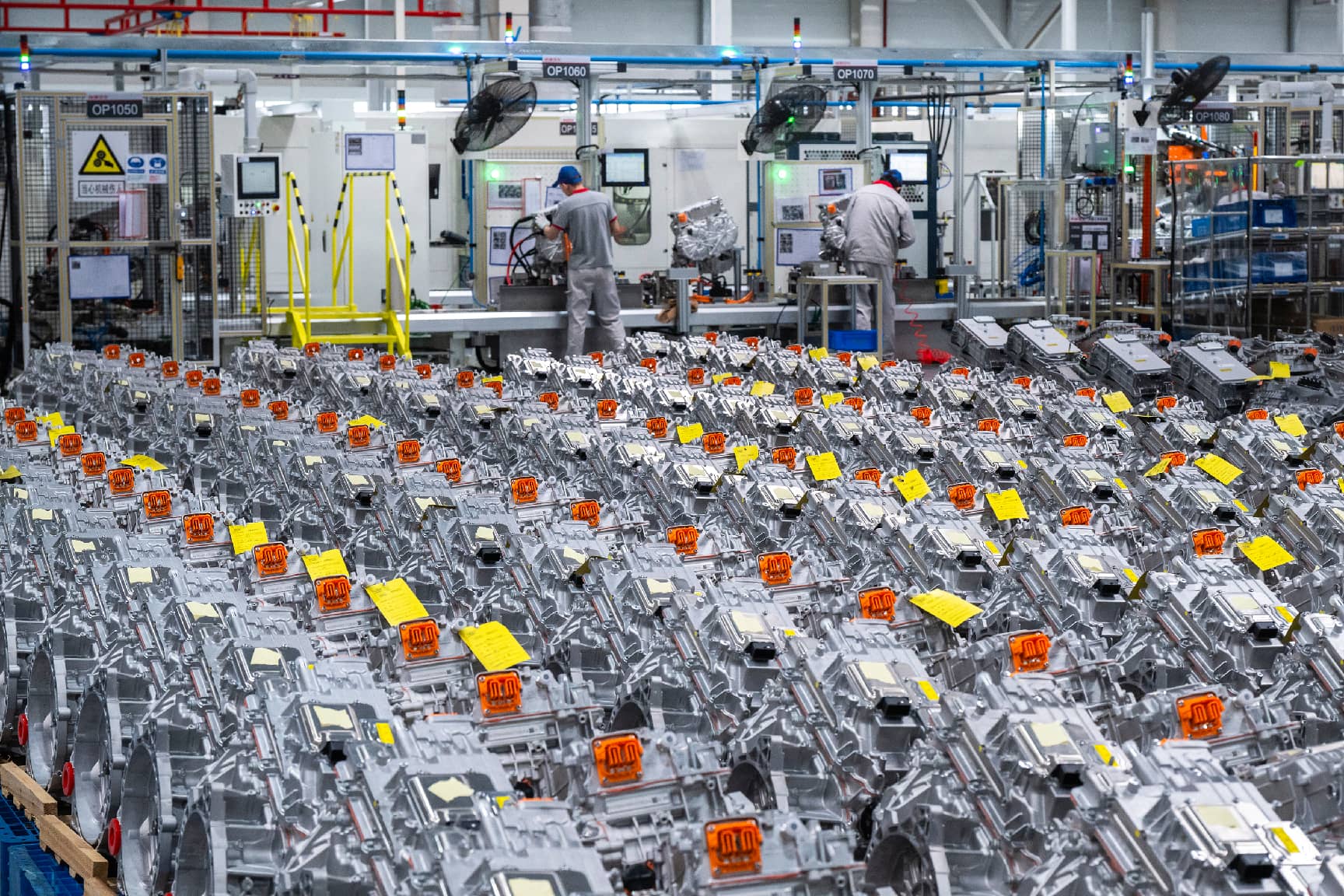
New energy vehicle gearboxes are manufactured in a smart workshop of Acteco, a powertrain solution provider based in Wuhu, east China's Anhui province. (Photo/Xiao Benxiang)
This fertile ground for innovation allows new ideas to take root and scale rapidly.
Today, a growing number of Chinese companies achieving technological breakthroughs reflects the strengths of China's system for mobilizing resources and coordinating innovation efforts on a national scale.
The recently released preview version of DeepSeek-V4, for example, is compatible with domestically developed chips such as the Huawei Ascend AI processors. Such progress would not have been possible without coordinated efforts to overcome technological bottlenecks in the semiconductor sector. Nor would today's massive computing power be possible without earlier strategic investments in energy infrastructure and green electricity.
This system-level coordination is accelerating China's innovation engine and continuously generating new breakthroughs in advanced technologies.
The subsequent leap from invention to affordability -- moving from "1 to 100" -- is underpinned by China's comprehensive industrial system
For years, exoskeleton robots remained prohibitively expensive. Yet the products showcased at the Canton Fair came with a significantly lower price tag. That shift owes much to highly integrated and efficient supply chains.
In Zhejiang province in east China, industries producing sensors, servo motors, and other intelligent hardware components are already well established, helping reduce manufacturing costs and making advanced technologies more affordable and accessible.
And Zhejiang is far from an isolated case.
Across China, local governments are actively removing barriers to production factors and enhancing industrial coordination, fostering opportunities for corporate growth and innovation.
In Shenzhen, south China's Guangdong province, companies can source 90 percent of the components needed for robotics production within just a few kilometers. Today, the city is home to more than 74,000 enterprises in the industry.
In east China's Anhui province, nearly all parts for a new energy vehicle can be sourced within a three-hour drive. This supports seven major automakers and helps the province rank first nationwide in annual automobile production.
These highly efficient industrial clusters have become powerful catalysts for business growth.
In today's China, the technological strength of innovation hubs is increasingly merging with the manufacturing capabilities of the "world's factory," allowing flashes of inspiration in laboratories to be transformed into continuous output on production lines.
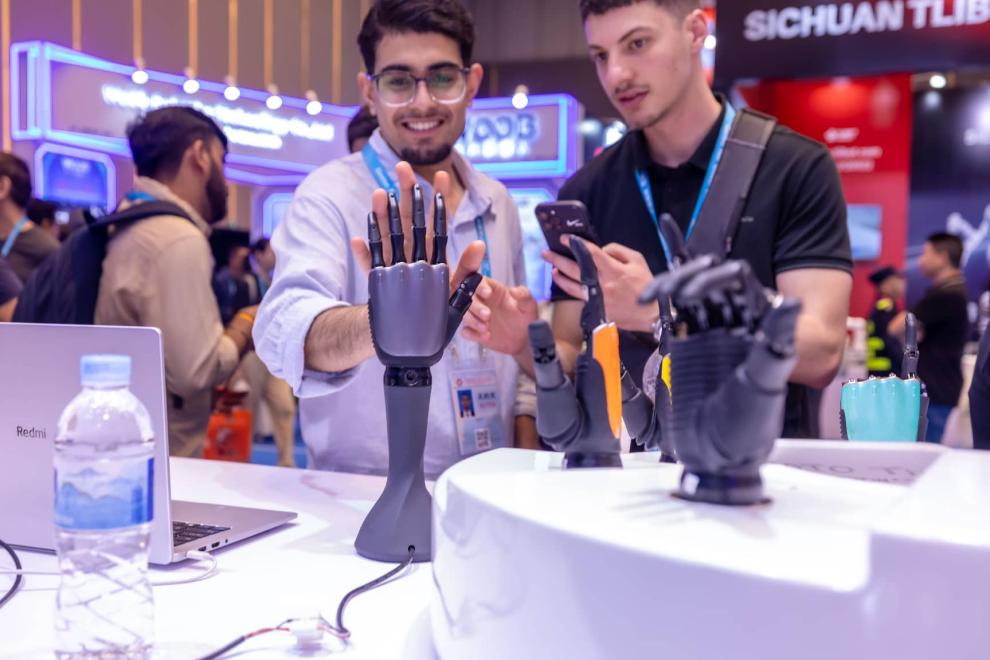
Foreign purchasers interact with robotic hands at the 139th edition of the China Import and Export Fair, April 17th. (Photo/Fu Haiyan)
The final leap -- scaling from domestic success to global reach, moving from "100 to 10,000" -- reflects China's commitment to shared global development. China's innovation journey is not about isolation, but about forging connections for mutual benefit.
After the exoskeleton video from the Canton Fair gained global attention, Taixi Robot proactively contacted the foreign patient and offered follow-up support. Over and over, she said "thank you" in Chinese, voicing her hope that more of the company's products could be brought to Argentina to help others living with similar conditions.
This spirit of shared development and global solidarity has become deeply embedded in China's approach to innovation.
In the field of artificial intelligence, for instance, China has become one of the world's major contributors to open-source software and open models. The goal of "advancing the development of open-source ecosystems" has even been included in the outline of China's 15th Five-Year Plan.
Bloomberg noted in an article that while some of the West's tech giants are racing to build increasingly powerful AI systems while tightly restricting access, Chinese research labs continue to share technological advancements openly and free of charge.
From Juncao technology benefiting countries around the world, to Chinese-built power grids illuminating remote communities in Brazil, to the Five-hundred-meter Aperture Spherical radio Telescope opening its facilities to global researchers, China's innovation has never been aimed at "holding others back." Instead, it seeks to "build roads for everyone," helping more countries cross development barriers and improve people's quality of life.
Persevering through hard work while embracing cooperation and mutual benefit -- this is one of the deepest, most powerful, and most inspiring forces shaping modern China.
Photos



Related Stories
- Profits of China's major industrial firms expand by 15.5% in Q1, 2026, boosted by high-tech manufacturing: official data
- China's industrial momentum shifts toward new drivers as high-tech manufacturing powers growth
- Inside China's county economies | Meet China's billiards capital: Yushan
- How innovation, industrial chain upgrading reshape China's slipper manufacturing
- Chinese heating appliances gain global traction amid seasonal demand
- Smart factories across China explore new models of manufacturing
- China steps up efforts to advance AI-assisted manufacturing
- China in elite global manufacturing club
- China becomes the world's fourth manufacturing power
- China's robot industry doubles revenue in five years
Copyright © 2026 People's Daily Online. All Rights Reserved.
