



Smart factories across China explore new models of manufacturing
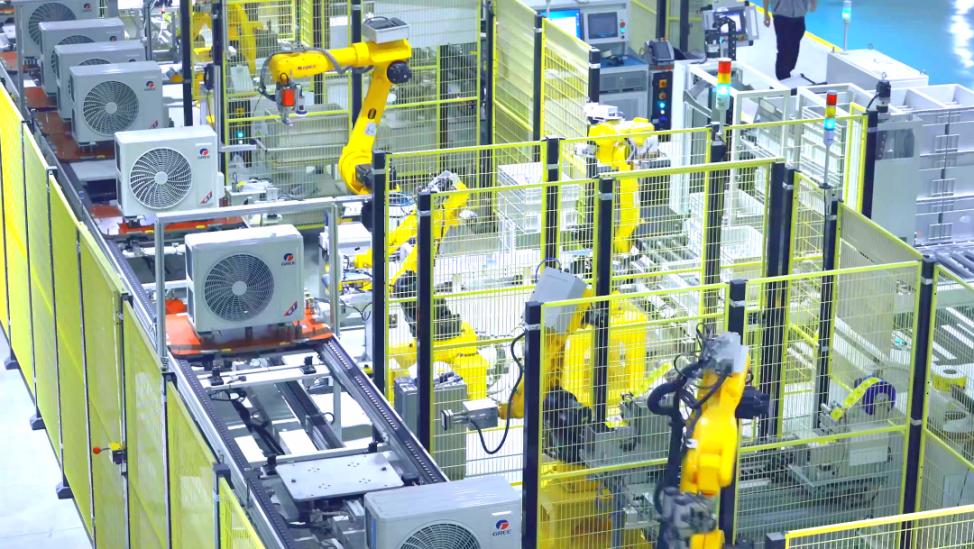
Photo shows a scene in a smart factory of Gree Electric Appliances. (Photo provided by Gree Electric Appliances)
Cars no longer have to be built on a traditional assembly line. In China, production is increasingly organized around what are known as "manufacturing islands."
An intelligent island manufacturing system in the body shop of joint venture SAIC-GM-Wuling in Liuzhou, south China's Guangxi Zhuang autonomous region, presents a striking scene: individual "smart process islands" operate independently yet remain interconnected. Together, three major island clusters enable the efficient mixed production of 24 different vehicle models.
"Model changeovers now take just two hours versus two days previously," said Yuan Yuzhu, senior manager of the final assembly workshop of the joint venture, pointing to a digital display screen.
"This has increased overall equipment effectiveness by 20 percent and reduced new model introduction costs by 35 percent. Behind these figures lies a fundamental shift in manufacturing logic," Yuan added.
At the plant's intelligent general assembly island, technologies such as modular switching allow different vehicle models to share the same assembly platform.
"Traditional lines are rigid like one-way roads," explained process engineer Cai Lin. "Our island system provides Lego-like flexibility while cutting equipment investment by 40 percent."
To build a smart factory that can think and evolve, SAIC-GM-Wuling has adopted a self-developed AI-driven operational model, enabling highly coordinated use of resources across the entire industrial chain, from production scheduling and warehousing to material distribution. The factory's overall level of intelligence has reached 75 percent.
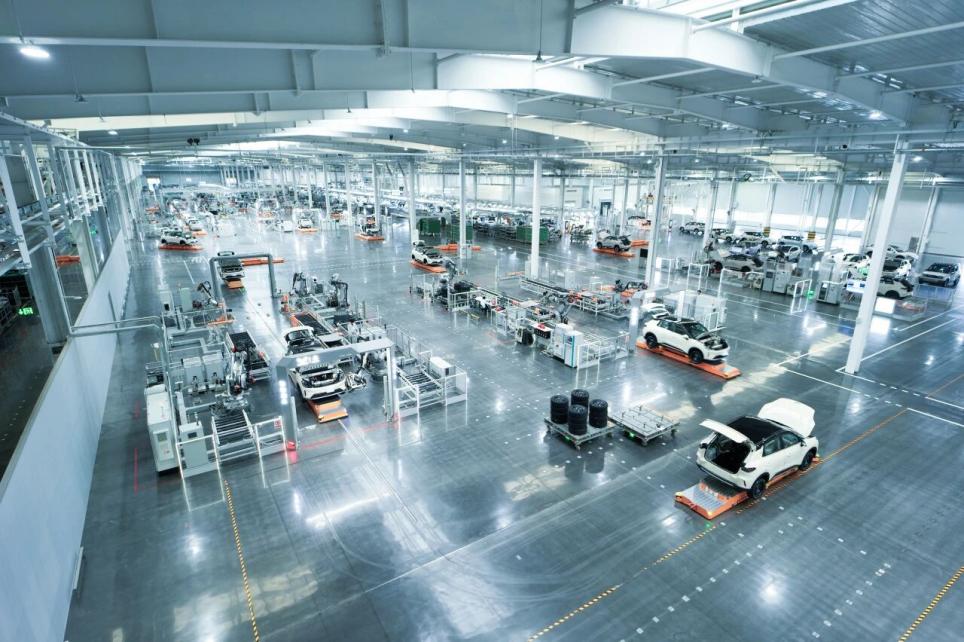
Photo shows an intelligent island manufacturing system in a workshop of joint venture SAIC-GM-Wuling. (Photo provided by SAIC-GM-Wuling)
Since the completion of the island-based smart factory at the end of 2023, manufacturing efficiency has increased by 30 percent; model changeover time in the body shop has been cut by 67 percent; investment in new product manufacturing has been reduced by 30 percent.
In 2025, the company's output value once again surpassed 100 billion yuan ($14.38 billion), up 24 percent year on year, while annual sales of new energy vehicles exceeded one million units for the first time, marking a year-on-year increase of 31.9 percent.
Built on process decoupling and production-line restructuring, SAIC-GM-Wuling's automotive island-based smart factory is one of China's 15 flagship smart factories recently announced.
China is currently accelerating the digital and intelligent transformation of its manufacturing sector. Since 2024, six government departments, including the Ministry of Industry and Information Technology, have jointly launched a smart factory gradient cultivation action for two consecutive years, developing them across four levels.
To date, China has built more than 35,000 basic-level smart factories, over 8,200 advanced-level facilities, more than 500 excellence-level factories, and 15 flagship smart factories.
Selected as the top among top, the first batch of China's flagship smart factories covers key sectors, including equipment manufacturing, raw materials, and electronic information, located in 10 provincial-level regions, such as Shanghai, Jiangsu, Zhejiang, Shandong, and Hubei.
Wang Minghui, director of the industrial research office at the Development Research Center of the State Council, noted that flagship smart factories integrate advanced manufacturing technologies, next-generation information technologies, and lean management concepts. Tasked with exploring future manufacturing models, they represent the pinnacle of China's intelligent manufacturing pyramid.
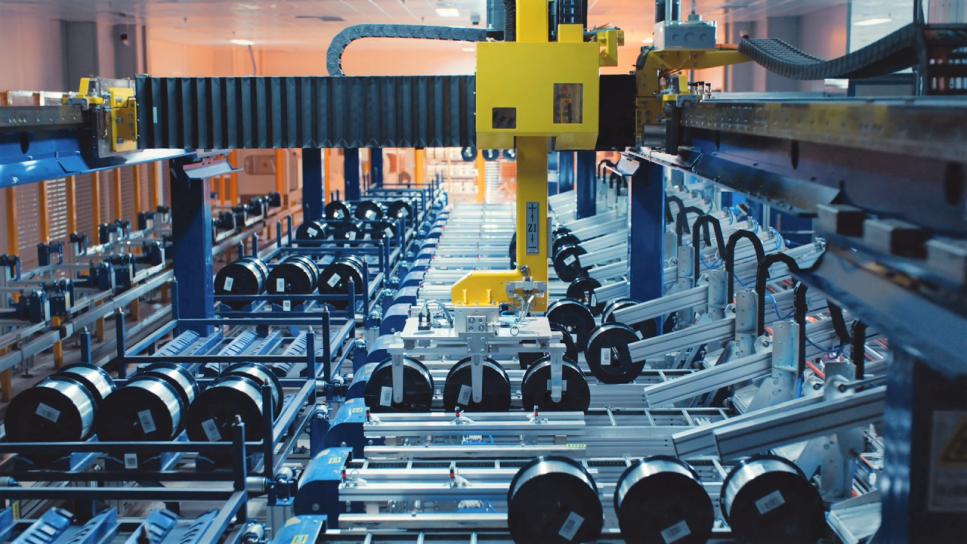
Photo shows a workshop of a smart factory of YOFC. (Photo provided by YOFC)
The core value of smart factories lies in reshaping production logic and unlocking industrial momentum. Flagship smart factories are continuously exploring new manufacturing models in practice, from automotive plants achieving flexible mixed-model production, to petrochemical facilities operating autonomously through digital twins, and to optical fiber plants overcoming the limits of ultra-large preform manufacturing. With high efficiency, precision, flexibility, and quality, they are setting transformation benchmarks for their respective industries.
As technological innovation accelerates, intelligent manufacturing is evolving faster than ever.
For example, Gree Electric Appliances, a leading Chinese home appliances maker, has achieved full digital coverage in its flagship smart factory, doubling production efficiency. The flagship factory of Yangtze Optical Fibre and Cable Joint Stock Limited Company (YOFC), a Chinese supplier of optical preform, fiber and cables, has fully integrated AI throughout its production process, enabling micron-level precision control at temperatures above 2,000 degrees Celsius. Its fiber drawing line achieves a world-leading speed of 3,500 meters per minute—entirely without human intervention.
Statistics show that across the 15 flagship smart factories, average production efficiency has increased by 29 percent, while product defect rate has dropped by 47 percent. Meanwhile, AI has been applied in more than 70 percent of business scenarios in these factories, resulting in over 6,000 vertical-domain models and driving the large-scale application of more than 1,700 key intelligent manufacturing equipment systems and industrial software solutions.
Intelligent manufacturing is moving beyond reactive automation, entering a stage of proactive, self-optimizing systems.
"We will open and share our technical standards with supply chain partners," said Wei Xiaowen, SAIC-GM-Wuling's manager of integrated planning. "After adopting the intelligent island manufacturing model, Liuzhou Saike Technology Development Co., Ltd. has seen its manufacturing efficiency increase by 30 percent."
Notably, smart factories are creating ripple effects that increasingly drive industrial collaboration. The 15 flagship smart factories are no longer just producers of high-end products; they are evolving into comprehensive providers of products, services and solutions, driving broader industrial transformation. To date, they have facilitated coordinated upgrades among more than 1,300 upstream and downstream enterprises, enhancing value across entire industrial chains.
Looking ahead, China's smart factories are poised to deliver greater benefits to the world. Innovation will drive progress, tiered capacity-building will strengthen their foundations, and ecosystem-wide collaboration will help break down barriers.
Photos



Related Stories
- China steps up efforts to advance AI-assisted manufacturing
- China in elite global manufacturing club
- China becomes the world's fourth manufacturing power
- China's robot industry doubles revenue in five years
- China's high-tech manufacturing sector reports robust profit growth from Jan-Oct
- Rationale behind China's commitment to keeping appropriate share of manufacturing in national economy
- Chinese products bring coolness to European consumers
- Yiwu's global buying spree reflects broader trends in China's foreign trade
- Yangtze River Delta region solidifies role as highland for high-end manufacturing
- Tesla video boasts 95% localization in China
Copyright © 2026 People's Daily Online. All Rights Reserved.
