



China steps up efforts to advance AI-assisted manufacturing
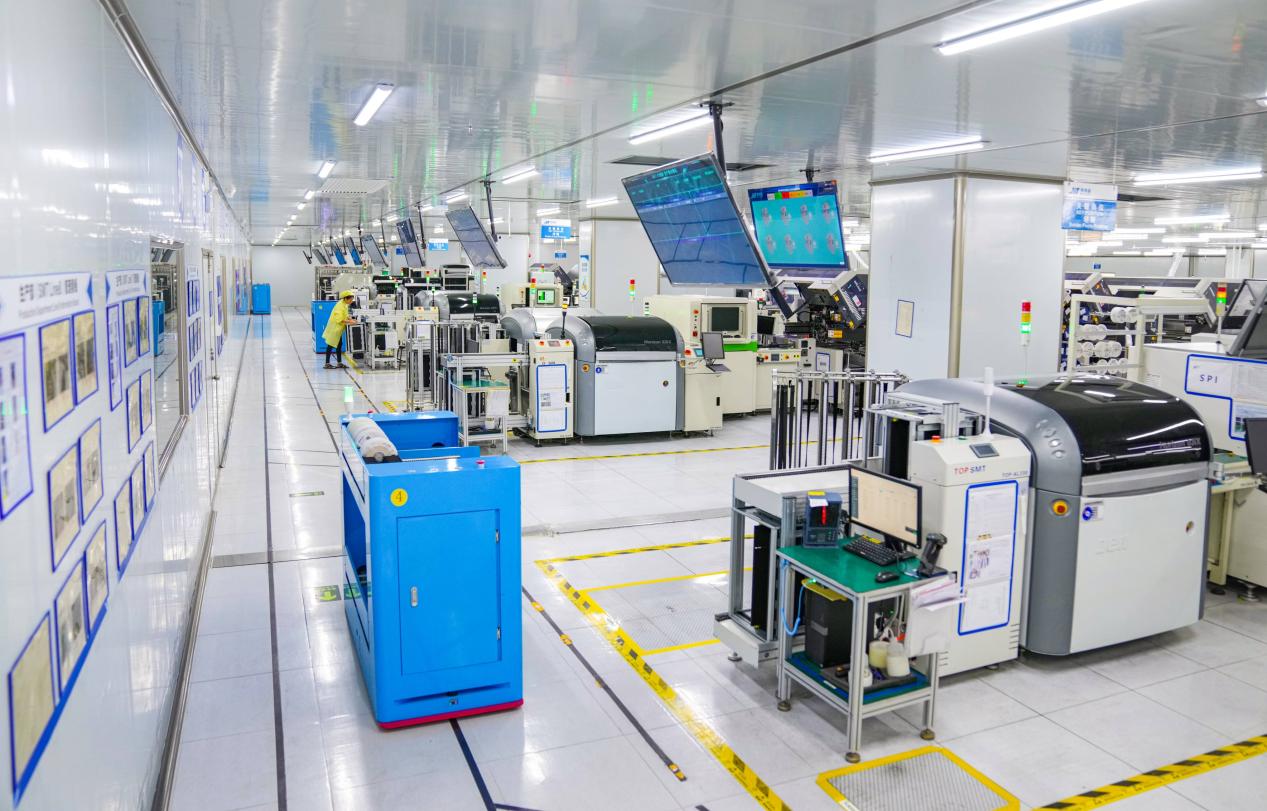
An automated delivery machine runs in an intelligent workshop of Jiangxi Intelligent Electronics Technology in Fuzhou, east China's Jiangxi province. (Photo/Guo Hao)
The deep integration of artificial intelligence (AI) with the real economy is profoundly reshaping models of manufacturing and economic structures, accelerating industrial upgrading.
On January 7, China's Ministry of Industry and Information Technology, together with seven other departments, released a work plan to deepen the integration of the manufacturing sector and artificial intelligence (AI).
The document outlines seven priority areas—innovation foundation, intelligent upgrading, product breakthrough, market player, ecosystem expansion, security assurance, and international cooperation. It also details 21 specific measures to speed up the intelligent, sustainable, and integrated development of the manufacturing sector.
According to the document, China will achieve secure and reliable supply of key AI technologies by 2027, with its industrial scale and empowerment capacity remaining among the world's leading ranks.
The document calls for promoting the in-depth application of three to five general-purpose large AI models in manufacturing, launching 1,000 high-level industrial intelligent agents, building 100 high-quality industrial data sets, and promoting 500 typical application scenarios.
It aims to foster two to three ecosystem-leading enterprises with global influence, nurture a group of specialized small and medium-sized businesses that produce novel and unique products, cultivate a number of application service providers proficient in both AI and industrial development, and establish 1,000 benchmark firms.
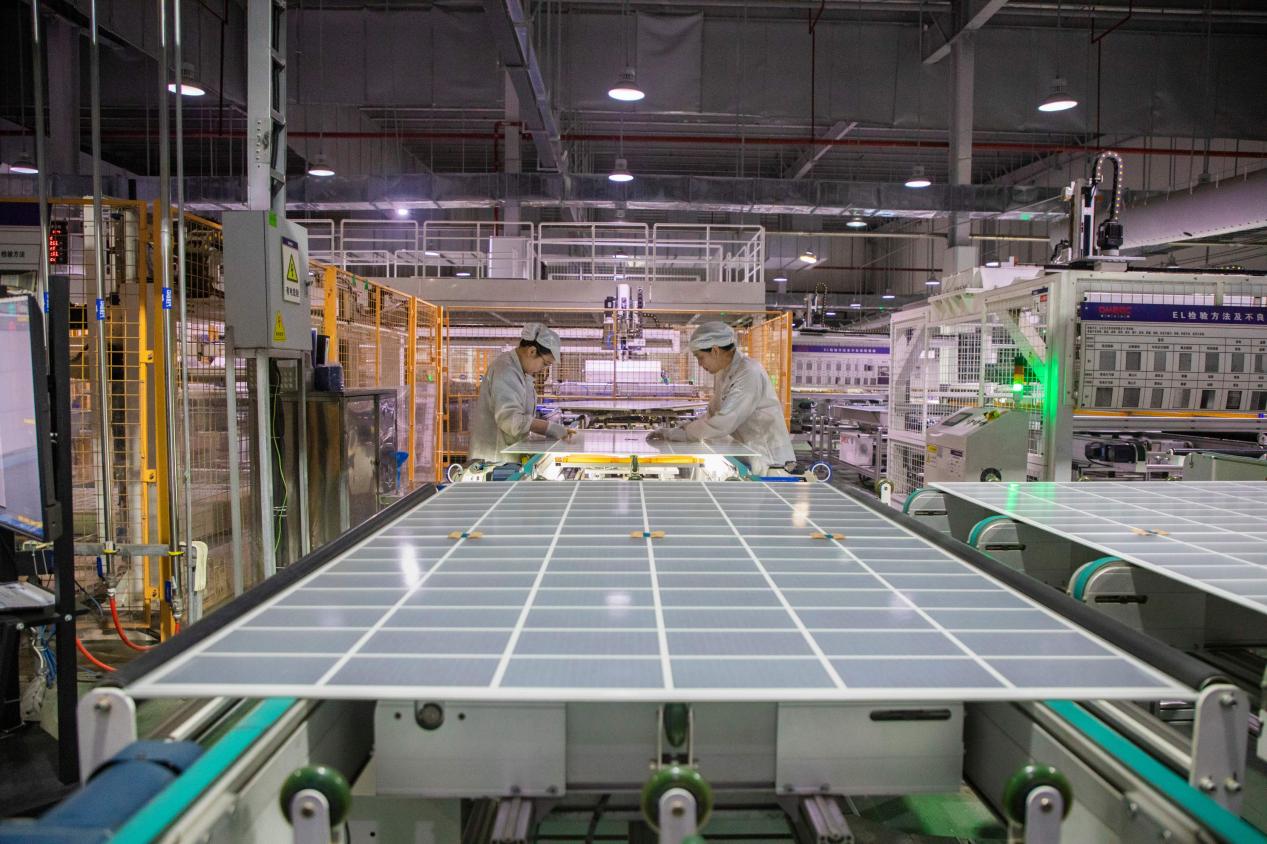
A 5G-enabled digital production line for photovoltaic panels runs at full capacity in a workshop of a new energy technology company in Suqian, east China's Jiangsu province. (Photo/Liu Ye)
A globally leading open-source and open ecosystem will be established, with comprehensive improvements in security governance, contributing Chinese solutions to global AI development.
In textile workshops, air-conditioning fans are needed to regulate temperature and humidity, purify the air, and ensure ventilation. Traditional products rely heavily on manual adjustment, resulting in low precision and difficulty in predicting equipment failures.
"By using Inspur Yunzhou Industrial Internet Platform, we installed multiple types of sensors on traditional fans to collect and train data, and developed digital-intelligent fans," said Wu Zicai, chairman of Shandong Jinxin Air Conditioning Group.
According to Wu, these digital-intelligent fans can optimize parameters such as air volume in real time based on operating conditions, precisely control workshop temperature and humidity, and reduce equipment maintenance cycles by 40 percent.
"Enterprises need to accelerate full-process transformation and upgrading by deeply embedding large-model technologies into all stages—from research and development (R&D) and pilot testing to production, marketing, services, and operations management—so as to enhance capabilities in assisted design, simulation modeling, production scheduling, and predictive maintenance," an expert said.
In the R&D and design phase, efforts should focus on promoting intelligent design assistance, software code generation, and pharmaceutical research, creating new R&D models that are more personalized, lower in cost, and higher in efficiency.
In production and manufacturing, industrial quality inspection technologies such as machine vision and unmanned intelligent inspections should be expanded. This will enhance real-time monitoring of production lines, predictive maintenance, and the precision of equipment fault identification, while enabling early warnings for potential safety risks and incidents in production operations.
In operations and management, the analytical and generative capabilities of large AI models should be used to enhance enterprises' management of strategy, human resources, finance, and risks.
To support enterprises using AI in R&D, production, operations, and value-added services, the document provides additional guidance for AI application in manufacturing.
This application guide provides detailed, step-by-step guidance on conducting intelligent assessments and planning, strengthening foundational digital capabilities, building high-quality data sets, reasonably planning computing power resources, selecting and optimizing models, deploying and integrating models, and ensuring AI application security—offering hands-on pathways and methods for intelligent transformation and upgrading.
From experience-based mining to smart exploration, and from craftsmanship-driven smelting to AI-enabled precision control, China's non-ferrous metals industry is also advancing rapidly. Recently, the industry's large model Kun'an 2.0 was released, further exploring the deep integration of AI technologies across the entire non-ferrous metals industrial chain.
"Over the past year, we have applied AI to key industrial processes and promoted the development of more than 100 application scenarios. From these, we selected and released 52 scenarios and built eight high-quality industry data sets," said Duan Xiangdong, chairman of Aluminum Corporation of China.
Ge Honglin, president of the China Nonferrous Metals Industry Association, noted that the industry features a wide range of products, complex resources, and highly intricate process flows, and faces challenges in digital and intelligent development in areas such as technology adaptation, data governance, coordination, and talent development. To address such industry-wide challenges, the document clearly calls for the development of high-level industry models and the acceleration of AI-enabled applications in key sectors.
"AI applications in manufacturing should be advanced through differentiated approaches, taking into account each industry's characteristics, technological maturity, and level of digitalization," said an official with the Department of Science and Technology of the Ministry of Industry and Information Technology.
The official added that the document also provides tailored guidance for sectors including raw materials, equipment manufacturing, consumer goods, electronic information, and software and information technology services, supporting industry-specific transformation efforts.
Photos



Related Stories
- China in elite global manufacturing club
- China becomes the world's fourth manufacturing power
- China's robot industry doubles revenue in five years
- China's high-tech manufacturing sector reports robust profit growth from Jan-Oct
- Rationale behind China's commitment to keeping appropriate share of manufacturing in national economy
- Chinese products bring coolness to European consumers
- Yiwu's global buying spree reflects broader trends in China's foreign trade
- Yangtze River Delta region solidifies role as highland for high-end manufacturing
- Tesla video boasts 95% localization in China
- China sees 182 major infrastructure, manufacturing projects being launched in the first quarter of 2025
Copyright © 2026 People's Daily Online. All Rights Reserved.
