



China's robot industry doubles revenue in five years
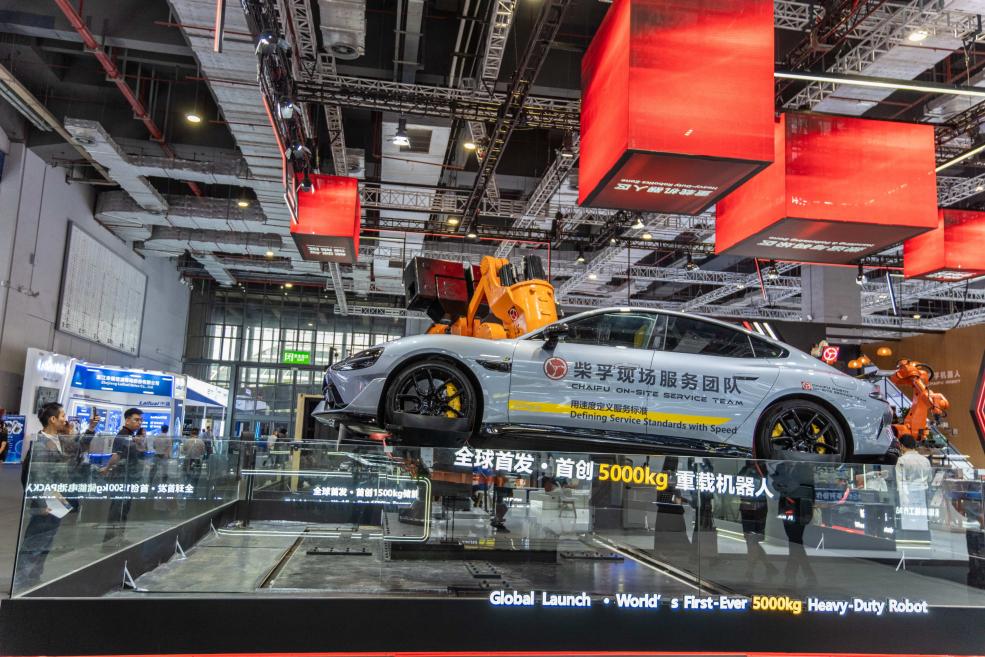
A heavy-duty robot is exhibited at the 25th China International Industry Fair in Shanghai, Sept. 26. (Photo/Wu Xue)
At the 2025 China Robot Industry Development Conference, the China Machinery Industry Federation (CMIF) briefed on the performance of China's robotics industry during the 14th Five-Year Plan period (2021-2025).
Industry revenue doubled from 106.1 billion yuan ($15 billion) in 2020 to 237.89 billion yuan in 2024. In the first three quarters of this year, revenue increased by 29.5 percent year on year.
Exports also expanded rapidly, growing from $390 million in 2020 to $1.15 billion in 2024. In the first three quarters of this year, exports reached $1.24 billion, surpassing last year's total and marking a 56 percent year-on-year increase.
Domestic industrial robot brands gained significant market share, rising from 31.4 percent in 2020 to 58.5 percent in 2024.
"The robotics industry in China has grown rapidly during the 14th Five-Year Plan period, with a relatively complete industrial chain now in place," said Xu Niansha, president of the CMIF.
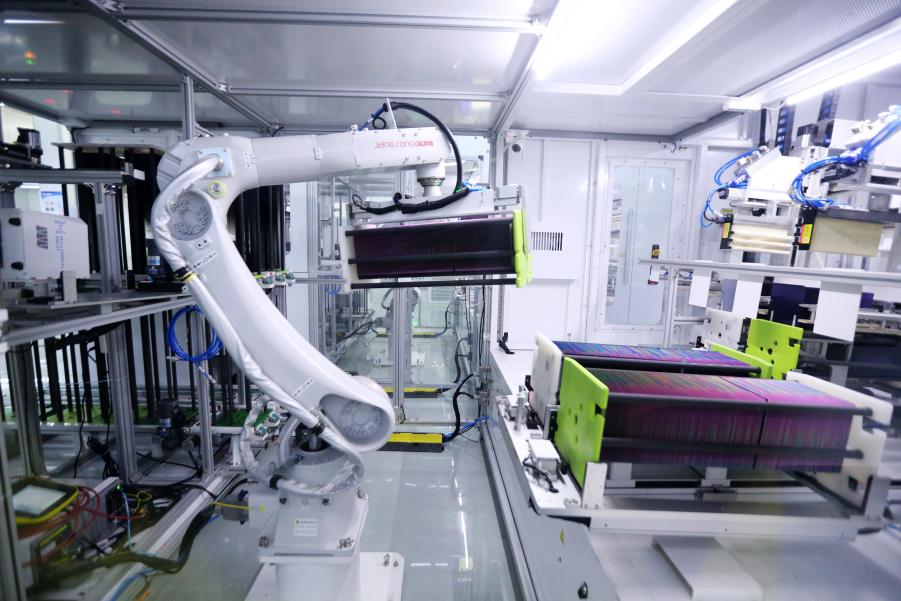
A smart robot moves products in a workshop of a solar panel manufacturing company in Yizheng, east China's Jiangsu province. (Photo/Meng Delong)
Stronger Capabilities
At the 25th China International Industry Fair, Chinese industrial robot company Estun Automation showcased a heavy-duty robot capable of stably lifting and transporting 1,200 kilograms.
"Payload capacity is a key performance indicator. As industrial robots become increasingly integrated into manufacturing, demand is rising for high-rigidity, high-precision, and highly reliable heavy-duty models," said a representative of Estun Automation.
Historically, China depended heavily on imported heavy-duty industrial robots, with domestic products accounting for less than 3 percent of the market. However, significant progress was achieved during the 14th Five-Year Plan period. For instance, Estun Automation's 700-kilogram-capacity model, launched in 2024, received more than 100 orders, and in 2025, the company introduced a 1,000-kilogram-level robot.
Technological advances have also transformed welding, often referred to as the "sewing line" of modern industry. "Our welding robots deliver high-speed, heavy-load, highly stable spot welding. The fastest cycle for a single weld point is just 2.2 seconds," said a representative of SIASUN Robot & Automation Co., Ltd., one of the largest robotics manufacturers in China.
Painting processes have similarly evolved. Traditional assembly lines typically require three to five days to paint a vehicle, whereas the automated production line using robots manufactured by Efort Intelligent Robot Co., Ltd. can complete the task in just over 80 seconds.
"This year's new technologies allow robots to integrate intelligent process systems directly into the equipment, enabling automated color mixing, switching, spraying, and cleaning," said engineer Wang Jinsong from Efort.
Stronger Industrial Support
In the first three quarters of this year, China's industrial robot output reached 595,000 units, exceeding the total production of the previous year. This rapid growth reflects the continued development and strengthening of the country's robotics industrial chain.
China has made significant advances in the production of core components, including high-precision reducers, high-performance servo systems, and intelligent controllers.
Harmonic reducers, often described as the "joints" of a robot, comprise a flexspline, wave generator, and circular spline. The flexspline, with a wall thickness of just 0.2 millimeters, requires micron-level machining precision. Chinese-made harmonic reducers now account for more than 40 percent of the domestic market.
Servo motors, the "muscles" of a robot, are essential for precise joint movement. Inovance Technology Co., Ltd., a leading global provider of industrial automation solutions based in Shenzhen, south China's Guangdong province, holds the largest market share in China's servo system sector.
At Inovance's production base in Yueyang, central China's Hunan province, the rotor production line has achieved full automation, while the stator line is 70 percent automated. "Our intelligent production lines deliver high precision and reliability, while also enabling customized services," an Inovance representative said.
According to Song Xiaogang, executive vice chairman of the robotics branch of the CMIF, China's robotics support system is becoming increasingly mature. Technological and industrial capacity has improved markedly, with leading robotics firms now producing over 80 percent of their components in-house.
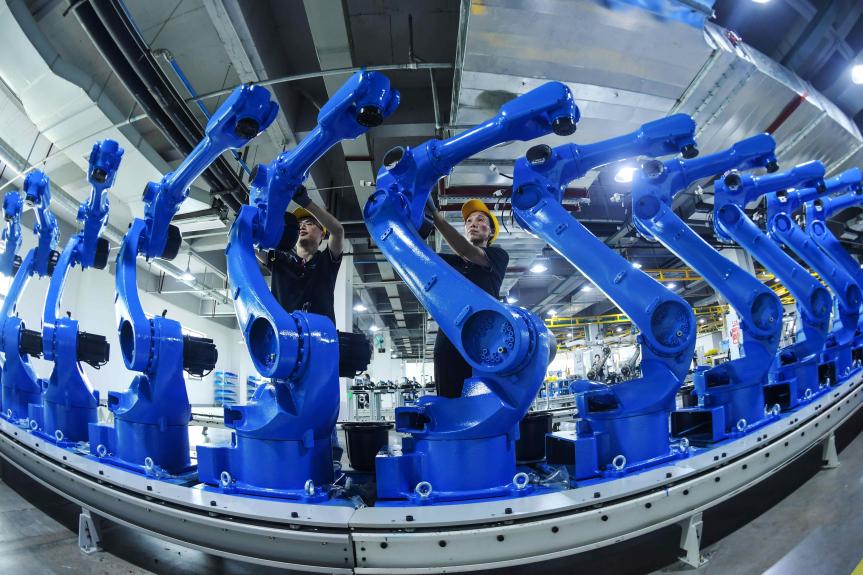
Industrial robots are assembled in a workshop of a robot company in Chengdu, southwest China's Sichuan province. (Photo/Li Xiangyu)
Broader Applications
By the end of 2024, China was home to over 2 million industrial robots, ranking first globally.
In 2024, 302,000 industrial robots were sold in the Chinese market, marking an increase of 68.7 percent over 2020 and accounting for 54 percent of global sales.
The application of industrial robots has expanded significantly. By 2024, Chinese industrial robots had been deployed across 71 major categories and 241 sub-categories of the national economy, covering 51 percent of all sub-categories. This represents an increase of 19 major categories and 98 sub-categories compared with 2020.
Robot density in China's manufacturing sector rose from eighth globally in 2020 to third in 2024.
The widespread integration of robotics has accelerated the development of intelligent manufacturing. China has established more than 35,000 basic-level intelligent factories, over 230 model factories, and 1,260 5G-enabled factories.
Looking ahead, intelligence and specialization are expected to drive future growth.
"As artificial intelligence becomes more deeply embedded in vertical industries, its integration with robotics is accelerating," Song said, adding that robots are rapidly evolving from functional equipment performing repetitive, programmed tasks to intelligent partners capable of perception, decision-making, and autonomous action.
Photos



Related Stories
- China's high-tech manufacturing sector reports robust profit growth from Jan-Oct
- Rationale behind China's commitment to keeping appropriate share of manufacturing in national economy
- Chinese products bring coolness to European consumers
- Yiwu's global buying spree reflects broader trends in China's foreign trade
- Yangtze River Delta region solidifies role as highland for high-end manufacturing
- Tesla video boasts 95% localization in China
- China sees 182 major infrastructure, manufacturing projects being launched in the first quarter of 2025
- China's UBTech pioneers world's first multi-robot collaborative training
- Luxshare gears up for bigger share of auto parts market
- High-tech manufacturing in spotlight
Copyright © 2026 People's Daily Online. All Rights Reserved.
