



China's tea industry embraces technology, tourism to brew new growth
China's major tea-growing regions have entered their peak spring harvest season. Across the country, regions are drawing on their distinct natural advantages, embracing new technologies, exploring new opportunities and cultivating new business models to drive the industry forward.
The scale of China's tea industry exceeded 1 trillion yuan ($147 billion) in 2025. In February this year, the Ministry of Industry and Information Technology and four other government departments jointly issued guidelines on upgrading the tea sector, covering the period 2026-2030.
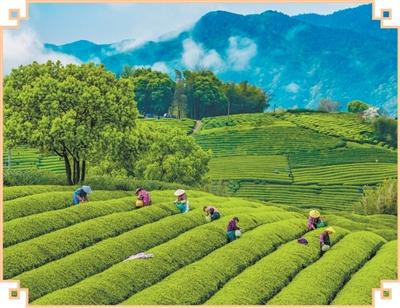
Farmers pick spring tea leaves at a tea garden in Xianyan town, Shengzhou city, east China's Zhejiang Province. (Photo/Pan Weifeng)
In Pingli town, Qimen county, Huangshan city, east China's Anhui Province, a smart tea garden spanning more than 200 mu (13.33 hectares) is managed through a network of five cameras and two sets of sensors working in coordination. Soil moisture sensors monitor water content in real time, intelligent cameras continuously track pest activity, and real-time readings of temperature, humidity, light intensity, and soil pH can be checked on a smartphone.
"We used to grow tea by experience. Now we grow it by data," said Huang Yonggang, a manager of the tea garden.
At the production workshop of Anhui Qimen Black Tea Industry Group Co., Ltd., an independently developed, 5G-enabled smart production line operates at full capacity. From fresh tea leaves to finished products, fully automated processes — including withering, rolling, fermentation and drying — are carried out seamlessly.
"Take the fermentation stage, for instance — sensors precisely control the process, using variable-temperature cycling to regulate heat and humidity so that every batch ferments evenly and consistently," said Dai Kui, head of the production workshop.
The facility can process more than 10,000 kilograms of fresh tea leaves per day, representing a substantial efficiency gain over traditional methods while ensuring greater consistency in quality.
Innovation extends well beyond the production floor. Tea seeds from Qimen's native variety that traveled to space aboard a satellite in 2024 have since been cultivated into more than 100 thriving space-bred tea seedlings.
Meanwhile, an AI model developed in partnership with universities can generate personalized tea-drinking plans through smart beverage equipment. Every batch of tea comes with its own digital identity — a traceability system built on Internet of Things (IoT) and QR codes that lets consumers scan and trace the full journey of their tea from planting and picking through to processing. In 2025, Qimen county's tea industry posted a combined output value of more than 7.5 billion yuan.
Amid the rolling green hills of Daicun town, Xiaoshan district, Hangzhou city, east China's Zhejiang Province, 3,500 mu of tea gardens are entering their peak harvest season.
A hilltop retreat has become a popular destination, drawing visitors with its surrounding hills, sea of clouds and tea gardens.
Around the retreat, farmers pick fresh tea leaves that are sent 7 kilometers away to a facility set within a tea garden. There, an outdoor adventure park, a paragliding center, and an immersive tea experience space offer visitors something beyond traditional tea culture.
From leisurely tea-tasting at the hilltop retreat to hands-on picking in the tea gardens and study tours at a tea workshop, Daicun town has developed a comprehensive tea tourism offering.
"We have built the Sanqing Tea regional public brand and worked hard to bring platforms and resources together, encouraging tea companies to integrate more deeply with cultural and tourism offerings," said Chen Hongdan, Party chief of Daicun town. "We are establishing study tour bases, hosting tea culture activities, and pushing the industry beyond pure production into leisure, cultural engagement, and brand development."
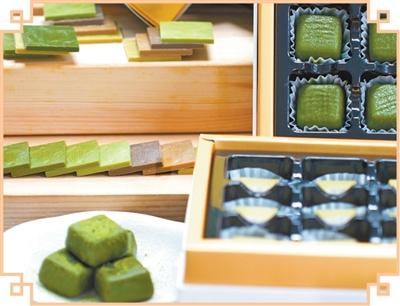
New matcha products on display at the industrial park of Gui Tea Group in Jiangkou county, Tongren city, southwest China's Guizhou Province. (Photo/Chen Qihang)
The integration of tea and tourism has not only raised the profile of the Sanqing Tea brand and opened new markets, but also boosted villager incomes and improved the countryside's appearance, Chen added.
In Guiyang city, southwest China's Guizhou Province, a matcha concept store — a directly operated outlet of Gui Tea Group — has been in business for eight years. Sales last year came close to 6 million yuan, setting a new record.
"Most of our customers are between 20 and 35 years old. More and more young people are embracing tea culture," said store manager Wu Yangyu.
To keep pace with demand, the store has developed new matcha beverages and expanded into more than 30 matcha-based food products, including cookies, cakes and ice creams. All have been well received, with sales doubling during the peak tourist season.
Across the country, new-style tea beverages, refreshments and tea spaces have become popular entry points for younger consumers discovering tea culture. Many places are finding creative ways to give this ancient tradition a fresh, contemporary edge.
At Gui Tea Group's production facility in Jiangkou county, Tongren city, Guizhou, automated matcha lines run at high speed.
"Our matcha has passed more than 500 pesticide residue tests and is exported to 54 countries and regions — it has become our flagship product for entering international markets," said Zhang Tinghong, the group's production director.
To meet the high standards and fast turnaround that matcha products demand, five production lines are being built simultaneously, covering pure matcha powder, roasted tea powder and solid beverages, with all lines set to be operational before the end of the year.
At the end of March, Guizhou released a three-year action plan for the high-quality development of the matcha sector. The plan targets, by 2028, a matcha cultivation area of at least 200,000 mu, more than 10 matcha production lines and over 300 tencha (the unground leaf used to make matcha) processing lines. It also sets goals of matcha output exceeding 8,000 tonnes and a combined output value of around 8 billion yuan.
Photos


Related Stories
- Tea harvest in full swing across China
- Tea farmers, enterprises busy harvesting and processing spring tea leaves across China
- Farmers sun-dry spring tea leaves on Jingmai Mountain in SW China's Yunnan
- White tea enters harvest season in Anji, E China's Zhejiang
- Locals turn fresh tea leaves into spring dishes in SW China's Yunnan
- Tea industry, rural tourism promote cross-provincial coordinated development in SW China
- One in every five cups of white tea sold worldwide comes from Jinggu, SW China's Yunnan
- Tea farmers harvest West Lake Longjing tea in China's Hangzhou
- Spring tea brings life to Ya'an
- Explainer: How Chinese tea drink brands are cultivating a global footprint
Copyright © 2026 People's Daily Online. All Rights Reserved.
