



Inland county in N China's Hebei emerges as new gateway to ASEAN markets
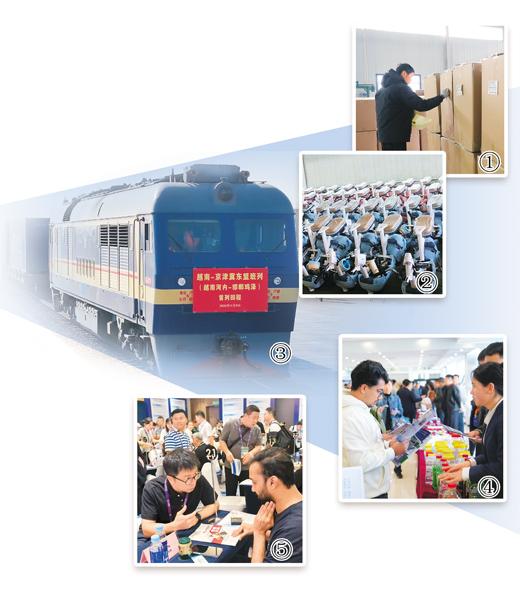
①: A worker labels packaged bags and luggage for export at a company in Jize county, Handan city, north China's Hebei Province. (Photo/Wei Xiao)
②: Photo shows e-bikes bound for Vietnam produced by an electric vehicle manufacturer in Jize county, Handan city, north China's Hebei Province. (Photo/Wei Xiao)
③: A Hanoi-Jize freight train arrives in Jize county, Handan city, north China's Hebei Province. (Photo/Wang Chao)
④: Business representatives browse the product exhibition area at a 2025 RCEP trade event in Jize county, Handan city, north China's Hebei Province. (Photo/Qi Pengfei)
⑤: An enterprise representative from Jize county discusses import and export business with a buyer from ASEAN at the 22nd China-ASEAN Expo. (Photo/Hou Xiaowen)
Inside a factory in Jize county, Handan city, north China's Hebei Province, workers are racing to fulfill an international order: bags and luggage bound for Vietnam.
"This batch is worth more than 10 million yuan ($1.45 million), spanning four product lines and over 50 styles," said Song Lifeng, general manager of a luggage manufacturing company.
After more than a decade working elsewhere, Song made a pivotal decision in 2025: return to his hometown of Jize county to start a business. What drew him back was a newly launched freight train route linking Jize and Hanoi, the Vietnamese capital, which he described as "a golden corridor to the Association of Southeast Asian Nations (ASEAN)."
The international freight train route has changed the fortunes of the inland county, allowing it to become a new gateway to ASEAN markets.
Nestled at the eastern foot of the Taihang Mountains, Jize had long cultivated a cluster of industries, including casting, textiles and home appliance components. The county had earned a string of national designations: "China's cotton textile hub," "China's municipal casting base" and "China's pepper hub."
Yet when local businesses tried to reach overseas markets, logistics proved to be a bottleneck.
"In the past, goods had to be loaded onto trucks and hauled hundreds of kilometers to Tianjin Port or Qingdao Port for overseas destinations," said Yan Jinfa, deputy director of Jize county's bonded logistics service center. "The whole process took at least 20 days."
The turning point came in 2024, when Jize set its sights on launching its own international rail service running straight to ASEAN.
On May 26, 2024, the first Jize-Hanoi freight train, carrying products including fasteners and rubber flooring, departed from Caozhuangzhen Freight Station along the Hanhuang (Handan-Huanghua) Railway.
The roughly 2,500-kilometer rail route, covered in 12 to 15 days, marked the first regular train service from the Beijing-Tianjin-Hebei region to Southeast Asia, and the starting gun for Jize's transformation from an inland county into an international logistics node.
"Shorter logistics time, fewer steps, simpler paperwork. It's like building an expressway directly to Southeast Asia, with door-to-door service," said Zhang Yongqiang, an official in Jize county and a long-time advocate for the county's international logistics park.
Jize has since made efforts to upgrade infrastructure, optimize services and improve its industrial system.
Song's factory warehouse sits roughly 200 meters from Caozhuangzhen Freight Station. "Once the containers are packed, we just transport them to the station — it's like sending a parcel," he said at the door of his warehouse.
Behind him is the Handan (Jize) International Logistics Industrial Park, covering a planned area of 2.55 square kilometers. The county has been steadily building out the park's eight functions, including rail operations, customs supervision, freight transport, bonded warehousing, import-export processing and general business services.
In 2025, Jize extended the rail line at Caozhuangzhen Freight Station from 450 to 1,050 meters, doubling operational efficiency. Annual freight-handling capacity at the yard is set to rise from 2 million tonnes to 5.6 million tonnes.
In March 2025, a direct service linking the Beijing-Tianjin-Hebei region to Hanoi launched, cutting transit time from 12-15 days to just five to seven days. "Time is a competitive edge. Fewer stops mean faster delivery," said Hu Yanfeng, head of Jize county.
The same month, a strategic cooperation memorandum of understanding on China-Vietnam cross-border freight train services was signed, giving Caozhuangzhen Freight Station formal recognition as one of three cross-border logistics nodes designated by Vietnam Railways Corporation in China. The agreement unlocks benefits including 12-hour customs clearance and a fast-track arrangement at the border.
A customs supervision facility within the park is expected to be completed in June.
"We'll offer round-the-clock clearance. Exports declared in Jize will be able to move through border crossings without additional inspection, dramatically reducing waiting time and costs," said Xu Wei, deputy head of Handan Customs under Shijiazhuang Customs.
A company established in April 2025 to operate the park is also developing a cross-border digital supply chain platform for ASEAN trade.
To date, Jize-Hanoi freight trains have made 39 trips, with cumulative cargo valued at $27.05 million. The cargo range has expanded from a handful of items to more than 30 categories, and the service's reach now extends beyond Jize county across much of Hebei and into western Shandong Province and northern Henan Province.
This year, the service has taken another significant step forward, adding inbound imports to complement outbound trade. In January, a train carrying a full load of Vietnamese cassava starch arrived at Caozhuangzhen Freight Station, marking the route's shift from a one-way export channel to a two-way operation.
Photos




Related Stories
- China emerges as key supply hub in ASEAN+3 production network, says regional research institute
- High-level opening up to boost China-ASEAN cooperation, says ASEAN-China Centre chief
- China-ASEAN experts discuss frontier AI development, governance
- Vocational programs build a bridge for ASEAN talents
- GT Voice: Fresh evidence shows ever closer China-ASEAN economic ties
- Sailing together toward new horizons -- China-ASEAN cooperation upgraded in 2025
- Hong Ting Forum held in Indonesia to promote China-ASEAN cooperation
- China to work with ASEAN to align development strategies, resist unilateral bullying: Chinese FM
- ASEAN-China Year of People-to-People Exchanges 2024-2025 closes in Malaysia
- China-ASEAN innovation base launched to boost collaboration in emerging industries
Copyright © 2026 People's Daily Online. All Rights Reserved.
