



China's mass fitness drive shifts toward higher-quality services
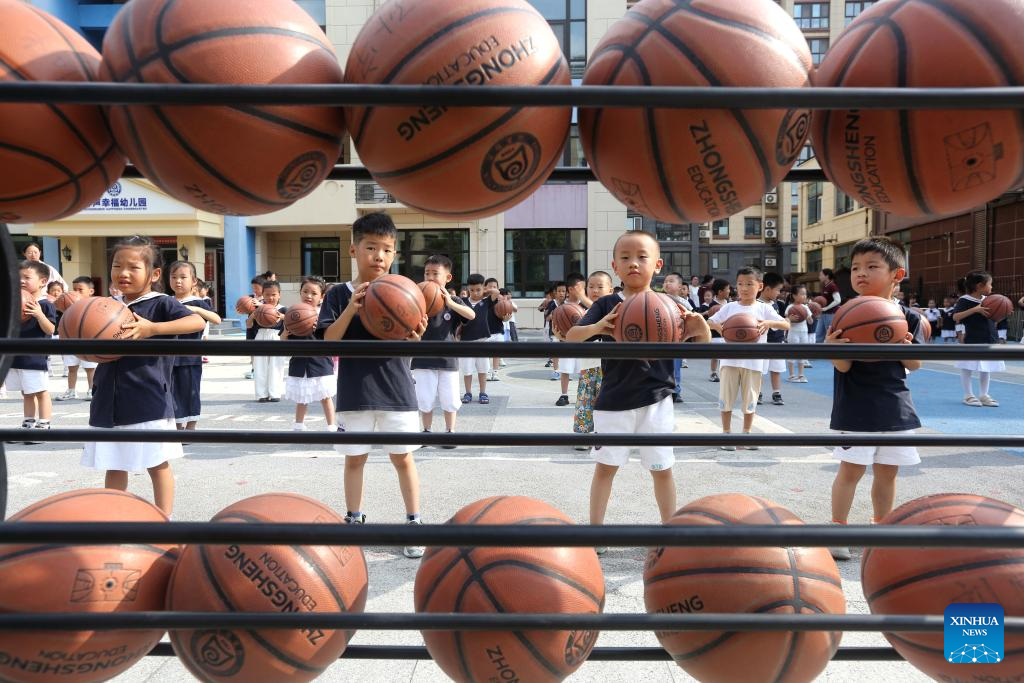
Kids practice freestyle basketball at a kindergarten in Lianyungang city, east China's Jiangsu Province, Aug. 8, 2025. (Photo by Wang Chun/Xinhua)
Some 38.5 percent of China's 1.4 billion people engaged in regular physical exercise in 2025, as the country continued to promote public fitness.
In recent years, China's public sports facilities have expanded steadily, and the national fitness service network has continued to reach deeper into communities.
By the end of 2025, China had over 5 million sports venues covering 4.37 billion square meters, with per capita venue space rising to 3.11 square meters.
During the 14th Five-Year Plan period (2021-2025), more than 1,500 sports parks were completed and put into use nationwide, well surpassing the target of around 1,000.
At the same time, access to fitness has become increasingly convenient. Surveys show that 90.4 percent of residents aged 19 and above have sports facilities within a 15-minute walk or bike ride.
A growing number of small but well-equipped facilities, such as compact fitness centers, pocket parks and multi-use courts, have been built close to home, making it easier for people to stay active.
Bao Mingxiao, a professor at Beijing Sport University, noted that convenience lies at the core of public demand for fitness. When sports facilities are embedded within communities, people can fit exercise into their daily routines and make physical activity a part of everyday life.
Today, people not only have more places to stay active nearby, but also more events to take part in and a wider range of services.
Around National Fitness Day on Aug. 8, 2025, more than 22,000 sporting events were held across the country, drawing over 11 million participants. The four consecutive editions of a nationwide online fitness campaign have attracted a total of more than 58.61 million participants.
In 2025, per capita sports consumption in China reached 2,428 yuan ($353) among residents aged 19-59, and 1,451 yuan among those aged 60 and above, with service-based spending accounting for 48.5 percent of the total. Increasingly, sports-related spending is shifting away from buying equipment and apparel toward paying for training, experiences, event participation and health services.
As fitness needs become more diverse, the support system has grown to match. By the end of October 2025, China had over 3.9 million social sports instructors, or about 2.77 per 1,000 people. The country had also established 375 national physical fitness monitoring stations.
The outline of the 15th Five-Year Plan (2026-2030) for national economic and social development calls for raising the share of people who regularly exercise to around 40 percent by the end of the period, while further improving public fitness services and expanding access to nearby facilities. This marks a shift in focus from broad coverage to offering higher-quality services.
Photos


Related Stories
- China selects 30 model projects in fitness volunteer services
- National Fitness Day marked across China
- Feature: Functional fitness competitions fuel sports boom in China
- Traditional fitness practices gain popularity among young people
- China improves fitness facilities
- National Fitness Day marked in Tianjin, N China
- Mass fitness thrives in Rizhao, E China's Shandong Province
- China's inaugural National Fitness Competition officially opens
- China makes progress in promoting extensive fitness-for-all activities
- National Fitness Day: Muay Thai
Copyright © 2026 People's Daily Online. All Rights Reserved.
