



Female rangers brave snowy forests to protect tigers, leopards
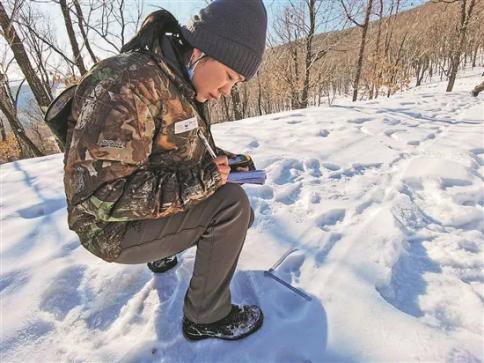
Xu Chunmei tracks footprints of wild animals during a patrol. (Photo provided by Xu Chunmei)
As the morning sun filtered through the misty forest, casting dappled light on the ground, members of a women's ranger team at a management center of the Northeast China Tiger and Leopard National Park in Dongning, northeast China's Heilongjiang province, were already assembled and ready for their daily patrol.
One of China's first national parks, the Northeast China Tiger and Leopard National Park is a vital habitat for rare species such as the Siberian tiger and Amur leopard. Established in 2019, the five-member team is the park's first all-female patrol unit. Over the past seven years, they have trekked more than 9,000 kilometers through rugged terrain -- removing traps, maintaining monitoring equipment, rescuing wildlife, and promoting conservation awareness.
At 8:30 a.m., the team gathered on schedule. Captain Xu Chunmei checked their gear one by one: GPS devices, bear spray, loudspeakers, spare batteries and memory cards for infrared cameras -- nothing can be left behind. Each backpack also carried heat packs and heated insoles, while notebooks were kept close to the body to prevent moisture damage.
At 9 a.m., the team set off by vehicle. An hour later, they arrived at the foot of the mountain and began a 6.5-kilometer hike. "Patrolling on foot is much tougher than I expected," said Li Caining, a young member born in the 2000s, who joined the team last year. Veteran ranger Song Yan patiently shared her experience, teaching Li how to navigate mountain paths and manage her energy.
"This time of year works in our favor," Xu explained as they walked. With no leaves on the trees, animal traces are easier to spot. Snow, she added, acts as a "natural record," clearly preserving footprints and droppings -- valuable data for researchers studying animal diets, health, and potential diseases.
Deep in the forest, a series of clicks broke the silence as Xu removed her gloves and skillfully adjusted an infrared camera mounted on a tree.
"Extreme cold can freeze the cameras, and sometimes wild boars or woodpeckers damage them. We can only detect these issues on-site," she said. The management center has deployed more than 400 real-time transmission cameras, over 200 infrared cameras, and more than 70 monitoring checkpoints, many located on cliffs or along wildlife corridors, making maintenance both difficult and risky.
"Technology is a great help, but it can't replace our eyes and feet," Xu noted. She is especially skilled at identifying animal tracks. By examining the size, depth, and pattern of footprints, she can determine an animal's sex, size, approximate age, and even its health condition.

Xu Chunmei (first from left) and other team members are on a patrol mission. (People's Daily/Guo Xiaolong)
Removing traps is another key task. Hidden wire snares become more visible against the snow. "These traps tighten the more an animal struggles," Xu said. "I once stepped into one myself. The pain made me determined to clear every single trap." Over the years, the team has removed more than 4,300 traps. Now, snares are rarely seen, while sightings of wildlife such as red foxes, squirrels, and wild boars have become more frequent.
During heavy snowfalls, when food becomes scarce for wildlife, the team sets up 20 feeding sites along frequently used animal corridors. "We carefully control the amount of feed," said team member Zhao Hongyu. "It helps animals get through tough times without disrupting their natural habits."
At a wildlife rescue center managed by the Chaoyanggou protection station, rescued sika deer and roe deer wandered calmly within enclosures. In recent years, the team has rescued around 70 wild animals.
Beyond fieldwork, the rangers are also active in public education. "Do you know how great a tiger's sense of smell is?" Xu asked students during an ecology class at a primary school in Dongning. "They can track prey by scent and mark their territory on trees." Her lively explanations drew excited reactions from the children.
Such outreach programs have been running for five years, reaching more than 20 primary and secondary schools. "Every session is an opportunity to spread environmental awareness," Xu said.
The team also visits local villages, posting notices and explaining regulations door to door, using real cases to highlight laws related to national parks and the prohibition of illegal hunting.
"When we first started, some older villagers still held the outdated belief of 'living off the mountains,'" Xu recalled. Through repeated outreach and visible ecological improvements, the team gradually helped change their perceptions.
Behind their hard work lies a deep bond with the forest. "Over the years, some members have had to leave due to injuries or other reasons," Xu said. "But love for the mountains and a strong sense of responsibility keep more of us going."
Photos




Related Stories
- Rare bonding moment as tiger cubs sleep alongside caretaker
- Chimpanzee named Szymon celebrates his 40th birthday in Warsaw
- Guideline to monitor animal release
- Highland Creatures: A snow leopard shares a Moment
- Twelve crested ibises released into wild
- Exotic pet vet relishes talk with animals
- Meeting a friend in the Moscow Zoo
- Marmot MMA in Gansu goes viral
- Nature's canvas: rare peacocks spread their tails
- Tibetan keeps close watch on 'sacred' black-necked cranes
Copyright © 2026 People's Daily Online. All Rights Reserved.
