



Chongqing's iconic spicy noodles go global
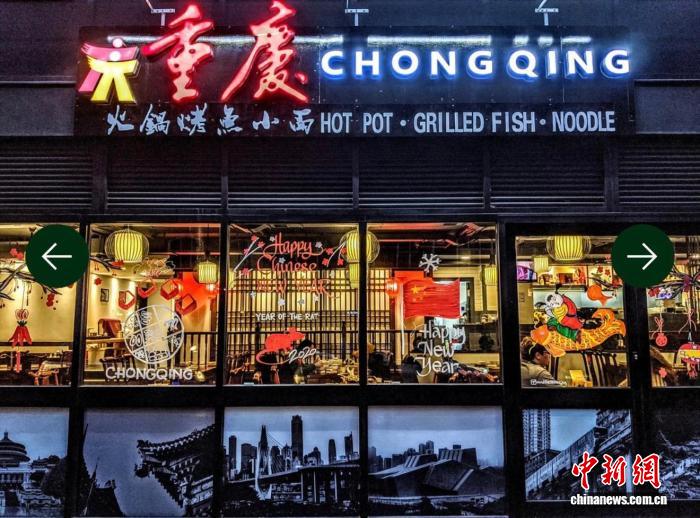
Photo shows the restaurant Taste of Chongqing in London. (Photo courtesy of Taste of Chongqing)
Yang Sichun and Hu Min, both from Chongqing Municipality in southwest China, have brought a taste of home to London. Their restaurant, Taste of Chongqing, serves Chongqing's signature spicy noodles — Xiaomian (small noodles) — at 10.80 pounds ($13.60) a bowl, alongside a version topped with mashed peas and minced pork at 12.80 pounds.
"Many of our customers are members of the Chinese community, but we also get locals coming in to try something new," Yang said during an interview in Chongqing.
The pair opened the 450-square-meter restaurant in 2019, offering a menu that extends well beyond Xiaomian to other classic Chongqing and Sichuan dishes.
"Our daily turnover exceeds 8,000 pounds, a third of which comes from Xiaomian," Yang added.
Chongqing native Bai Xue runs a restaurant, Bai Lu Noodles, in Cologne, Germany. Most of her clientele are locals, for whom the restaurant has become a window into Chongqing's food culture.
Having studied and settled in Germany, Bai said she wanted reliable access to the flavors of home, and in 2018 opened her eatery specializing in Xiaomian and hot and sour rice noodles, with prices ranging from 5 euros ($5.45) to 16 euros.
Across its entire value chain, the Xiaomian industry has surpassed an annual output of 56 billion yuan ($8.14 billion), supporting nearly 500,000 jobs, according to data released by the Chongqing Municipal Commission of Commerce in November 2025.
At the heart of the sector sits the Chongqing Xiaomian Industrial Park, established in 2021 in the city's Dadukou district.
Prepackaged Chongqing Xiaomian is now shipped worldwide. More than 10,000 boxes of prepackaged Xiaomian from Kings Noodle, a local brand, cleared customs for the first time ahead of the Spring Festival, bound for the United Kingdom, the Netherlands, Poland, France, Germany and other European markets.
"Previously, we relied mainly on cross-border e-commerce channels. Completing this customs declaration marks our entry into a more standardized, scalable and sustainable phase of overseas trade," said Mei Hao, general manager of Kings Noodle.
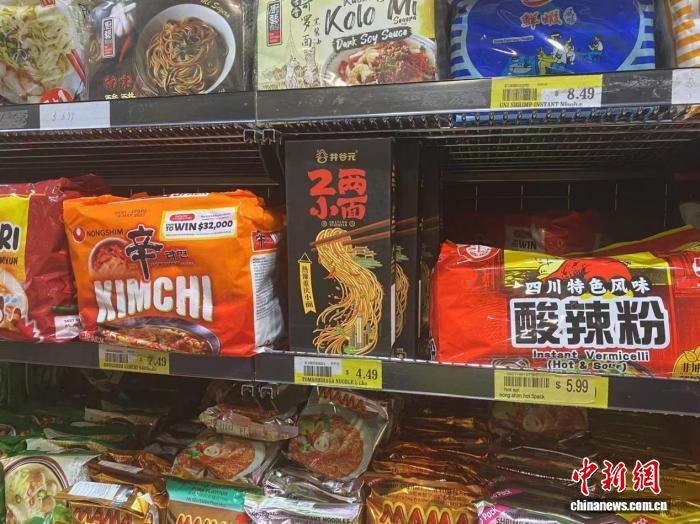
Photo shows prepackaged Chongqing Xiaomian produced by Chongqing Jingguyuan Food Technology Co., Ltd. in a store in Australia. (Photo courtesy of Chongqing Jingguyuan Food Technology Co., Ltd.)
Chongqing Jingguyuan Food Technology Co., Ltd. was the first company in Chongqing to obtain a food production license for Xiaomian. Its roughly 90-metre-long smart production line runs three shifts a day from 6 a.m., producing up to 15 tonnes of noodles daily — equivalent to 150,000 to 200,000 prepackaged servings.
After the noodles enter the sterilization system, the line precisely controls moisture content to between 22 and 23 percent, ensuring the texture of semi-dried noodles while extending shelf life to around eight months. For export, that shelf life is a crucial advantage, said Fu Yong, chairman of the company and president of the Chongqing Xiaomian Industrial Promotion Association.
Fu noted that the company's prepackaged Xiaomian, beverages and porridge products currently account for about 5 percent of total output destined for overseas markets, reaching brick-and-mortar supermarkets in Southeast Asia and Australia as well as global consumers through international e-commerce platforms.
Fu is in talks with a France-based partner about plans to open shops and set up production facilities in France, Spain, Portugal and beyond.
"Xiaomian has broad appeal and a highly adaptable market," said Zhang Shoujiang, president of the Chongqing Xiaomian Association, adding that the association plans to focus on accelerating overseas expansion, brand incubation, e-commerce product optimization and franchise development in 2026.
An official with Dadukou district's Xiaomian industry office said the product has generated more than 50 million yuan in cumulative overseas sales, with exports now reaching more than 30 countries and regions.
The industry has also spurred growth in upstream and downstream sectors including hotpot ingredients, packaging materials and logistics, emerging as a new driver of the district's foreign trade. The Xiaomian industry's total revenue for 2025 surpassed 10 billion yuan.
To support the industry's development, the office has assembled a dedicated working group that has helped resolve more than 30 obstacles facing exporters, from export licensing to compliance with international standards.
Supporting facilities, including a 90,000-square-meter production and testing center, have been developed within the Chongqing Xiaomian Industrial Park. These facilities have helped cut enterprise export costs by more than 50 percent and boost efficiency by over 20 percent.
The office has also organized companies to participate in more than 80 trade events. Looking ahead, the office plans to deepen trade cooperation with ASEAN countries, expand into European and American markets and send enterprises to international trade fairs.
It also aims to strengthen partnerships with established overseas brands and upgrade its one-stop foreign trade service platforms and overseas warehouse networks.
Photos


Related Stories
- Lanzhou beef noodle training schools raise new generation of chefs
- Trending in China | Shacha noodles
- Lanzhou beef noodles soar to global fame
- In pics: Villagers dry noodles in the sun in E China's Jiangxi
- Lanzhou beef noodle turns into thriving industry
- What Hebei Can Offer丨Hebei instant noodles go global
- Trending in China | A bite of Chinese culture: Dragon beard noodles
- Cook shows dazzling noodle-making skills
- Try a bowl of spicy biang biang noodles!
- In pics: vermicelli noodles factory in Bangladesh
Copyright © 2026 People's Daily Online. All Rights Reserved.
