



Chinese festive goods spread Spring Festival spirit worldwide

A worker dries lanterns in Jintang county, Chengdu, southwest China's Sichuan Province. (Photo courtesy of the interviewee)
During the Spring Festival, or Chinese New Year, festive goods from China were widely seen in countries around the world. They not only helped relieve the homesickness of overseas Chinese but also gave foreign citizens a taste of the holiday's charm, fostering cultural exchange between China and the rest of the world.
Before the festival, workers at a factory in Jinlong town, Jintang county, Chengdu, southwest China's Sichuan Province, were busy crafting lanterns. In the factory's livestreaming studio, hosts from Malaysia sold the lanterns, describing them as a symbol of reunion and good fortune.
Chen Junlong, who took over the factory from his father, explained that for overseas Chinese, lanterns symbolize homesickness, while for foreign citizens, they serve as a tangible representation of Spring Festival culture.

Fresh-cut flowers from China are sold at a flower shop in Kazakhstan. (Photo courtesy of the interviewee)
He added that the growing number of overseas orders reflects not only the factory's thriving business but also the increasing influence of Chinese culture globally. Looking ahead, the company plans to expand its sales channels through exhibitions and e-commerce platforms.
At the land ports of Horgos and Baktu in northwest China's Xinjiang Uygur Autonomous Region, cold-chain vehicles carrying fresh-cut flowers sailed through customs via a dedicated "green channel." Sourced from Kunming in southwest China's Yunnan Province, the flowers were expected to reach flower shops in Kazakhstan within four to six days, still in prime condition.
Yuan Zhaohui, president of Shaanxi Silk Road City Holding Group Co., Ltd., said that in 2025, the company exported more than 20 categories of fresh-cut flowers to Central Asia, with order volumes showing a significant increase from the previous year. That year, the company shipped more than 7 million stems of fresh-cut flowers, valued at 23.15 million yuan ($3.38 million).
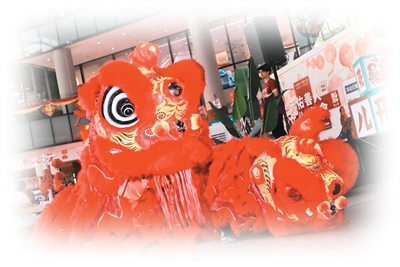
Photo shows a lion dance performance at a Spring Festival fair in Kuala Lumpur, Malaysia. (Photo courtesy of the interviewee)
During the Spring Festival, accessories and clothing were delivered to overseas Chinese via China-Europe freight trains.
"Specialty food, tea, and new Chinese-style clothing were also sent to international consumers through this service," said Feng Yabin, a cross-border trade professional based in Italy.
At a Spring Festival fair in Kuala Lumpur, Malaysia, a member of the Malaysian Chinese community and owner of a Hanfu store helped a customer fasten the waistband of a Mamianqun, or horse-faced skirt. The garment is a distinctive style of Hanfu, the traditional clothing of the Han ethnic group in China.
The Mamianqun has become a best-seller in her shop, bridging the gap between traditional formalwear and everyday fashion. It allows people to express their personal style, with many customers opting for matching parent-child sets, she said.
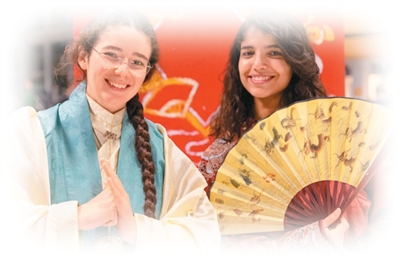
University students wear Hanfu, the traditional clothing of the Han ethnic group, in Paris, France. (Photo courtesy of the interviewee)
She has noticed that customers frequently discover Hanfu through Chinese historical costume dramas, and videos of young people wearing Hanfu to send Chinese New Year greetings have been trending on social media.
Photos



Related Stories
- Woodblock Chinese New Year paintings thrive in village in C China's Henan
- International visitors flock to Beijing for 2026 Spring Festival
- Feature: Chinese Spring Festival gains traction in Russian universities
- Free trains and buses carry migrants back to work
- Spring Festival cherries show trade is not zero-sum game
- Auspicious aoyu performance in Anhui
- In Numbers: Nine-day Spring Festival holiday fuels consumption momentum
- My Spring Festival in China: A reminder that we are more alike than we think
- Chinese New Year in Montpellier: Celebrating the Year of the Horse together
- China records 596 mln domestic tourist trips during Spring Festival holiday
Copyright © 2026 People's Daily Online. All Rights Reserved.
